
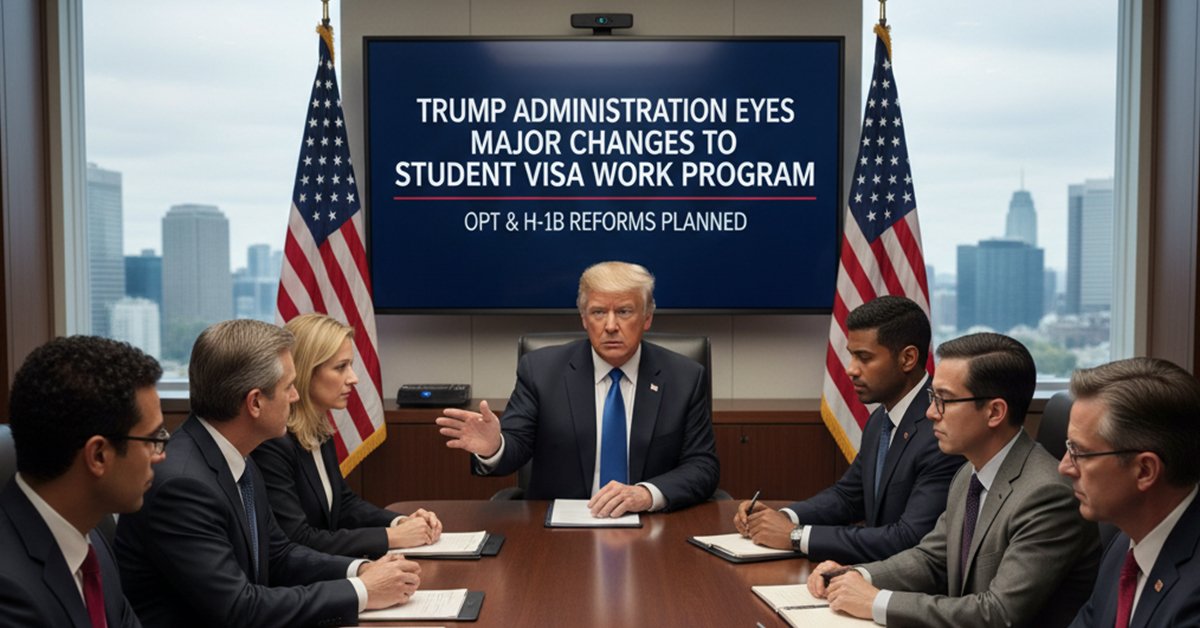

The Trump administration is preparing to make sweeping changes to the Student Optional Practical Training (OPT) program — a move that could dramatically limit the ability of international students to work or gain training experience in the United States after graduation.
According to an unpublished rule draft from the Department of Homeland Security (DHS), the government is reviewing new regulations that would “better align” the student visa system with what officials describe as “national security and labor protection goals.”
In essence, this means the administration is considering restrictions that could significantly reduce — or even eliminate — post-graduation employment options for F-1 visa holders, a cornerstone of the U.S. international education system.
What the New Rule Means
The proposed rule, listed on the Office of Information and Regulatory Affairs (OIRA) website, outlines plans to modify OPT in order to:
- Address fraud and national security concerns,
- Protect U.S. workers from being displaced by foreign nationals, and
- Strengthen oversight of the Student and Exchange Visitor Program (SEVP).
The DHS summary claims these reforms will bring “greater clarity and integrity” to the student visa system. However, details remain sparse, and no official implementation timeline has been announced.
A Program at the Heart of U.S. Global Education Appeal
Under current regulations, the OPT program allows international students on F-1 visas to gain up to 12 months of practical training in their field of study after graduation. Those in STEM fields (science, technology, engineering, and mathematics) may apply for a 24-month extension, giving them a total of three years of U.S. work authorization.
The program is widely seen as a critical bridge between education and employment, helping U.S.-trained foreign graduates apply their skills in industries ranging from healthcare and renewable energy to cybersecurity and artificial intelligence.
Critics of the Trump administration’s proposal say that restricting or ending OPT would severely damage America’s competitiveness as a global education destination.
“Any proposed rule aiming to restrict or end post-graduation Optional Practical Training (OPT) would be fundamentally short-sighted,” said Miriam Feldblum, Executive Director of the Presidents’ Alliance on Higher Education and Immigration. “OPT helps ensure our position as the top destination for global international student talent.”
Why the Change Matters
The potential OPT restrictions come amid a broader effort by the Trump administration to tighten immigration pathways and emphasize “America First” labor policies.
While previous reforms have focused on H-1B visa programs and border enforcement, student visa holders are now increasingly under scrutiny — especially after incidents involving pro-Palestinian protests on college campuses led to several foreign students losing their visas.
More broadly, the administration argues that U.S. graduates face growing competition from foreign talent in an already tight job market. With over 1.5 million international students currently in the U.S., critics within the government say the OPT system “displaces” American workers by allowing employers to hire lower-cost labor.
However, supporters counter that the OPT program is limited in duration and scope, and that it fuels innovation rather than displacement.
The Economic Impact of International Students
The economic footprint of international students in the United States is massive. According to data from NAFSA: Association of International Educators, international students contributed $43.8 billion to the U.S. economy during the 2023–2024 academic year, supporting more than 368,000 American jobs.
These contributions go far beyond tuition payments — encompassing housing, food, transportation, and retail spending in local communities.
“These U.S.-trained, foreign-born STEM graduates work in critical sectors including healthcare, cybersecurity, sustainable energy, and AI,” said Anne Walsh, an immigration attorney at Corporate Immigration Partners. “From Harvard to Stanford, studies show that foreign-born graduates contribute disproportionately to patents, research breakthroughs, and technology development.”
For many experts, reducing OPT access risks pushing this valuable talent pool to Canada, the United Kingdom, or Australia — nations that have recently expanded post-study work rights to attract international talent.
Concerns About “Worker Displacement” and Fraud
The DHS rationale for reform focuses on two main issues: protecting U.S. workers and addressing fraud.
Some lawmakers and labor groups argue that large employers — particularly in technology and engineering sectors — use student and H-1B visa programs to undercut wages and bypass American job seekers.
However, data suggests that OPT participants represent a tiny fraction of the U.S. workforce. In Fiscal Year 2024, roughly 110,000 student visa holders were employed under OPT authorization — a small share compared to the 160 million-strong American labor force.
As for fraud and national security, DHS claims that improved monitoring is needed to prevent visa misuse and false employment claims. Under current rules, students must work in a field directly related to their degree, but enforcement largely depends on employer reporting and SEVP audits.
- → New Canada Benefit Payments Arriving This Week in May 2026
- → Canada Bread Settlement Payments Begin Rolling Out Across Canada in 2026
- → Canada Immigration Backlog Update 2026: IRCC Application Inventory Crosses 2.15 Million
- → Canada Expands Visa-Free Travel Access for Citizens of Indonesia and Malaysia in 2026
- → Canada’s 365-Day Maintained Status Work Rule in 2026: What Foreign Workers Need to Know
- → Canada Launches Early Retirement Incentive Program in 2026: Eligibility, Benefits, and Application Process Explained
- → Bringing Your Family to New Zealand on a Work Visa: Complete 2026 Guide
How the OPT Program Works Now
Here’s a quick overview of the current OPT process:
- Eligibility – F-1 students at accredited U.S. institutions may apply for OPT during or after their studies.
- Duration – Standard OPT allows for 12 months of work authorization; STEM graduates may extend for another 24 months.
- Employment Rules – Work must be directly related to the student’s major field of study.
- Transition Options – After OPT expires, students may apply for an H-1B work visa or other immigration pathways if eligible.
The SEVIS (Student and Exchange Visitor Information System) tracks participation, but critics say it lacks the resources for deep compliance monitoring — a point DHS is expected to address in its new rule.
Advocates Push Back
Education groups, universities, and business leaders have expressed growing concern about the potential rollback. They argue that the U.S. must strengthen — not weaken — its ability to attract global talent in the face of rising competition from other nations.
“OPT is not just a work program; it’s an innovation pipeline,” said Feldblum. “Every restriction sends a message that global talent is unwelcome — and that hurts America’s long-term competitiveness.”
University associations warn that eliminating or limiting OPT could cause international enrollment to plummet, mirroring a similar decline during earlier Trump-era visa restrictions between 2017 and 2020.
A study by the National Foundation for American Policy (NFAP) found that previous uncertainties around OPT caused a measurable drop in foreign student interest, costing U.S. universities hundreds of millions in tuition revenue.
Broader Immigration Context
This proposed OPT reform is part of a larger immigration overhaul the Trump administration has been pursuing since returning to office.
Earlier executive actions have already tightened asylum rules, expanded deportation powers, and restricted visa issuance for applicants from certain countries. The student visa changes represent an extension of that strategy — applying stricter scrutiny even to highly educated immigrants.
While some view these policies as necessary for protecting domestic workers, economists warn that long-term consequences could include brain drain, reduced innovation, and loss of global competitiveness.
What Comes Next
The DHS proposal is currently under regulatory review, meaning it could take months before it appears in the Federal Register for public comment.
If enacted, it could reshape how the U.S. higher education and job markets interact — and how international students plan their futures after graduation.
For now, universities, advocacy groups, and employers are mobilizing to urge the administration to reconsider.
“This is about the future of America’s innovation economy,” said Walsh. “If we make it harder for brilliant, U.S.-educated students to stay and work, we’re effectively training our competitors.”
