
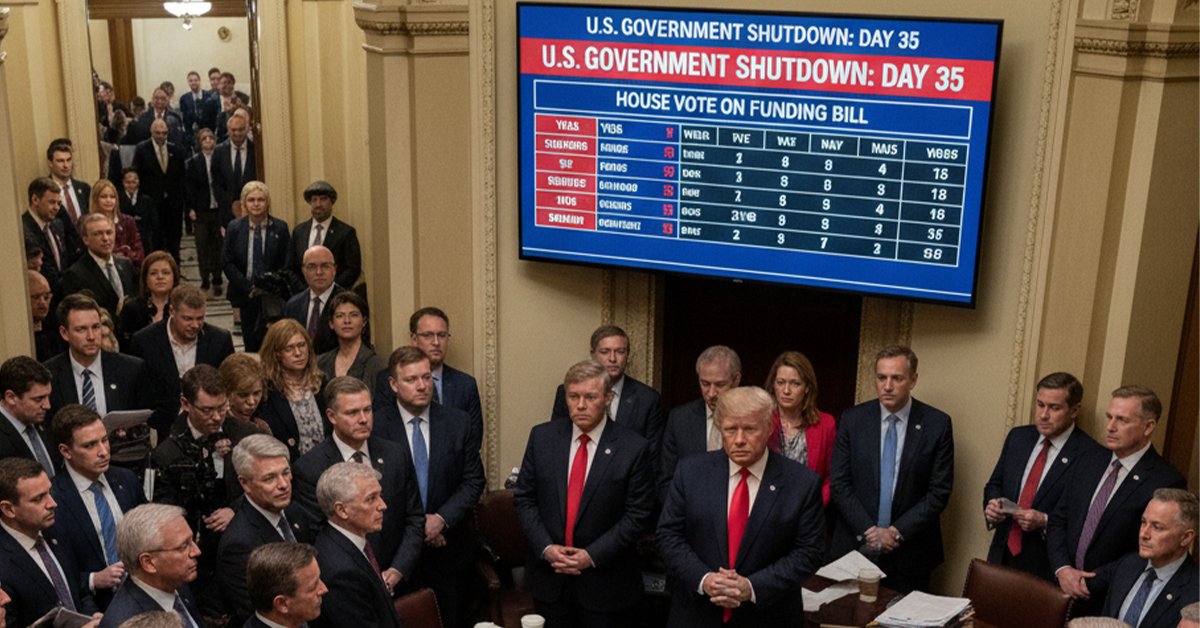

The end of the longest government shutdown in U.S. history appears to be in sight, as the House of Representatives prepares to vote on a federal funding bill that could finally reopen federal agencies after 43 days of closure.
House lawmakers are expected to take a procedural vote in the 5 p.m. hour, setting the stage for a final vote later Wednesday evening. If the bill passes, it would mark a long-awaited resolution to a standoff that has disrupted essential services, strained federal employees, and underscored deep partisan divides in Congress.
Historic Shutdown Nears Resolution After 43 Days
The 43-day shutdown—the longest in U.S. history—was triggered by a bitter dispute between Democrats and Republicans over the federal government’s short-term spending plan.
At the center of the conflict lies the GOP’s proposed stopgap bill, which sought to extend fiscal year (FY) 2025 funding levels through November 21. The bill aimed to keep the government operational while lawmakers negotiated a longer-term spending package.
However, Democrats fiercely opposed the measure, arguing that it failed to include key provisions such as the extension of enhanced Obamacare subsidies set to expire at the end of the year.
Despite opposition from across the aisle, Republican leaders appear confident that they have secured enough support within their narrow majority to push the bill through the House and move it to President Donald Trump’s desk for approval.
House Republicans Rally Around Funding Bill
In recent days, House GOP leaders have expressed optimism that internal divisions within their ranks have largely dissipated.
House Freedom Caucus Policy Chairman Chip Roy (R-Texas) said he saw no significant dissent among fiscal conservatives in his caucus.
“I’m not going to speak for everybody, but I think there’s general support,” Roy told reporters Tuesday night. “I’m unaware of any opposition of significance.”
Similarly, House Appropriations Committee Chairman Tom Cole (R-Okla.) said the bill is expected to pass, though not without difficulty.
“Nothing’s ever easy around here,” Cole said. “But I didn’t notice any dissent. I think the votes will be there on our side.”
With only a two-vote margin, House GOP leaders can afford minimal defections. Still, House Majority Leader Steve Scalise (R-La.) expressed confidence that the bill will pass, possibly with some bipartisan support.
“I think you’re seeing just a few Democrats come to their senses,” Scalise told Fox News Digital. “It should be a lot more.”
Shutdown Fallout: Federal Workers and Public Services Hit Hard
As the shutdown dragged on, its impact spread across nearly every corner of the country.
Thousands of air traffic controllers and TSA agents, deemed essential workers, were forced to work without pay. Many have since taken second jobs or relied on community food banks to make ends meet.
The lack of staffing caused nationwide flight delays and cancellations, particularly at major transportation hubs such as Atlanta, Chicago, and Los Angeles.
Federal benefits also hung in limbo. Programs supporting low-income families, veterans, and seniors faced funding gaps that threatened food assistance, housing subsidies, and medical reimbursements.
In Washington, the National Mall, Smithsonian museums, and national parks remained closed, costing local economies millions in lost tourism revenue.
The shutdown’s estimated cost to the U.S. economy, according to analysts, has exceeded $15 billion in lost productivity, delayed contracts, and interrupted services.
The Central Sticking Point: Healthcare Subsidies
At the heart of the partisan standoff is a policy dispute over healthcare subsidies.
Democrats, led by House Minority Leader Hakeem Jeffries (D-N.Y.) and Senate Majority Leader Chuck Schumer (D-N.Y.), have insisted that any funding extension must also include the renewal of enhanced Affordable Care Act (ACA) subsidies introduced during the COVID-19 pandemic.
These subsidies significantly reduced healthcare premiums for millions of Americans but are set to expire by year-end unless Congress acts.
Democrats argue that extending them is crucial to prevent a nationwide spike in healthcare costs and to maintain coverage stability. Republicans, however, have refused to tie partisan policy measures to federal funding bills, calling such linkages fiscally irresponsible.
“We’re not going to let Democrats hold the government hostage over subsidies that should be debated in a separate healthcare reform bill,” one senior GOP aide said Tuesday.
The impasse resulted in weeks of Senate gridlock, with Democrats rejecting GOP proposals more than a dozen times before a compromise finally emerged.
The Compromise Deal: Extending Funding and Addressing Key Agencies
The new compromise legislation, brokered after weeks of tense negotiations, extends FY 2025 federal funding levels through January 30, 2026.
This temporary measure gives lawmakers additional time to negotiate a comprehensive FY 2026 spending agreement while restoring functionality to shuttered agencies.
Key provisions of the bill include:
- Funding for the Department of Agriculture and the Food and Drug Administration (FDA): Ensuring continued food inspections, nutrition programs, and agricultural research.
- Funding for the Department of Veterans Affairs and military construction: Providing critical resources for veterans’ healthcare and ongoing infrastructure projects.
- Funding for the legislative branch: Allowing Congress to operate fully during extended negotiations.
- Reversal of federal layoffs: In a concession to Democrats, the bill reinstates federal workers laid off by the Trump administration in October and provides back pay for their time off.
Senate Deal Paves Way for Obamacare Vote
In a side arrangement, Senate Democrats secured an agreement guaranteeing a future vote on legislation that would extend enhanced Obamacare subsidies.
While this separate vote does not appear in the House version of the bill, it represents a symbolic victory for Democrats who have made healthcare affordability a top priority heading into the 2026 midterm elections.
Speaker Mike Johnson (R-La.), however, has not committed to holding a similar vote in the House, citing ongoing concerns about spending and the need to focus on fiscal reforms.
Political Reactions: Tentative Optimism Across Washington
While tensions remain high, signs of bipartisan relief have emerged as both parties recognize the urgency of reopening the government.
“We’ve been through the longest shutdown in American history. It’s time to move forward,” said Sen. Amy Klobuchar (D-Minn.). “Families are hurting, workers are tired, and the economy needs stability.”
Republicans, too, have expressed a desire to move past the standoff, though many still blame Democrats for “manufacturing the crisis.”
- → Need a Passport Fast? How to Expedite Your U.S. Passport Renewal Step-by-Step
- → Want a $60K+ Salary Without a 4-Year Degree? 15 Certificates You Can Finish in Under a Year
- → Planning a Trip to Europe? 6 Essential Entry Rules to Avoid Denial at the Border
- → Heading to Border Control? Key Immigration Questions You Must Be Ready to Answer
- → Planning a European Trip? What Starkville’s Indian Community Should Know About Schengen Visas
- → 11 Countries Offering Funded Ph.D. Programs for International Students
- → U.S. Dollar Reaches Two-Week High Driven by Middle East Tensions and Fed Policy Outlook
“President Trump has wanted the government reopened since day one,” a White House official told Fox News Digital. “The action in the Senate is a positive development, and we look forward to seeing it progress.”
Economic Impact: A Costly 43 Days for America
The nonpartisan Congressional Budget Office (CBO) estimates that each week of shutdown reduces quarterly U.S. GDP growth by roughly 0.1 percentage points.
With 43 days of disruption, the economic damage could rival the aftermath of the 2018–2019 shutdown, which cost the economy more than $11 billion in lost output—$3 billion of which was never recovered.
Small businesses reliant on federal contracts have suffered the most, while national parks, tourism industries, and research agencies saw severe disruptions.
Next Steps: What Happens After the House Vote
If the House passes the funding bill on Wednesday night, it will move to President Donald Trump’s desk for signature.
The White House has already expressed support for the bill’s passage, framing it as a Republican victory that forces Democrats to separate healthcare policy from essential government funding.
Once signed, federal agencies will begin reopening within 24 hours, and back pay will be issued to furloughed workers within days.
The government will then operate under temporary funding through January 30, 2026, providing time for Congress to draft and negotiate a full-year spending bill.
However, without a long-term deal, the U.S. could face another funding showdown early next year.
A Reminder of Political Fragility
The 43-day shutdown has served as a stark reminder of America’s political volatility.
It underscored how slim congressional majorities and entrenched ideological divisions can paralyze governance, even in the face of widespread public frustration.
Polls conducted by Gallup during the fifth week of the shutdown found that 72% of Americans disapproved of how Congress was handling the situation, while 61% said both parties shared the blame.
As lawmakers prepare for the 2026 election cycle, the political fallout from the shutdown could shape both parties’ strategies — particularly on issues like healthcare affordability, fiscal responsibility, and bipartisan compromise.
Conclusion: Cautious Optimism as the Shutdown’s End Draws Near
After six weeks of paralysis, political gridlock, and mounting economic costs, the longest government shutdown in U.S. history appears poised to end.
The House’s expected vote tonight represents not just a procedural step, but a symbolic one — a moment of unity after weeks of division that tested the endurance of both the government and the American people.
If approved, the bill will reopen the federal government, restore stability to millions of Americans affected, and mark a tentative step toward renewed cooperation in Washington.
But as history has shown, funding resolutions are often just temporary ceasefires in longer political battles. For now, however, relief — and perhaps a bit of hope — is finally on the horizon.
