

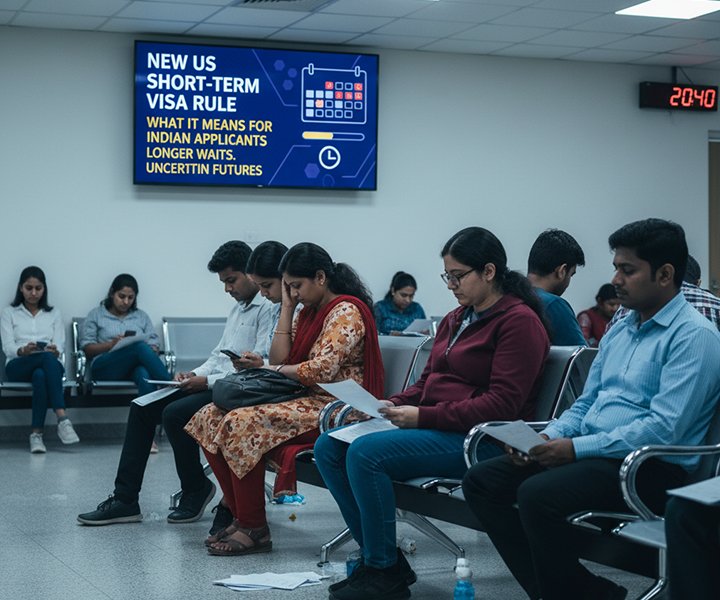
For millions of Indians, the United States remains one of the most sought-after destinations for education, business, tourism, and work. However, getting a visa to travel to the US has always been a challenging process — often marked by long wait times, limited appointment slots, and complex documentation requirements.
Now, a new rule introduced by the US Department of State (DoS) has added another layer of difficulty. Effective immediately, all individuals applying for a non-immigrant visa (NIV) must schedule their interviews in their country of citizenship or legal residence.
This move has major implications for Indians, who for years have relied on applying through other countries to speed up their visa processing.
What the New US Visa Rule Says
According to the official notification released by the State Department, applicants must now apply for their US visas in their home country or the country where they are legally residing.
In the past, many Indians practiced what was commonly known as “visa shopping” — applying for a US visa in another country where appointment wait times were shorter, even if they were not residents there. For example, some Indian applicants would fly to Thailand, Singapore, Germany, or Brazil to secure faster visa interviews.
That option has now been eliminated.
The DoS clarified:
- Applicants must prove residence in the country where they apply.
- All non-immigrant visa categories are affected — including B1 (business), B2 (tourism), F1 (students), H-1B (temporary workers), and others.
- If someone applies outside their home country and is unable to prove residency, they may face greater difficulty in qualifying.
- Visa fees are non-refundable and non-transferable. If your application is rejected abroad, you’ll have to reapply (and pay again) in your home country.
Why This Rule Matters for Indians
Indians are one of the largest groups applying for US non-immigrant visas every year. From students heading to American universities, to professionals traveling for conferences, to families going on vacations, the demand is massive.
However, appointment wait times in India are already long. For short-term visas like B1/B2, applicants often wait three to twelve months just to get an interview slot. Student visa slots are highly competitive and disappear within days of being released.
The option of applying in another country provided a valuable workaround. For example:
- A student heading to the US for fall semester could try to get an F-1 visa appointment in Vietnam or Singapore, where wait times were shorter.
- Business travelers often applied from countries where they were visiting temporarily for work.
- Families sometimes clubbed their overseas holidays with a US visa appointment in a different country.
With this new rule, all those alternatives are off the table. Indians must now apply in India, which will only add to the backlog.
The Growing Backlog Problem
US visa wait times in India have been a persistent issue since the Covid-19 pandemic. During the lockdowns, consulates suspended in-person interviews, creating massive backlogs that continue today.
Even though the US Embassy and Consulates in India have increased staffing and expanded operations, demand remains overwhelming. According to the latest figures:
- Visitor visas (B1/B2): Wait times average 3.5 months or more across Indian consulates.
- Student visas (F-1): Appointment availability is limited, especially during peak admission seasons.
- Work visas (H-1B, O-1): Processing is tighter, with longer checks and reduced flexibility.
By forcing all Indian applicants to apply in India, the new rule is expected to push wait times even higher.
Trump Administration’s Stricter Immigration Approach
The rule change is part of a series of visa policy adjustments under the Trump administration, which returned to power in January 2025. Historically, the Trump government has taken a harder stance on immigration, emphasizing stricter checks and reducing flexibilities in the system.
This directive reflects that approach. By limiting applications to home countries, the administration aims to:
- Reduce what it sees as misuse of third-country visa applications.
- Increase scrutiny of applicants by ensuring they are assessed within their own country’s context.
- Standardize processing by linking applications directly to country of residence.
For applicants, however, the result is longer waits, more paperwork, and fewer options.
Impact on Different Categories of Indian Applicants
1. Students (F-1 Visas)
Indian students are among the largest group of international students in the US. For them, the timing of visa appointments is critical — missing an interview can mean losing an entire semester.
With fewer slots in India and no option to apply abroad, students may face greater uncertainty in 2025 and beyond.
2. Tourists and Business Travelers (B1/B2 Visas)
Families planning holidays or professionals needing quick business trips are also hit hard. Longer waits in India mean many may have to postpone or cancel travel plans.
3. Temporary Workers (H-1B, O-1, L-1)
Even work visa renewals may now take longer. Professionals who once used consulates abroad while traveling for work must now return to India for renewals, adding to costs and delays.
4. Children and Seniors
The State Department also clarified that all applicants, including children under 14 and seniors over 79, generally need to attend in-person interviews. This increases the burden on families and elderly travelers.
What Applicants Should Do Now
If you are planning to apply for a US visa in 2025, here are some key steps:
- Plan Early: Apply as soon as possible. Don’t wait until the last minute, especially if you’re a student with fixed semester dates.
- Stay Informed: Regularly check the US Embassy and Consulates in India websites for updated appointment availability.
- Prepare Documents Carefully: With stricter checks, ensure all forms, financial proofs, and supporting documents are complete and accurate.
- Budget for Delays: Travel plans may need to be adjusted around visa processing times. Build in extra flexibility.
- Seek Guidance: If unsure, consult verified immigration advisors or education consultants who can help navigate the process.
Final Thoughts
The new US short-term visa rule is a game-changer for Indians applying for non-immigrant visas. By ending the long-standing practice of applying from third countries, the US government has effectively funneled all applications back to India — a country already struggling with overwhelming demand and long wait times.
While the move may streamline processes from the US perspective, for Indians it means longer waits, higher stress, and reduced flexibility. Students risk missing semesters, families may delay trips, and professionals could lose business opportunities due to visa bottlenecks.
As the Trump administration continues to tighten visa policies, Indian applicants must brace themselves for a more challenging road ahead. For now, the only strategy is to plan early, stay updated, and prepare thoroughly.