

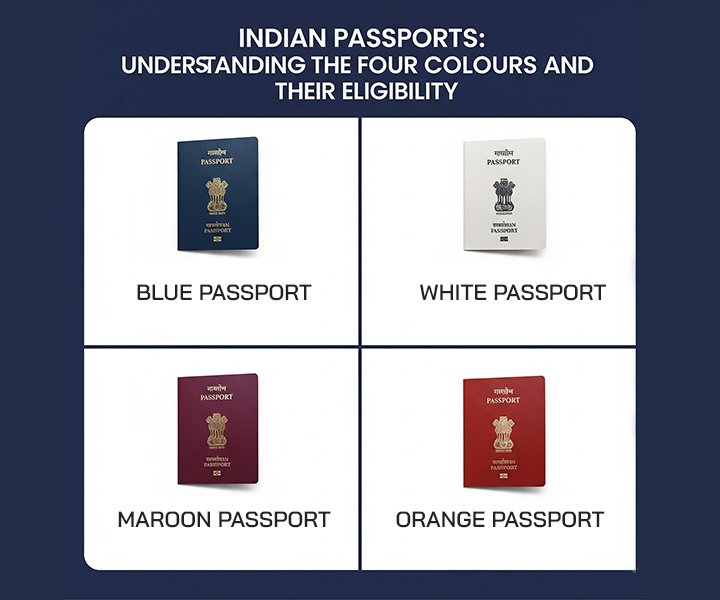
For most of us, a passport is simply a ticket to travel abroad. But in reality, it’s much more than that. In India, a passport isn’t just a travel document—it’s one of the most important forms of international identification. What many don’t realize is that India issues passports in four different colours: blue, white, red, and orange.
Each colour serves a specific purpose, representing different categories of travellers—from ordinary citizens to diplomats and government officials. This colour system makes it easier for authorities to identify the traveller’s status or reason for travel at a glance.
Let’s break down what each Indian passport colour means and who gets it.
1. Blue Passport – For Ordinary Citizens
The blue passport—known officially as the Ordinary Passport—is by far the most common in India. It’s issued to Indian citizens travelling for:
- Personal trips
- Business travel
- Education abroad
- Leisure
Today, even blue passports are being rolled out as e-passports with embedded biometric chips. This technology makes immigration faster and more secure.
Eligibility & Documents Required:
- Birth certificate or proof of date of birth
- Valid photo ID (Aadhaar, PAN, Voter ID, etc.)
- Proof of residence (e.g., electricity bill or rental agreement)
- Proof of Indian nationality
2. White Passport – For Government Officials
The white passport is reserved for:
- Civil servants,
- Government employees,
- Armed forces personnel
travelling overseas on official assignments.
The white cover clearly distinguishes the bearer as a government official, which often helps streamline immigration and security checks.
Application process for a white passport is stricter than for a blue one. Required documents include:
- Official government ID
- Duty certificate from the relevant department
- Forwarding letter
- Clearance from the Prime Minister’s Office (PMO)
Like other categories, government officials now also receive biometric e-passports with RFID chips for added protection and tamper-proofing.
3. Red (Maroon) Passport – For Diplomats
The red passport, often referred to as the Diplomatic Passport, is issued to:
- Diplomats
- Senior government officials
- Their spouses and dependent family members
Holders of this passport enjoy certain diplomatic privileges, including:
- Faster visa approvals
- Visa-free or visa-on-arrival access to several countries
- Priority processing at immigration counters
Just like ordinary and official passports, diplomatic passports are also issued as e-passports, ensuring higher security and global acceptance.
Eligibility requirements include submitting official ID, duty certificates, forwarding letters, and PMO clearance.
4. Orange Passport – For ECR (Emigration Check Required) Applicants
The orange passport is issued to citizens who fall under the ECR (Emigration Check Required) category. This usually applies to:
- People without higher educational qualifications
- Workers travelling abroad (especially to certain countries) for employment
The orange cover makes it clear that the passport holder must go through additional emigration checks before leaving India. This step ensures better protection and monitoring for vulnerable categories of workers.
Why Does Passport Colour Matter?
Each Indian passport colour acts as a visual identifier:
- Blue → Ordinary citizens (personal, business, education, tourism travel)
- White → Government officials travelling on duty
- Red → Diplomats and senior officials with diplomatic privileges
- Orange → Citizens under the ECR category (requires special emigration clearance)
With the recent introduction of biometric e-passports, India has also made passport identification more secure, globally compliant, and efficient.
Final Thoughts
The colour of your passport says more about your travel purpose and status than you might have thought. Whether it’s the blue passport for everyday travellers, the white cover for government officials, the red (maroon) passport for diplomats, or the orange passport for ECR holders—India’s four-colour system helps immigration authorities quickly identify and process applications.
By combining this system with modern chip-enabled e-passports, India has brought its travel document security up to international standards—making global travel easier, safer, and more efficient for its citizens.