

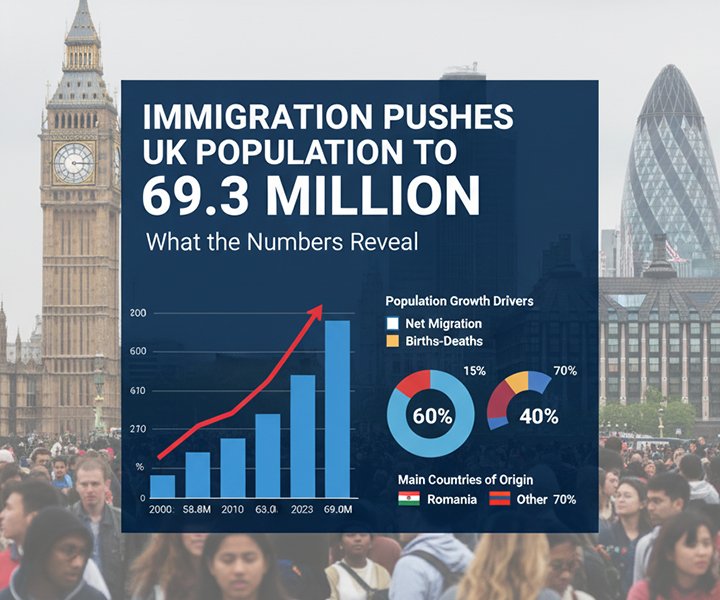
The United Kingdom’s population has reached a new milestone of 69.3 million, driven largely by immigration. According to the latest data from the Office for National Statistics (ONS), the population grew by 755,300 people between mid-2023 and mid-2024. This marks the second-largest annual increase since records began in 1950.
While the numbers highlight long-term demographic trends, they also reignite political debate around migration, border control, and the future of the UK’s social and economic fabric.
Breaking Down the Population Growth
The ONS report shows that the UK’s population increase is unevenly spread across the four nations:
- England: Population grew by 1.2%, accounting for the largest share of growth.
- Scotland: Population rose by 0.7%.
- Wales: Saw a 0.6% rise.
- Northern Ireland: Population increased by 0.4%.
England, already home to the majority of the UK population, continues to absorb most of the growth due to higher levels of international migration and job opportunities concentrated in major cities such as London, Manchester, and Birmingham.
ONS: Net Migration Remains the Main Driver
Nigel Henretty of the ONS explained the trend in clear terms:
“The UK population has increased each year since mid-1982. The rate of population increase has been higher in recent years, and the rise seen in the year to mid-2024 represents the second-largest annual increase in numerical terms in over 75 years. Net international migration continues to be the main driver of this growth, continuing the long-term trend seen since the turn of the century.”
This underlines an important reality: migration has become the single biggest factor behind the UK’s growing population. Birth rates among native-born citizens have slowed, and without migration, the population would be growing at a much slower pace.
Why Migration Numbers Matter
Migration is one of the most politically charged topics in the UK. It intersects with debates about:
- Economic growth – Migrants fill key labor shortages in healthcare, construction, and technology.
- Public services – Population growth increases demand for housing, schools, and the NHS.
- Cultural diversity – Immigration brings innovation and global connections but also raises concerns about integration.
- Regional pressure – Growth is concentrated in urban areas, straining housing and infrastructure.
These complexities explain why every new set of migration statistics sparks heated debate in Parliament and beyond.
Political Pressure on Keir Starmer
For Prime Minister Sir Keir Starmer, the timing of this population update is politically sensitive.
Starmer’s government is already under fire over immigration policy, especially Channel crossings and the use of asylum seeker hotels, which many voters see as symbols of a broken system. The surge in legal migration numbers adds another layer of political pressure.
Critics argue that Starmer has not done enough to curb arrivals. Meanwhile, the Labour government insists it is balancing humanitarian obligations with the need to maintain border integrity.
Nigel Farage and the Immigration Debate
The figures have also given fresh ammunition to Nigel Farage, leader of Reform UK and one of Britain’s most outspoken voices on immigration.
Farage has long called for tougher restrictions and recently demanded an end to indefinite leave to remain (ILR), arguing it creates a “back door to citizenship.” However, he later softened his stance after criticism, saying reforms should target specific loopholes rather than scrapping ILR entirely.
His rhetoric reflects a wider public frustration, especially among communities where rapid population growth has added pressure to housing, jobs, and healthcare.
Historical Context: A Long-Term Trend
The ONS points out that the UK has seen consistent population growth since 1982. But what has changed in recent decades is the scale and source of growth.
- In the 1960s–70s, natural increase (births minus deaths) was the main driver.
- Since the early 2000s, net migration has overtaken natural growth as the dominant factor.
- The expansion of the EU, refugee crises, and demand for skilled labor all contributed to rising migration levels.
This helps explain why immigration dominates today’s political landscape in a way it did not during previous decades of population growth.
The Challenges Ahead
With a population of 69.3 million and rising, the UK faces pressing challenges:
1. Housing Shortages
Demand for housing is outstripping supply. Rising rents and property prices make it difficult for young people to get on the housing ladder.
2. Healthcare Pressure
The NHS is already overstretched. A larger population means higher demand for doctors, nurses, and hospital beds. Ironically, the NHS relies heavily on migrant workers to fill staff shortages.
3. Education and Infrastructure
Schools in many urban areas are under pressure to accommodate growing numbers of children. Transport systems also face overcrowding.
4. Social Integration
Managing cultural diversity and integration remains a sensitive issue. While many celebrate the UK’s multicultural identity, others fear that rapid migration risks social cohesion.
Balancing Growth and Public Sentiment
The government is walking a fine line. On one hand, migration is essential to keep the economy functioning, particularly in industries where there are skill shortages. On the other, voters are increasingly demanding stricter control over borders and a reduction in overall numbers.
Public opinion polls consistently show that immigration ranks among the top three concerns for UK voters. If the government fails to respond, it risks losing political ground to parties like Reform UK that campaign on stricter migration policies.
Looking Ahead: What Might Change?
Several potential policy shifts are being discussed:
- Stricter visa rules for dependents of international students.
- Raising salary thresholds for skilled worker visas to reduce low-wage migration.
- Reforming asylum policies to speed up decision-making and reduce reliance on hotels.
- Reviewing indefinite leave to remain rules, though major overhauls remain politically risky.
The ONS numbers will likely intensify calls for action, making immigration one of the defining issues of UK politics in the coming years.
Final Thoughts
The latest ONS report confirms what has been evident for years: immigration is the main driver of the UK’s population growth, pushing it to 69.3 million. While this growth brings economic benefits, it also creates social and political challenges that cannot be ignored.
For Keir Starmer, these figures represent both a warning and an opportunity. A warning that public patience is running thin on migration, and an opportunity to set out a credible, balanced policy that addresses concerns while safeguarding the UK’s need for talent and diversity.
The immigration debate is far from over — in fact, it is only just beginning a new chapter.