

Meta Description: An Indian couple’s US B1/B2 visa was denied under section 214(b), dashing their FIFA World Cup 2026 travel plans. Here’s what happened during the interview and lessons for self-employed applicants.
US Visa Rejection Before FIFA World Cup 2026
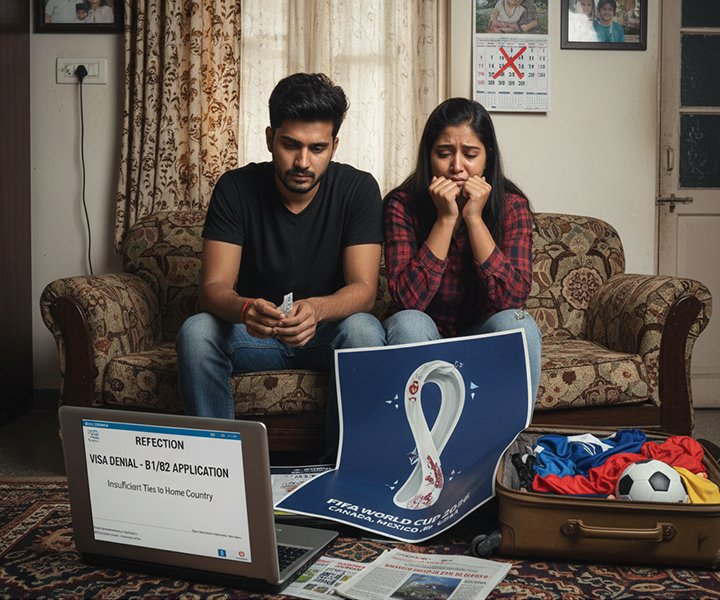
For many football fans, watching the FIFA World Cup live is a once-in-a-lifetime dream. But for one Indian couple, that dream was cut short when their B1/B2 tourist visa application was denied at the US Consulate in Chennai.
The applicant, a 31-year-old self-employed video marketing professional, shared his experience on Reddit, where it quickly drew attention from other travelers and visa hopefuls. He and his 29-year-old wife had planned a 10-day trip to Seattle and Los Angeles between July 5 and July 15, 2026, to catch the World Cup matches.
Despite strong financial backing and a clear purpose of travel, the couple was handed the dreaded 214(b) refusal slip, leaving them disappointed and reconsidering their approach.
The Interview Experience
According to the Reddit post, the visa interview was straightforward and lasted only a few minutes. The consular officer (described as a woman in her mid-30s to early 40s) began with the standard request: “Good morning, passports please.”
The applicant explained confidently:
“We are going to watch the FIFA World Cup next year in Seattle and Los Angeles. I had been to the last World Cup in Qatar and I want to experience it again this time with my wife.”
However, the officer didn’t engage much on football knowledge. Instead, she asked routine questions about the purpose of visit, length of stay, occupation, and funding.
- Duration of stay: 10 days.
- Occupation: Self-employed, running a GST-registered video marketing business.
- Financials: Around ₹8 lakh in bank balance and mutual funds worth ₹30 lakh.
- Wife’s status: Currently studying classical dance, but described as “not employed.”
The applicant felt that while his answers were truthful, they may not have been convincing enough to establish strong ties to India.
The Visa Refusal
After fingerprinting, the couple was informed:
“Unfortunately, your visa is not approved this time.”
They were handed a 214(b) refusal slip, which indicates that the consular officer was not convinced about their intent to return to India after the trip.
The applicant later reflected on what may have gone wrong:
- Not emphasizing strong home ties, such as parental responsibilities or business commitments.
- Describing his wife as “not employed” instead of “student,” which might have raised concerns.
- Limited travel history beyond Qatar, which may have weakened the case.
Lessons for Self-Employed Applicants
The Reddit user candidly admitted that being self-employed sometimes complicates the visa process because consular officers look for clear, stable ties to one’s home country. Unlike salaried applicants, entrepreneurs may need to work harder to demonstrate:
- Business stability (consistent income, taxes filed regularly).
- Family obligations (caring for parents, spouse, or children).
- Time constraints (showing you cannot stay abroad indefinitely due to work).
He noted that saying something like, “I cannot take more than 10 days off due to work and family commitments,” might have strengthened his case.
Considering Reapplication
Despite the setback, the couple is not giving up on their dream. The applicant shared that they might reapply in the future, but only after strengthening their profile. His strategy includes:
- Building a stronger travel history by visiting countries like Japan or Schengen nations.
- Presenting his wife’s status more clearly as a student.
- Highlighting professional and personal ties to India more convincingly.
What Others Can Learn from This Case
This incident serves as a reminder for Indians applying for a US B1/B2 visa:
- Financial strength is not enough. Consular officers want proof that you’ll return home after your trip.
- Travel history matters. Prior visits to other developed countries can improve your chances.
- Present family ties clearly. Spouse, children, or parents in India show strong reasons to come back.
- Be precise with occupation. If self-employed, explain your business stability and responsibilities.
- Student vs. unemployed: Always present the current occupation status correctly — a student is not “unemployed.”
Final Thoughts
Visa refusals are disheartening, especially when tied to once-in-a-lifetime experiences like the FIFA World Cup 2026. For this Indian couple, the rejection was a tough blow, but also an opportunity to reassess their approach.
Their story highlights how important it is for applicants to demonstrate strong ties to India, maintain transparency, and prepare convincing answers.
For self-employed Indians dreaming of traveling to the US — whether for tourism, business, or global events — this case underlines the need for preparation beyond finances. With better travel history, clearer explanations, and strong documentation, chances of approval can improve significantly.