

Canada has long been seen as one of the most welcoming destinations for international students. With world-class universities, multicultural cities, and promising career pathways, it consistently attracted hundreds of thousands of students from across the globe—especially from India, China, and other Asian countries.
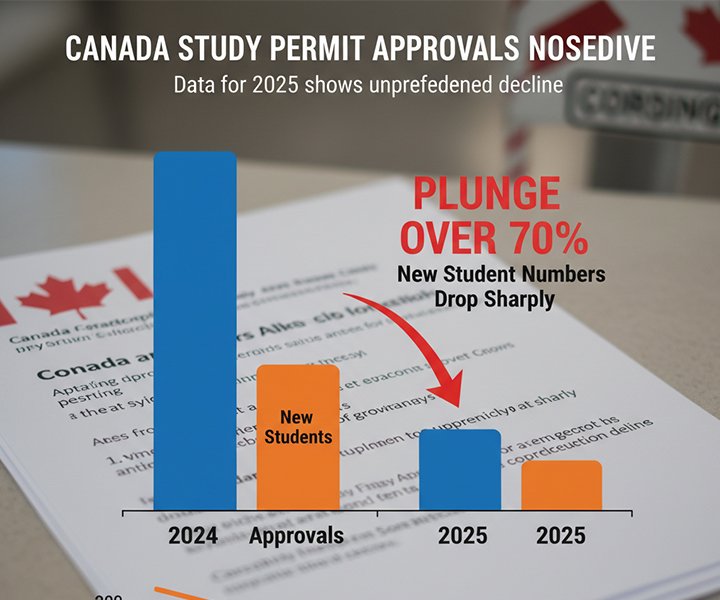
But 2025 tells a very different story. For the first time in decades, the number of new international students entering Canada has dropped dramatically. According to the latest figures, study permit approvals fell by more than 70% in the first half of 2025 compared to the same period last year.
This steep decline marks one of the sharpest contractions in Canada’s international education sector and has left many aspiring students and their families rethinking their plans.
A Sharp Decline in International Arrivals
Between January and June 2025, Canada admitted 214,520 fewer foreign nationals compared to the same period in 2024. This represents an almost 57% drop in total arrivals, including both international students and foreign workers.
- Work permits issued (Jan–Jun 2024): 245,137
- Study permits issued (Jan–Jun 2024): 125,034
- Work permits issued (Jan–Jun 2025): 119,234
- Study permits issued (Jan–Jun 2025): 36,417
These numbers reveal the extent of the downturn: while work permits for foreign workers fell by around 50%, study permits for international students collapsed by more than 70%.
Study Permits: Month-by-Month Breakdown
The numbers for student permits highlight just how severe the decline has been:
- April 2024: 45,806 study permits issued
- April 2025: Just 8,543 study permits issued
- March 2025: The lowest month of the year with only 3,819 permits issued
- May 2025: 4,553 permits issued
- June 2025: 4,185 permits issued
In total, 88,617 fewer students were approved between January and June 2025 compared to the same timeframe in 2024.
For a country that has relied heavily on international students to support universities, boost the workforce, and fuel the rental housing market, these figures signal a major policy-driven slowdown.
Why Did Canada Slash Student Numbers?
The decline is not accidental—it is the result of deliberate policy changes introduced by the Canadian government.
1. Annual Cap on Study Permits
In January 2024, the government introduced a two-year cap on international student permits. The cap was designed to reduce the inflow of students by about 40%, with the aim of easing pressures on the housing market and public services in cities with high student populations.
For 2025, the target was tightened further. IRCC (Immigration, Refugees and Citizenship Canada) planned to issue a maximum of 437,000 study permits, which is a 10% decrease from 2024’s cap.
2. Attestation Letter Requirement
As part of the new rules, every international student applying for a study permit now needs an attestation letter from a Canadian province or territory. This measure ensures that provinces have more oversight of student inflows, preventing certain regions from being overwhelmed.
3. Post-Graduation Work Permit (PGWP) Restrictions
Another significant change came into effect on September 1, 2024. International students who enroll in programs delivered under curriculum licensing arrangements—where private colleges partner with public institutions—are no longer eligible for a PGWP upon graduation.
Since the PGWP has long been one of the biggest incentives for students to study in Canada, this rule change has reduced the appeal of many private institutions, especially those relying heavily on international enrolments.
Impact on International Students
The stricter rules and reduced approvals are reshaping the international education landscape in Canada.
1. Fewer Opportunities
With permits capped and rejection rates soaring, students who might have easily secured approval just two years ago are now facing delays, refusals, or the need to explore other countries.
2. Rising Competition
Fewer study permits mean tougher competition for seats at Canadian universities and colleges. Students with stronger academic records, higher language scores, and clearer financial proof are more likely to succeed.
3. Limited PGWP Options
The new restrictions on PGWP eligibility mean students must carefully choose their programs and institutions. Low-quality or unapproved courses now carry significant risks, as graduates may not qualify for work permits after finishing their studies.
4. Shift to Other Destinations
Many Indian and Asian students who once viewed Canada as their first choice are now considering alternatives such as the UK, Australia, Germany, or the US, where post-study work pathways may seem more accessible.
Why Canada Is Taking This Path
The Canadian government’s actions are part of a broader effort to balance economic, housing, and labor market realities.
- Housing Crisis: Major cities like Toronto and Vancouver have struggled with soaring rents and limited availability. Reducing student inflows is seen as one way to ease demand.
- Quality Assurance: Some private colleges have been criticized for offering substandard education while charging high fees, leaving graduates underprepared for jobs. The new rules aim to curb such practices.
- Public Sentiment: With over a million international students in Canada in 2024, many Canadians voiced concerns that the system was unsustainable. Tightening rules was partly a response to domestic political pressure.
What the Future Looks Like
The steep drop in student numbers is expected to continue through the remainder of 2025 as the cap and new rules remain in place. Universities and colleges, particularly smaller private institutions, are likely to feel the financial strain from declining international enrolments.
For students, this means:
- Better preparation is essential. Strong academic profiles, clear career goals, and well-documented financial stability will be key to securing a permit.
- Choosing the right program matters. Only government-approved institutions and eligible programs should be considered.
- Language proficiency is crucial. With rising competition, strong English or French skills will give applicants a clear edge.
Final Thoughts
Canada’s reputation as an open and welcoming destination for international students is undergoing a profound shift. With study permit approvals plunging by over 70% in 2025, the country is making it clear that it is prioritizing quality over quantity when it comes to international education.
While the new rules present challenges, they also encourage students to plan more carefully, apply to stronger institutions, and approach the process with greater transparency.
For Indian students—who form the largest group of international applicants—the dream of studying in Canada is no longer guaranteed. But with proper preparation and realistic expectations, it remains achievable.
The new era of Canadian education is here: stricter, smaller, but more selective.