

Introduction
Canada has long been regarded as one of the world’s most attractive destinations for foreign workers and international students. Its strong economy, multicultural society, and clear pathways to permanent residency have historically drawn hundreds of thousands of people every year.
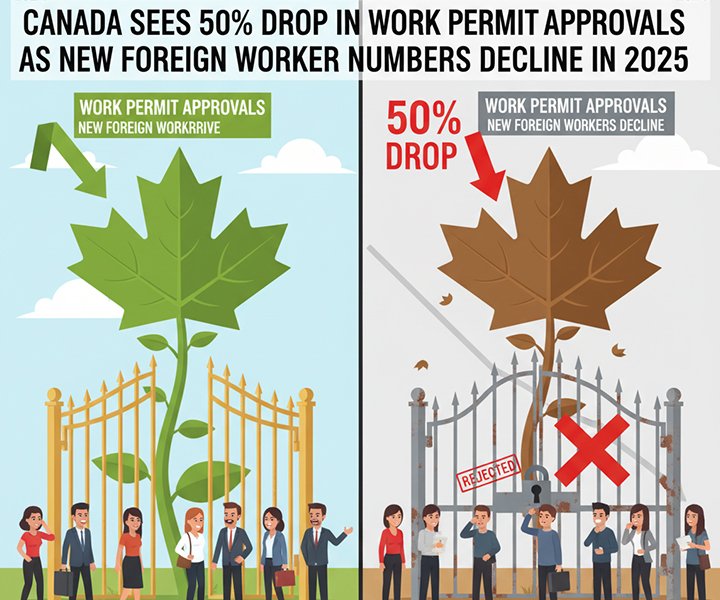
But 2025 has marked a major turning point. In the first half of the year, the number of work permits issued to foreign nationals dropped by nearly 50% compared to 2024, signaling a sharp decline in new arrivals. Alongside this, study permit approvals for international students also witnessed a steep fall of more than 70%, raising concerns about Canada’s future as a top choice for skilled talent and learners.
Let’s break down the numbers, the reasons behind this decline, and what it means for workers, students, and employers moving forward.
A Sharp Decline in Canada’s Work Permits
Between January and June 2024, Canada issued 245,137 work permits. Fast forward to the same period in 2025, and the number fell dramatically to 119,234 permits. That’s a reduction of 125,903 permits in just one year, translating into nearly a 50% drop.
The monthly figures highlight the seriousness of this decline:
- March 2024 – 63,618 work permits issued
- March 2025 – Only 18,540 permits issued
- February 2025 – Lowest figure of the year at just 14,396 permits
- May 2025 – 14,243 permits issued
- June 2025 – 11,287 permits issued
This data makes it clear that 2025 has seen the sharpest fall in recent memory when it comes to foreign workers entering Canada.
Decline in International Student Approvals
The situation isn’t limited to foreign workers. International students, one of Canada’s largest sources of temporary residents, are also facing new hurdles.
By June 2025, Canada recorded over a 70% decline in study permit approvals, drastically reducing the flow of new international students into Canadian universities and colleges. This decline has already begun impacting educational institutions, housing markets, and local economies in student-heavy cities like Toronto, Vancouver, and Montreal.
Why Are Work Permits Dropping So Sharply?
The fall in approvals isn’t accidental—it’s the direct outcome of policy reforms introduced over the past year.
1. New Cap on Low-Wage Workers
On September 26, 2024, Canada introduced strict new rules under the Temporary Foreign Worker Program (TFWP).
- A 10% cap was set on low-wage hires per workplace (20% in certain high-demand sectors like healthcare and construction).
- A refusal-to-process policy was introduced in urban regions where unemployment is at or above 6%, making it harder for employers to hire temporary workers in such areas.
2. Raised Wage Thresholds
From November 8, 2024, the government increased the wage threshold for high-wage stream applications, meaning that more job positions were pushed into the low-wage category, where stricter rules apply.
3. Targeted Reduction in Temporary Population
Through the 2025–2027 Immigration Levels Plan, Canada has made it clear that it intends to reduce its temporary resident population to below 5% of the national population. This means fewer approvals for both temporary foreign workers (TFWs) and international students.
4. Reforms to the Post-Graduation Work Permit Program (PGWP)
The PGWP has been one of the main attractions for international students, allowing them to work in Canada after graduation and eventually apply for permanent residency. But in 2025:
- The eligibility requirements have been tightened, making it harder for students to qualify.
- Institutions and programs that were once eligible no longer automatically qualify for PGWP access.
5. Restricted Work Permits for Spouses
Previously, spouses of international students and temporary foreign workers often received open work permits, allowing them to work anywhere in Canada. But new rules have limited spousal work permit eligibility, further reducing the number of foreign nationals able to work in Canada.
The Bigger Picture: Canada’s Immigration Strategy
For years, Canada relied heavily on temporary foreign workers and international students to fill labor shortages, boost the economy, and support population growth. However, the recent policy changes indicate a major shift:
- The government is now focusing on sustainable immigration levels rather than rapid growth.
- By restricting temporary residents, Canada hopes to ease pressure on housing, healthcare, and labor markets.
- The long-term aim is to rebalance immigration by prioritizing permanent pathways over temporary ones.
While these measures may reduce strain on local infrastructure, they also raise concerns about labor shortages in industries that rely on temporary workers, such as agriculture, hospitality, and healthcare.
Impact on Employers and the Economy
For Canadian employers, especially those in labor-intensive industries, the decline in work permits is a growing challenge.
- Fewer workers available: Many businesses are struggling to fill roles in construction, caregiving, retail, and food services.
- Rising costs: Employers may need to offer higher wages to attract local workers.
- Reduced growth: Sectors that previously relied on international talent could face slower expansion.
At the same time, universities and colleges that depended heavily on international student fees are already feeling financial pressure from the 70% drop in study permits.
What This Means for Future Applicants
If you’re planning to move to Canada for work or study, here are some key takeaways:
- Expect stricter rules: Both work permit and study permit approvals are under tighter scrutiny.
- Plan ahead: Apply well in advance and ensure you meet the updated eligibility requirements.
- Explore alternative pathways: Programs like provincial nominee programs (PNPs) or direct permanent residency streams may be more reliable than temporary permits in the long run.
- Stay updated: Immigration rules are changing rapidly—following the latest government updates is crucial.
Conclusion
The first half of 2025 has reshaped Canada’s immigration landscape. With a 50% drop in foreign work permits and a 70% fall in student permits, the country is taking a more restrictive approach toward temporary residents.
Driven by policy changes such as caps on low-wage hires, tighter PGWP rules, and limited spousal work permits, these shifts are part of Canada’s broader plan to reduce its temporary resident population to below 5%.
While these measures may relieve pressure on housing and public services, they also present new challenges for employers, educational institutions, and prospective immigrants. For those planning to move to Canada, understanding these changes and exploring permanent immigration pathways may now be more important than ever.