
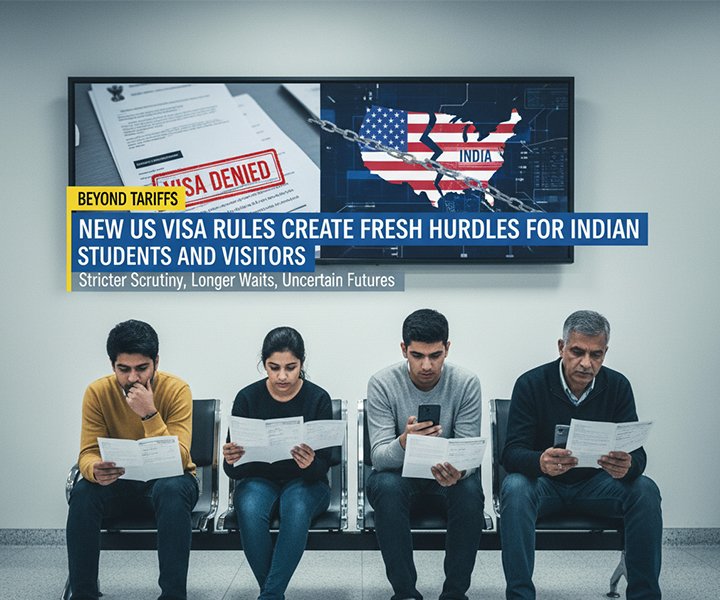
For many Indians, studying in the United States or visiting the country for business and leisure has always been a dream. However, that dream has become increasingly difficult in 2025. Already struggling with long wait times for appointments, Indian applicants are now facing yet another obstacle — a new directive from the US Department of State (DoS) issued on September 6, 2025.
The rule change has made it mandatory for Indian citizens and residents to apply for their US non-immigrant visas — whether it is a student visa (F-1), visitor visa (B1/B2), or even work categories such as H-1B and O-1 — only from India. Earlier, many applicants had been sidestepping India’s year-long waitlists by booking appointments in third countries such as Vietnam, Thailand, Singapore, or even parts of Europe.
Now, with the new restriction, that option is off the table.
The New Rule Explained
Until recently, Indians frustrated with the massive wait times for visa interviews in India had the flexibility to apply for their visas abroad. For example, students seeking F-1 visas often traveled to countries like Vietnam or Thailand to secure faster appointments. This system was also widely used during the Covid-19 pandemic, when the DoS relaxed its rules to help ease global backlogs.
However, the September 2025 directive has reversed that flexibility. According to the new rule:
- Non-immigrant visas must now be applied for only in the country where the applicant resides or is a citizen.
- Indians who have already applied in other countries but have not yet completed the process (biometrics and interviews) will now need to start over and apply only from India.
- Fees paid overseas are not transferable, meaning applicants may have to pay all over again.
This is a significant setback, as many Indians had relied on third-country applications to beat India’s notoriously long appointment delays.
Why Were Indians Applying Abroad in the First Place?
India has one of the highest demands for US visas in the world. According to travel and immigration experts, wait times for visitor visas (B1/B2) often stretch beyond 12–15 months, while student visa slots are limited and disappear quickly during peak admission seasons.
Rachit Agarwal, founder of AdmitKard, an overseas education platform, explained:
“Since June, getting US visa slots has been very difficult. One workaround we found was sending students to Dubai, Singapore, Vietnam, and Thailand for their applications. Slots were more available there.”
However, this approach came with its own challenges. Applicants had to spend at least a week in the country where they were applying because biometric appointments and interviews could not be scheduled on the same day. The added costs of travel, stay, and logistics made it an expensive but sometimes necessary option for those in a hurry.
Now that flexibility is gone.
The Immediate Impact on Indian Applicants
The DoS directive has affected several groups:
- Students (F-1 Visas)
- Indian students preparing to start their studies in US universities now face greater uncertainty.
- With slots limited in India, many students risk missing semester start dates if they cannot secure timely interviews.
- Tourist and Business Visitors (B1/B2 Visas)
- Short-term travel for family visits, tourism, or business meetings has become harder.
- Many Indians had been applying from nearby countries while traveling — an option that no longer exists.
- Work Visa Applicants (H-1B, O-1)
- Even those renewing work visas faced additional delays in India and were using overseas consulates for faster processing.
- This group too must now reapply at home.
According to Gnanamookan Senthurjoti, founder of The Visa Code, an immigration advisory firm:
“Many of my clients had applied in Europe, in countries like the UK, Luxembourg, Germany, or France — often combining the process with a vacation. Now we are forced to transfer these applications back to India and pay new fees, as overseas applications will no longer be processed.”
Trump-Era Immigration Strictness Returns
The timing of this decision is also notable. Since the Donald Trump administration returned to power in January 2025, US immigration has once again become more restrictive. There has been:
- Rising visa denials.
- More scrutiny during interviews.
- Reduced flexibility in processing, even for legitimate applicants.
Experts believe this policy change is part of a broader tightening of immigration and visa rules. For Indians — who are among the largest beneficiaries of US student, work, and visitor visas — the shift creates uncertainty and additional hurdles.
Real-Life Consequences for Students and Visitors
The change is not just bureaucratic; it has real-world implications.
- For Students: Admission timelines are strict, and missing a visa appointment could mean deferring a semester or even losing admission offers. Since June 2025, many Indian students have struggled to book slots, and now their last workaround has been taken away.
- For Families: Parents hoping to visit children in the US for graduations, weddings, or vacations must wait much longer for appointments in India.
- For Business Travelers: Professionals who often need short-notice travel for meetings or conferences face longer delays that can affect business deals and opportunities.
Immigration lawyer Joel Yanovich from Murthy Law Firm explained:
“Nearly everything is becoming more challenging in US immigration right now, and B1/B2 visas are no exception. Third-country processing was a practical solution, but that’s no longer available.”
What Should Applicants Do Now?
With this new directive in place, Indian applicants have limited choices. Here’s what experts recommend:
- Plan Early
- Students must apply for visas as soon as they receive admission offers. Waiting too long can mean losing a slot.
- Stay Updated
- Check the US Embassy and Consulates in India website regularly for new slot releases. Sometimes additional slots open unexpectedly.
- Work With Advisors
- Immigration consultancies and education platforms often get early information about slot availability. Partnering with them can improve your chances.
- Be Financially Prepared
- If you previously applied abroad, you may need to pay the visa fees again in India. Budget for this extra cost.
Final Thoughts
The new US visa directive of September 2025 is a blow to Indian students, visitors, and professionals who had found creative ways to overcome India’s long wait times. By restricting applications only to the home country, the US has added more pressure on an already overloaded system.
For Indian families, this means more delays, more uncertainty, and in some cases, missed opportunities. For students, it could even mean lost semesters or deferred dreams.
While the rule aims to streamline processing and reduce misuse, its timing could not be worse — especially when India’s demand for US visas is at an all-time high.
As things stand, Indians hoping to study, work, or travel to the US must now prepare for longer waits, stricter checks, and the reality that shortcuts through third countries are no longer an option.