
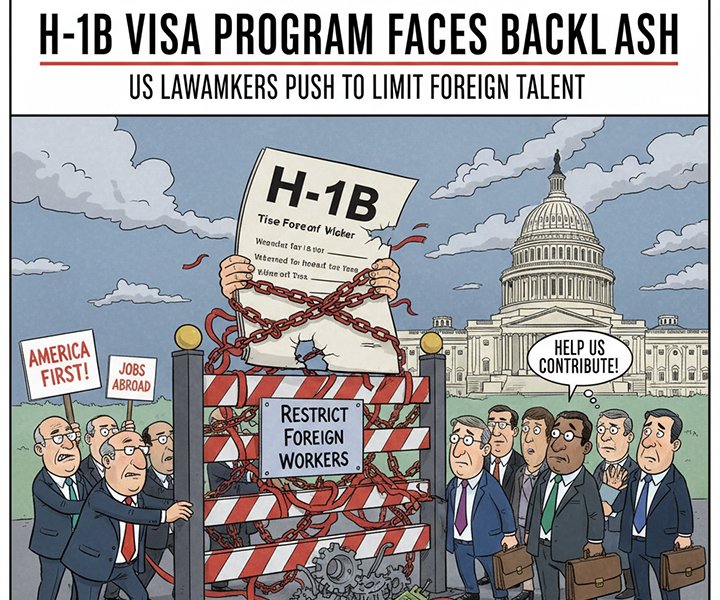
The H-1B visa program has long been one of the most debated immigration pathways in the United States. Originally designed to bring in highly skilled professionals to fill gaps in America’s workforce, it has now become the center of a heated political and economic debate. Lawmakers, labor unions, and sections of the American public argue that the program is being misused to undercut domestic workers. On the other hand, US companies and global talent advocates continue to defend it as a critical tool for innovation and growth.
In 2025, the backlash against the H-1B program has intensified. With new legislative proposals, social media campaigns by lawmakers, and policy changes being considered by the Department of Labor, the future of H-1B visas could look very different in the coming years.
This blog takes a deep dive into the controversy surrounding the H-1B visa program, the perspectives of different stakeholders, and the major changes that could redefine how foreign professionals work in America.
Why the H-1B Visa Is Back in the Spotlight
The H-1B visa allows US companies to hire foreign professionals in specialty occupations such as technology, engineering, mathematics, and medical sciences. To qualify, workers generally need at least a bachelor’s degree or an equivalent qualification.
While tech giants like Google, Microsoft, and Amazon rely heavily on H-1B talent, critics claim the program has strayed far from its original intent. Instead of addressing genuine shortages in critical skills, opponents argue it has become a tool to replace American workers with cheaper foreign labor.
This sentiment has grown stronger over the last few years as economic uncertainties, layoffs in the tech sector, and rising nationalism have influenced public opinion.
Lawmakers Push for Stricter Rules
Several US lawmakers have openly expressed their dissatisfaction with the H-1B program. Congressman Riley M. Moore, in a recent post on X (formerly Twitter), called the program “grossly abused to undercut the American worker.” He emphasized that companies often exploit loopholes to bring in foreign workers under the false pretext of a STEM workforce shortage.
Moore recently pushed an amendment in the House Appropriations Committee that directs the US Department of Labor to review how the H-1B program and the Schedule A list (pre-certified shortage occupations) affect American workers. His argument is simple: before relying on foreign workers, the US must first ensure it is not overlooking or sidelining its own citizens.
Similarly, Republican Senator Eric Schmitt of Missouri echoed these concerns, stating that H-1B visas have been used to “replace American workers and transfer entire industries overseas.” Such statements reflect a growing bipartisan consensus that the current system is flawed and needs reform.
The STEM Workforce Debate
One of the strongest arguments in favor of H-1B visas is the shortage of skilled workers in STEM fields—Science, Technology, Engineering, and Mathematics. US companies argue that there are simply not enough qualified Americans with advanced STEM degrees to fill critical roles, particularly in industries such as information technology, cybersecurity, and artificial intelligence.
However, opponents challenge this claim. They argue that the shortage is exaggerated and used as a cover to bring in lower-wage workers from countries like India and China.
Recent data from Boundless Immigration adds context to this debate. In 2024, a record 165,524 international students participated in STEM Optional Practical Training (OPT), which allows foreign graduates to work temporarily in the US. Of these, 95,384 received new STEM OPT authorizations—a 54% increase in just one year. Nearly half were from India (48%), followed by China (20.4%).
These numbers show that while international talent is heavily contributing to the US workforce, critics question whether this dependence is sustainable or fair to American graduates seeking jobs in the same fields.
How the Department of Labor Regulates H-1B
The US Department of Labor (DOL) plays a key role in managing the H-1B program. Employers hiring foreign professionals must file a Labor Condition Application (LCA), where they certify that they will pay the H-1B worker at least the prevailing wage in the occupation and region.
This requirement is meant to prevent companies from undercutting wages and ensure that hiring foreign workers does not negatively impact American employees. Additionally, certain occupations are listed under Schedule A, meaning the DOL has already determined that there are not enough qualified US workers available for those jobs.
But critics argue that in practice, enforcement is weak, and many companies still manage to exploit the system by offering just the minimum wage required under regulations, rather than truly competitive salaries.
The Push for Wage-Based Selection
In response to growing criticism, US authorities are considering a significant reform: moving toward a wage-based allocation system for H-1B visas.
Currently, H-1B visas are awarded through a lottery system due to overwhelming demand. Each year, around 85,000 visas are made available, but hundreds of thousands of applications pour in. Under the proposed reform, the selection process would prioritize candidates offered higher wages by US employers.
This change could have far-reaching implications.
- For US workers: It ensures that companies are hiring foreign talent only when they are willing to pay premium salaries, reducing the chances of wage suppression.
- For foreign workers: It means that those with lower-wage job offers will have much slimmer chances of being selected. Fresh graduates, entry-level employees, and workers at smaller firms may struggle to compete.
- For large tech firms: Big corporations that can afford to offer higher salaries will have a better shot at securing top foreign talent.
Supporters of this model argue it will align the program more closely with market demand and protect American wages. However, critics warn it may create inequality by favoring wealthy corporations while shutting out startups and smaller businesses that also rely on global talent.
The Bigger Picture: America’s Immigration Balancing Act
The controversy surrounding the H-1B visa is not just about jobs—it’s about America’s broader immigration philosophy.
On one hand, the US prides itself on being a global hub for innovation, attracting the best minds from around the world. From Silicon Valley startups to groundbreaking medical research, foreign professionals have played a key role in building America’s competitive edge.
On the other hand, growing public pressure to “put American workers first” has made immigration reform a political flashpoint. With elections on the horizon, lawmakers are keen to respond to voter concerns about job security, wages, and economic fairness.
What the Future Holds for H-1B Applicants
For aspiring H-1B applicants—especially from countries like India and China—the road ahead looks more challenging. Wage-based selection, stricter Department of Labor oversight, and political opposition could significantly reduce opportunities for lower- and mid-level professionals.
However, demand for top global talent in areas like artificial intelligence, data science, cybersecurity, and healthcare is unlikely to fade anytime soon. US companies will continue to seek highly skilled workers, even as policies evolve.
Students considering studying in the US should pay close attention to these changes. The growing emphasis on STEM fields and wage-based allocation suggests that advanced degrees and specialized skills will be more valuable than ever.
Final Thoughts
The H-1B visa program stands at a crossroads. While it has undeniably contributed to America’s growth and innovation, the concerns around wage suppression and job displacement cannot be ignored. The proposed shift to a wage-based system signals a new era where only the most competitive offers will stand a chance.
For foreign workers, this means the dream of working in the US will require not just qualifications, but also a strong market value. For American workers, it may mean better wage protection and a fairer labor market.
As lawmakers continue to debate and push reforms, one thing is clear: the H-1B visa program will remain central to the conversation on immigration, jobs, and America’s future competitiveness.