
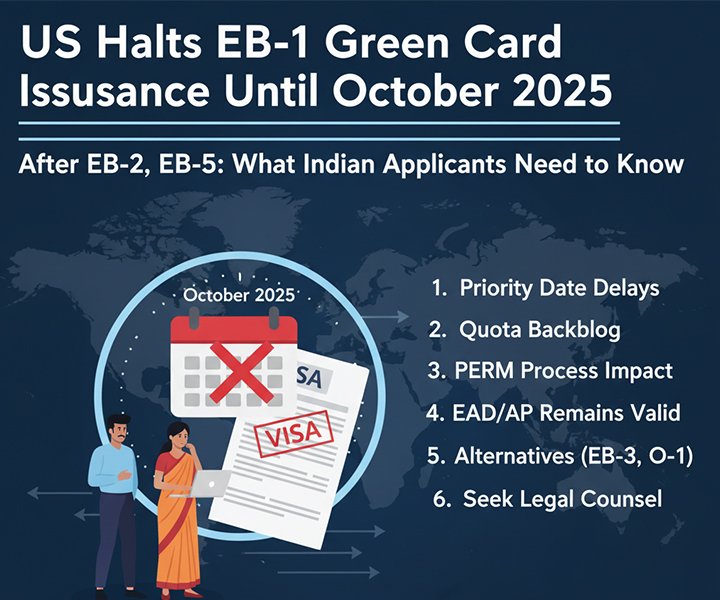
The United States has long been the top destination for skilled professionals, researchers, and students from around the world. For Indian applicants in particular, the dream of settling in the US often revolves around securing an employment-based green card. But in a major development, the US Department of State (DOS), along with US Citizenship and Immigration Services (USCIS), has announced that both EB-1 and EB-2 green card categories have hit their annual limits for the fiscal year 2025.
This means no new visas will be issued in these categories until October 1, 2025, when the next fiscal year begins. The freeze is creating fresh uncertainty for thousands of highly skilled professionals, many of whom are Indian nationals already stuck in long backlogs.
In this blog, we’ll explain what this freeze means, why it happened, its impact on Indian applicants, and what you can do to stay ahead during this pause.
What Are EB-1 and EB-2 Green Cards?
Before diving into the freeze, it’s important to understand what these categories mean.
EB-1 (Employment-Based First Preference)
The EB-1 green card is designed for individuals at the very top of their fields. It is divided into three main groups:
- EB-1A: People with extraordinary ability in sciences, arts, education, business, or athletics.
- EB-1B: Outstanding professors and researchers.
- EB-1C: Multinational executives or managers.
The EB-1 is attractive because it typically has shorter wait times compared to other employment categories. For many Indians, this category is seen as a fast-track option to permanent residency.
EB-2 (Employment-Based Second Preference)
The EB-2 green card is for professionals who hold advanced degrees (Master’s or higher) or have exceptional ability in sciences, arts, or business. This category is very popular among Indian IT professionals, engineers, healthcare workers, and academics.
While EB-2 generally has more applicants, it also faces longer wait times—sometimes stretching over a decade for Indians due to country-specific limits.
Why Did the Freeze Happen?
Every year, the US allocates a fixed number of green cards under the Immigration and Nationality Act (INA). Employment-based visas make up about 140,000 slots annually, divided into categories like EB-1, EB-2, EB-3, EB-4, and EB-5.
Annual Caps
The EB-1 category accounts for about 28.6% of the total employment-based visas. Similarly, EB-2 also has a fixed share. Once these caps are reached, no more green cards can be issued until the start of the next fiscal year.
Spillover Rules
Unused visas from EB-4 (religious workers and certain special immigrants) and EB-5 (investors) sometimes “spill over” to EB-1. Despite these extra numbers, demand for EB-1 visas—especially from India and China—was so high in 2025 that the entire quota got exhausted before the end of the fiscal year.
High Demand from India
Indians are among the largest applicants in both EB-1 and EB-2 categories. Long waiting times in EB-2 push many to try EB-1, which further fuels demand and speeds up the exhaustion of annual caps.
Impact on Indian Applicants
This freeze is a major setback for Indian professionals who were counting on the EB-1 category as a faster alternative to EB-2.
Visa Bulletin Cut-Offs Remain Stuck
The September 2025 Visa Bulletin shows that the final action date for EB-1 applicants from India is February 15, 2022. This means only those with priority dates before this cutoff can move forward—but even they cannot get approvals until October 2025 when visa numbers reset.
Adjustment of Status Applications Paused
Applicants who already filed for Adjustment of Status (AOS) will remain in limbo. USCIS can continue to accept applications if dates are current, but no final green card approvals will be issued until the freeze is lifted.
Worsening Backlogs
For Indian nationals, this freeze adds to the already decades-long backlog. According to estimates, some Indian professionals in EB-2 and EB-3 may wait over 80 years for their green cards unless legislative changes are made. The EB-1 freeze, though shorter, still delays progress for thousands who had hoped to avoid the EB-2 backlog.
EB-2 Already Frozen, Now EB-1 Too
The EB-1 freeze comes shortly after the EB-2 category was also declared unavailable for FY 2025. EB-2 reached its cap earlier in the year, leaving applicants in limbo.
- EB-2 Freeze: USCIS continues to accept filings but cannot issue final approvals until October 2025.
- EB-1 Freeze: Now joins EB-2 in being unavailable until October.
This dual freeze highlights how overwhelming demand is compared to the limited number of green cards available each year.
EB-5 Investor Visas Still Moving
While EB-1 and EB-2 categories have come to a halt, the EB-5 investor visa program has shown some progress. The EB-5 program allows individuals to secure green cards by investing a significant amount (usually $800,000 to $1,050,000) in US businesses that create jobs.
In fact, the August 2025 Visa Bulletin showed forward movement for Indian EB-5 applicants, offering some relief for wealthy investors. However, this progress does little to help the majority of Indian professionals who rely on EB-1 and EB-2 pathways.
What Should Indian Applicants Do Now?
The freeze is frustrating, but there are steps applicants can take to stay prepared:
1. File Adjustment of Status Applications
Even though approvals are paused, USCIS continues to accept AOS filings if your priority date is current. Filing early ensures your place in the queue once numbers reopen.
2. Keep Documents Updated
Ensure that all your immigration documents, work permits (EAD), and travel permits (Advance Parole) are valid. Renewal timelines should be carefully tracked to avoid gaps.
3. Explore Alternative Categories
Some applicants may qualify under EB-3 (skilled workers, professionals, and other workers) or even EB-5 if they have the financial resources. Discussing options with an experienced immigration attorney can help.
4. Stay Informed
Follow monthly Visa Bulletin updates from the DOS. Priority date movements, even small, can make a difference.
5. Plan Career Moves Carefully
If your green card timeline is uncertain, factor this into your career planning. Extensions of H-1B or L-1 visas are common while waiting, but long-term planning is essential.
What Happens After October 1, 2025?
When the new fiscal year begins on October 1, 2025, the annual green card limits reset. This means:
- EB-1 and EB-2 visa numbers will become available again.
- Pending Adjustment of Status cases will resume adjudication.
- New applicants with current priority dates can receive approvals.
However, given the overwhelming demand from India, backlogs will not disappear. It may still take years before priority dates for Indian applicants move significantly forward.
Outlook for the Future
Unless the US Congress passes immigration reforms, the annual green card caps will continue to create long delays for Indian applicants. The Fairness for High-Skilled Immigrants Act, which aimed to eliminate country caps, has been debated for years but has not yet become law.
For now, Indian applicants must prepare for:
- Continued long wait times in EB-2.
- Slower movement in EB-1 due to growing demand.
- Tough competition for the limited number of green cards available each year.
Conclusion
The halt of both EB-1 and EB-2 green cards until October 2025 is a stark reminder of the challenges within the US immigration system. For Indian applicants, already burdened with some of the longest wait times in the world, this pause only adds to the uncertainty.
Yet, it’s not all bleak—applicants can still file their paperwork, maintain legal status, and prepare to act quickly once the fiscal year resets. Patience, preparation, and proper legal guidance will be key during this period.
The demand for US permanent residency remains high, and while delays are frustrating, staying proactive ensures that when the gates open again in October 2025, you’ll be ready to move forward.