
In the last few years, one immigration buzzword has been making rounds everywhere—from startup WhatsApp groups to Telegram visa forums and even mainstream news: the so-called “Einstein visa.”
The term sounds glamorous, almost mythical, and many people are intrigued. Can a consultant, entrepreneur, or even a social media influencer really get this visa, once considered reserved for Nobel laureates, Olympic athletes, or world-class professors?
Immigration consultants, especially in India, are quick to fan this curiosity. Many now advertise “profile-building packages” that promise to turn ordinary professionals into “EB-1 visa eligible” candidates. From arranging ghostwritten research papers to planting names in obscure journals, the methods being sold are both creative—and questionable.
But let’s pause and ask the important questions:
👉 What exactly is the Einstein visa (EB-1)?
👉 Who actually qualifies for it?
👉 Are these “shortcuts” sustainable, or just risky traps?
This blog cuts through the myths, hype, and misinformation to explain what the EB-1 visa is really about—and what you should know if you’re considering it.
What Is the Einstein Visa?
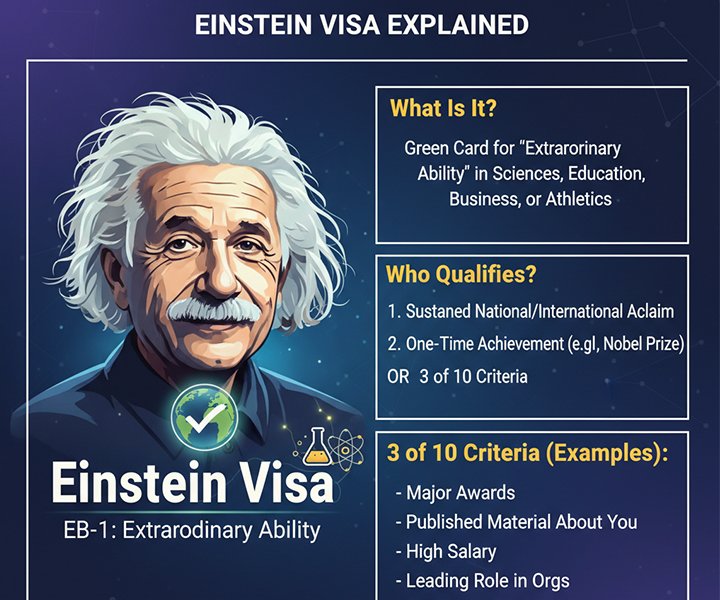
The EB-1 visa is officially known as the Employment-Based First Preference Green Card. It has earned the nickname “Einstein visa” because it is designed for individuals with extraordinary ability—people whose talent and work have placed them at the very top of their fields.
Unlike many other US immigration routes, the EB-1 stands out because:
- It is a direct pathway to permanent residency (green card).
- It often does not require employer sponsorship, especially under the extraordinary ability category.
- It is faster compared to other employment-based visas like the EB-2 or EB-3, which often involve long waiting lists.
The EB-1 is not about being rich, famous, or well-connected—it’s about proving global excellence and recognition.
EB-1 Visa Categories: Who Can Apply?
The EB-1 isn’t a one-size-fits-all visa. It has three subcategories, each tailored to different types of applicants.
1. Individuals of Extraordinary Ability (EB-1A)
This is the most well-known EB-1 route and the only one that allows self-petitioning. That means you don’t need a US employer to sponsor you—you can apply on your own.
To qualify, you must show sustained national or international acclaim in science, business, arts, education, or athletics.
There are two ways to qualify:
- Win a major international award (think Nobel Prize, Olympic medal, Academy Award).
- Or meet at least 3 out of 10 USCIS criteria, which include:
- Featured in major media outlets.
- Membership in exclusive associations based on merit.
- Original contributions of major significance.
- Academic publications.
- High salary compared to peers.
- Judging the work of others.
- Commercial success in performing arts.
⚠️ But here’s the key: it’s not just about checking boxes—it’s about proving genuine, consistent excellence.
2. Outstanding Professors and Researchers (EB-1B)
This category is for top academics who have:
- International recognition in their field.
- At least three years of experience in teaching or research.
- A job offer from a US university or research institution (must be permanent or tenure-track).
In this case, the employer sponsors the petition by filing Form I-140 on the applicant’s behalf.
3. Multinational Managers and Executives (EB-1C)
This category is designed for corporate leaders who:
- Have worked for a qualifying multinational company for at least one year in the last three years.
- Are being transferred to a US branch in an executive or managerial role.
- Can prove the company’s financial and operational health.
Employer sponsorship is required here as well.
Why Is the EB-1 Suddenly So Popular?
The EB-1 visa has existed for decades, but its popularity has skyrocketed in recent years. Why?
- Frustration with the H-1B visa
The H-1B is capped, lottery-based, and temporary. Even those selected often face long green card backlogs. For many Indian and Chinese applicants, the wait can stretch over a decade. - The promise of speed
The EB-1 is seen as a “fast-track” to the green card, especially compared to EB-2 and EB-3 categories. - Social media hype
Immigration consultants and agents market it as a golden ticket. Instagram reels, YouTube videos, and LinkedIn posts sell the idea that almost anyone can “upgrade their profile” to qualify. - Global talent wars
The US wants to attract the world’s best. At the same time, countries like Canada, Australia, and Germany are also opening doors for skilled immigrants. The EB-1 fits into America’s strategy to remain competitive.
The Pitfalls of “Manufactured Excellence”
Here’s where things get tricky.
With rising demand, a parallel industry of “profile-building” services has sprung up. These services promise to:
- Publish your name in journals (sometimes obscure or irrelevant ones).
- Secure speaking roles at little-known conferences.
- Arrange ghostwritten academic papers.
- Pay for awards or memberships that sound prestigious but aren’t.
On paper, this might make you look like a rising star. But in reality, USCIS officers are trained to detect embellishment and fraud.
They will:
- Verify publications and citations.
- Investigate whether associations are genuinely merit-based.
- Check the legitimacy of conferences and awards.
If they find inconsistencies or deception, the consequences are severe:
- Immediate rejection of your application.
- Possible ban from entering the US for misrepresentation.
- Permanent damage to your immigration record.
EB-1 vs H-1B: Why People Confuse Them
Many professionals compare the EB-1 with the H-1B, but the two are very different:
| Aspect | EB-1 Visa | H-1B Visa |
|---|---|---|
| Type | Green card (permanent residency) | Work visa (temporary, 3–6 years) |
| Employer sponsorship | Not always required (EB-1A is self-petition) | Always required |
| Selection process | Merit-based | Lottery-based (random) |
| Waiting time | Shorter (if approved) | Often long, plus green card backlog |
| Flexibility | Freedom to work anywhere (once green card issued) | Restricted to sponsoring employer |
This is why many skilled workers stuck in the H-1B backlog see the EB-1 as a more attractive option.
Who Actually Qualifies for EB-1?
This is the million-dollar question. While agents may make it sound easy, the truth is:
- The EB-1 is for the top 1–2% in any field.
- It requires proof of impact, not just participation.
- Real candidates include:
- Researchers with widely cited publications.
- Tech founders with patents or industry recognition.
- Athletes competing at global levels.
- Artists or performers with international acclaim.
A genuine EB-1 profile doesn’t need artificial boosting—the achievements speak for themselves.
What If You Don’t Qualify for EB-1?
Not everyone fits into the EB-1 category, and that’s okay. The US offers multiple immigration routes:
- EB-2 NIW (National Interest Waiver): For professionals whose work benefits the US, even without employer sponsorship.
- H-1B visa: Still viable for skilled workers, despite challenges.
- Student visas (F-1): Often the starting point for many future EB-1 or EB-2 applicants.
- O-1 visa: A temporary visa for individuals with extraordinary ability (sometimes a stepping stone to EB-1).
Each of these pathways has its own requirements, timelines, and opportunities.
Final Thoughts: The Einstein Visa Is Prestigious, Not Magical
The EB-1 visa is one of the most powerful US immigration options. It offers:
- A direct route to a green card.
- Freedom from lottery systems and temporary work limits.
- Recognition for the world’s brightest and best.
But here’s the truth:
👉 The EB-1 is not a shortcut.
👉 It cannot be bought with fake prestige.
👉 It is reserved for those who have earned international recognition.
For the truly exceptional—be it a groundbreaking scientist, a global entrepreneur, or a celebrated artist—the EB-1 can be life-changing.
For everyone else, it’s better to explore legitimate alternatives than risk everything on manufactured claims.
Exceptional talent is earned, not engineered. And the US immigration system is designed to tell the difference.