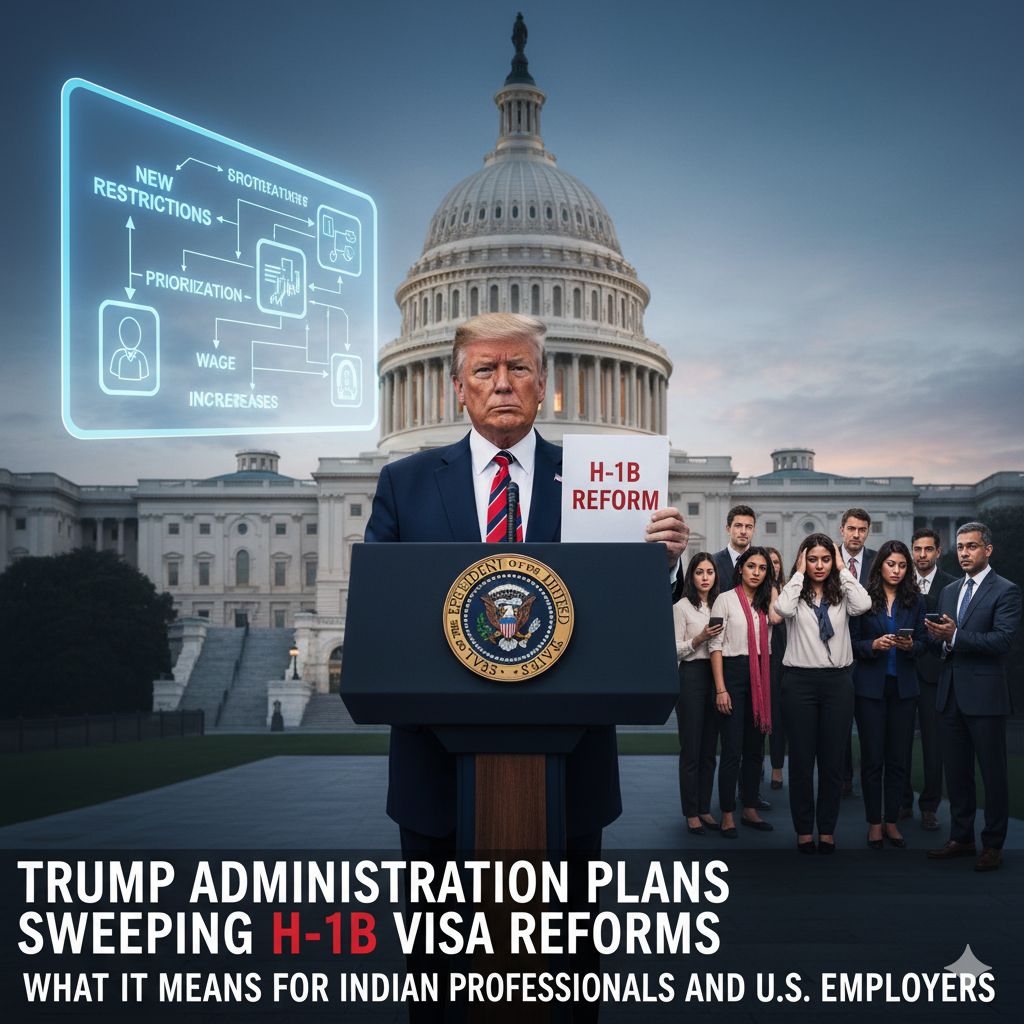
The Trump administration is preparing another major shake-up of the H-1B visa program, and the changes on the horizon could have long-lasting consequences for both U.S. businesses and skilled foreign workers—particularly Indians, who make up the majority of H-1B recipients. According to the Department of Homeland Security’s (DHS) regulatory agenda, new rules expected by December 2025 will tighten eligibility criteria, redefine exemptions, and impose stricter compliance checks on employers.
This development comes at a time when the U.S. continues to face a growing shortage of STEM professionals, while countries like Canada, Australia, and Germany are actively rolling out red-carpet immigration policies to attract the very talent the U.S. risks shutting out.
So what exactly is changing, why now, and how will it impact Indian professionals, U.S. tech companies, and global competitiveness? Let’s break it down.
A Quick Refresher: What Is the H-1B Visa?
The H-1B visa allows U.S. employers to hire foreign workers in specialty occupations—roles that typically require advanced knowledge in fields like IT, engineering, mathematics, or medicine.
- Each year, the U.S. allocates 85,000 H-1B visas under the annual “cap.”
- Of these, 65,000 are available to general applicants, while 20,000 are reserved for individuals holding advanced degrees from U.S. institutions.
- Certain organizations—such as universities, nonprofit research institutions, and government research agencies—are exempt from this cap, making them an attractive route for professionals who want to bypass the lottery system.
For years, the program has been a cornerstone of U.S. innovation, fueling the success of Silicon Valley and supporting critical sectors like healthcare and scientific research. But it has also been politically controversial, with critics arguing it displaces American workers, while supporters point out it fills gaps in a workforce that simply doesn’t have enough home-grown talent in key areas.
What the Trump Administration Wants to Change
The new proposal highlights three major reform areas:
1. Redefining Cap-Exempt Categories
Currently, jobs at higher education institutions, nonprofit research groups, and government research entities are exempt from the annual H-1B cap. Workers already counted under the cap—such as those seeking to extend their stay or change employers—are also not subject to the lottery again.
The Trump administration’s proposed rule aims to narrow the definition of who qualifies as cap-exempt. This could reduce opportunities for foreign workers in universities and research labs, sectors that heavily rely on international talent to sustain programs and research output.
2. Stricter Rules on Third-Party Placements
Under the earlier Trump term, USCIS required consulting and staffing firms that placed H-1B employees at client sites to submit detailed contracts and itineraries. Employers had to prove that a “specialty occupation” job would exist for the entire duration of the H-1B request.
This often led to approvals for shorter terms—sometimes just a few months—if USCIS felt the contract didn’t guarantee three years of work. Many companies faced heavy scrutiny under the “employer-employee relationship” test, which examined whether the staffing firm or the client truly controlled the worker’s day-to-day duties.
Although a district court later struck down parts of this policy, and USCIS eventually rescinded the memo, the Trump administration is now signaling it will codify these restrictions into formal regulation—making them harder to challenge in court.
3. Wage-Based Selection in the H-1B Lottery
Another upcoming reform could fundamentally alter how H-1B visas are allocated. Instead of the current random lottery system, the DHS has floated a wage-based selection process. This would prioritize workers offered higher salaries, as determined by the Department of Labor’s Occupational Employment and Wage Statistics (OEWS).
This system would give experienced, higher-paid professionals an edge over new graduates and entry-level workers, including those who studied in U.S. universities. While this may benefit large corporations offering high salaries, it could significantly disadvantage fresh graduates who often rely on H-1Bs as their first pathway to U.S. employment.
Why This Matters to Indians
Indians have long been the largest beneficiaries of the H-1B program. In fiscal year 2023 alone:
- Indians received 68,825 new H-1B visas, making up 58% of the total issued.
- They also accounted for 210,000 H-1B extensions (79% of all renewals).
- By contrast, China—the second largest source—received only 16,094 new visas and about 29,250 extensions.
This dominance means that any tightening of rules will disproportionately affect Indian professionals.
Potential Impacts for Indians:
- Fewer Opportunities in Universities & Research: Narrowing exemptions could make it harder for Indian researchers and PhD students to stay and work in U.S. institutions.
- Greater Barriers for IT Consultants: Indian IT staffing firms, which rely on third-party placements, may face higher rejection rates and shorter visa approval terms.
- Reduced Chances for Fresh Graduates: Wage-based selection would favor mid-career professionals, putting Indian students graduating from U.S. universities at a disadvantage.
How U.S. Employers Could Be Affected
It’s not just foreign workers who will feel the pinch. U.S. companies—especially in technology, healthcare, and research—rely heavily on the H-1B program to fill roles that cannot be met with domestic supply.
- Tech Firms: Companies like Google, Amazon, Microsoft, and startups in Silicon Valley depend on highly skilled Indian engineers to fuel innovation.
- Healthcare: Hospitals, particularly in underserved areas, hire foreign doctors and medical researchers through H-1Bs.
- Research Institutions: University labs often depend on international PhDs to sustain their research output.
By tightening rules, the U.S. risks creating talent bottlenecks, leading firms to move more operations overseas where hiring policies are more flexible.
Economic Consequences: A Double-Edged Sword
The Trump administration frames these reforms as a way to “protect American jobs.” But economists argue the opposite could happen.
- Skilled immigrants complement, not replace, U.S. workers. They bring in niche expertise and help grow companies, which in turn creates more jobs for Americans.
- Immigrant founders drive innovation. Many U.S. startups—including some of the biggest tech unicorns—were founded or co-founded by Indian H-1B visa holders.
- Revenue impact: H-1B professionals contribute billions in taxes each year. Restricting their entry means lost revenue for the U.S. government.
Without this steady pipeline of talent, companies may increasingly look to Canada, Europe, or Asia to expand operations—taking innovation and investment dollars out of the U.S. economy.
Policy Confusion: Mixing Trade and Immigration
Another concern is how immigration policy is being tied to trade negotiations. Reports suggest that U.S.-India trade talks could include discussions around visa allocations. However, immigration and trade are managed by different agencies and serve different objectives.
Mixing the two creates confusion for businesses, universities, and families who depend on predictable immigration pathways. It also sends a negative message to global partners, portraying skilled immigration as a bargaining chip rather than a strategic advantage.
The Bigger Picture: Global Competition for Talent
The U.S. is not “full.” In fact, it is in a global race for talent. Countries like Canada, Germany, and Australia are aggressively simplifying work visas, offering permanent residency pathways, and actively marketing themselves to international students.
If the U.S. tightens its doors, the world’s brightest minds—many of them Indian—will simply choose other destinations where their skills are welcomed. Over time, this could weaken America’s competitive edge in tech, research, and healthcare.
What Happens Next?
The proposed rule is expected to be published in December 2025, after which it will go through a period of public comment. Businesses, universities, and immigrant advocacy groups will likely push back strongly against the changes.
However, if finalized, the reforms could mark one of the most significant overhauls of the H-1B program in decades. For Indian professionals, it means planning career paths more carefully, considering alternative countries, and staying updated on shifting regulations. For U.S. employers, it means bracing for talent shortages and reassessing global hiring strategies.
Conclusion: A Turning Point for H-1B Visas
The Trump administration’s proposed H-1B reforms represent more than just bureaucratic changes—they reflect a shift in how America views skilled immigration.
By narrowing cap exemptions, restricting third-party placements, and moving toward wage-based selection, the U.S. could make it significantly harder for Indians—its largest pool of skilled workers—to access opportunities.
While the reforms may score political points with protectionist audiences, they risk undermining America’s innovation economy at a time when global competition for talent is fiercer than ever.
The reality is clear: the U.S. does not suffer from an oversupply of skilled workers; it suffers from a shortage. And in trying to close the door on Indian professionals, it may end up shutting itself out of the future.