
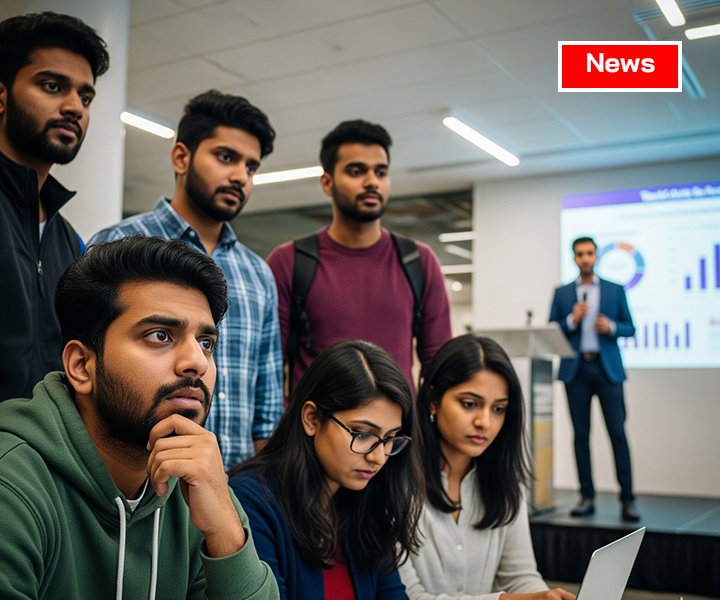
Every year, hundreds of thousands of Indian students flock to American universities with the dream of earning a degree and eventually securing a job in the United States. But for many, that dream may now be slipping further away.
In a recent post, tech influencer Deedy Das painted a grim picture of the current job market, warning that the majority of Indian Master’s graduates in the US will likely struggle to secure employment in 2025. His insights have sparked concern among students and families who see the US as a land of opportunity.
A Surge in Indian Master’s Students
Over the past five years, the number of Indian students pursuing a Master’s degree in the US has tripled—reaching nearly 300,000 today. This surge represents about 81% of all Indian students in America and marks a significant jump compared to pre-pandemic levels.
Das highlighted that 150,000 to 200,000 students are expected to graduate this year alone, most of whom will immediately begin their job hunt. Many of them are relying on student loans to finance their education, making post-graduation employment a crucial lifeline.
According to official data:
- An ICE report (June 2024) confirmed that 422,335 Indian students were actively enrolled in US institutions.
- The Open Doors report (November 2024) revealed that, for the first time in 15 years, Indians surpassed Chinese students as the largest international student group in the US.
‘Not Enough Jobs to Go Around’
Despite the impressive growth in numbers, Das warned that the job market cannot keep pace with the influx of new graduates. He pointed to four major challenges facing Indian students in 2025:
- Oversupply of talent – Around 70% of Indian Master’s students are enrolled in Computer Science and Engineering, saturating the tech talent pool.
- Shrinking opportunities in Big Tech – Hiring freezes continue, with giants like Microsoft employing only about 100,000 engineers globally. Demand simply doesn’t match the supply.
- Fresh graduates hit hardest – Those with 0–2 years of experience are facing the brunt of the slowdown.
- Immigration barriers – Visa restrictions are making it even harder to transition from student to working professional.
Das summed it up bluntly: “There are simply not enough tech jobs to meet this demand. BigTech hiring has still not recovered, and trends show that new graduates are the worst affected.”
Immigration Hurdles Add to the Challenge
Adding to the employment crunch, the US government under President Donald Trump has introduced tougher visa regulations that disproportionately affect international students. Key changes include:
- H-1B wage-based system: Fewer jobs will qualify, reducing opportunities for fresh graduates.
- Four-year F-1 visa cap: Limits flexibility, making it harder to switch courses or universities.
- Stricter OPT rules: Optional Practical Training (OPT) grace periods are tighter, leaving less time to find work.
- Day 1 CPT restrictions: Students may no longer be able to extend their stay beyond three years of OPT without winning the H-1B lottery.
Das cautioned that under the current administration, visa hurdles are only expected to get tougher.
What This Means for Indian Students
For the nearly 200,000 Indian students graduating in 2025, the road ahead looks uncertain. While the US remains a top study-abroad destination, the traditional pathway of study → graduate → get a job → stay on H-1B is becoming less reliable.
With rising tuition fees, heavy student loans, and uncertain career prospects, families and students may need to rethink their approach—exploring alternative countries, diversifying career plans, or preparing for the possibility of returning to India after graduation.
Final Thoughts
The US has long been seen as the ultimate destination for education, innovation, and career growth. But with job markets tightening and immigration rules growing stricter, the dream is becoming harder to achieve for many Indian Master’s students.
As Das warned, “Education is becoming an unviable path to the US.” For aspiring students, it’s now more important than ever to weigh the risks, plan finances carefully, and explore backup options before making the leap.