
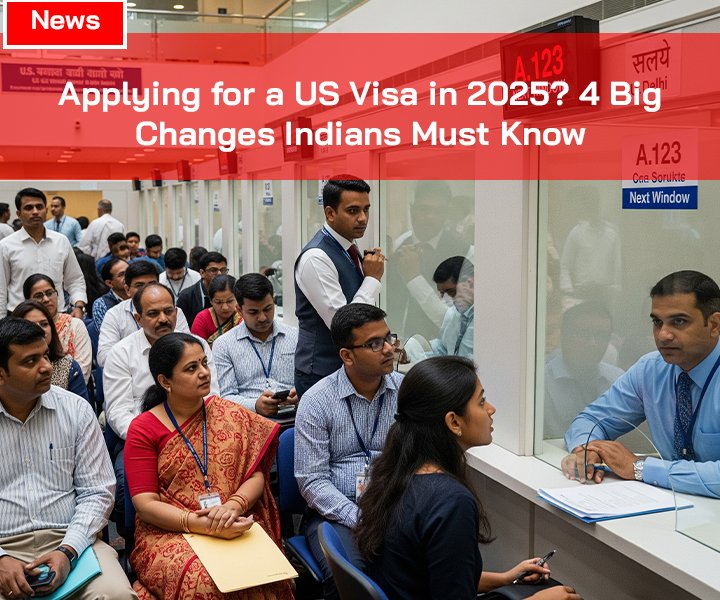
If you’re planning to visit the United States this year—whether as a student, professional, or tourist—you should be aware of some important visa rule changes. Starting mid-2025, the US government has introduced a set of new requirements that will affect Indian applicants. Some rules are already in place, while others will roll out between August and October 2025.
From tougher digital checks to new fees, here are the four key updates you need to know before applying for a US visa.
1. New Social Media Rules for Student Visa Applicants (From 23 June 2025)
Indian students applying for an F, M, or J visa must now make their social media accounts public. US consular officers will review applicants’ online presence as part of their background check.
Along with this, students must list all usernames and handles used over the past five years on the DS-160 visa application form.
What consular officers will look for:
- Posts or affiliations that could raise national security concerns
- Support for extremist or terrorist groups
- Violent, antisemitic, or threatening content
- Membership in suspicious online groups
Important:
- Don’t delete or deactivate accounts right before applying—it may raise suspicion.
- Keep usernames consistent across platforms to avoid confusion.
- Avoid posting content that may be seen as inflammatory or politically sensitive.
This change signals a clear increase in digital vetting for students and exchange visitors heading to the US.
2. Introduction of $250 “Visa Integrity Fee” (From 1 October 2025)
Beginning October, most Indian applicants will need to pay a new $250 (₹21,539) “visa integrity fee.”
This fee applies to travelers from countries not included in the US Visa Waiver Program—including India.
Who needs to pay?
- Students: F-1, F-2
- Exchange visitors: J-1, J-2
- Temporary workers: H-1B, H-4
- Tourists & business travelers: B1, B2
The fee is in addition to existing charges such as the MRV (machine-readable visa) fee, reciprocity fees, and fraud prevention fees.
Impact on costs for Indians:
- Student and work visa applicants: Around $473 (₹40,785) in total fees
- Tourist visa applicants (B1/B2): Around $425 (₹36,690)
A potential silver lining: the Department of Homeland Security has hinted that travelers who comply with visa rules (leave the US on time or extend/change status lawfully) may be eligible for partial reimbursement.
3. Stricter Visa Interview Waivers (From 2 September 2025)
The interview waiver program—which allowed many applicants to skip in-person interviews—will now be more limited.
What’s changing?
- Only certain renewals of B1, B2, or B1/B2 visas (business/tourism/medical travel) may qualify.
- Conditions for waiver eligibility:
- Must apply in home country (India for Indian nationals)
- No prior visa refusals (unless overturned)
- No potential ineligibility concerns
Even if you qualify, a consular officer can still call you for an interview. This shift is part of the “One Big Beautiful Bill Act”—bringing visa scrutiny back to pre-pandemic levels.
What this means for Indians:
Expect longer processing times and be prepared for an in-person interview, even for renewals.
4. Mandatory In-Person Passport Collection in India (From August 2025)
The US Embassy in New Delhi has ended third-party passport collection. This means applicants must now collect their passports in person from the embassy or consulate.
Exceptions:
- For applicants under 18, a parent/legal guardian can collect on their behalf.
- Parents must provide an original consent letter signed by both parents.
- Scanned or emailed copies will not be accepted.
For convenience, the embassy now offers a paid delivery option:
- ₹1,200 per applicant for home/office courier delivery.
Final Thoughts
The US visa process in 2025 is getting stricter, costlier, and more paperwork-heavy. To recap:
- Students must open up their social media accounts for vetting.
- All applicants (including Indians) will pay a new $250 integrity fee from October.
- Fewer applicants will qualify for interview waivers, so be prepared to appear in person.
- Indian applicants must collect passports themselves unless they pay for courier delivery.
If you’re planning to apply for a US visa in the coming months, make sure to prepare early, budget for extra fees, and stay updated on embassy guidelines.