
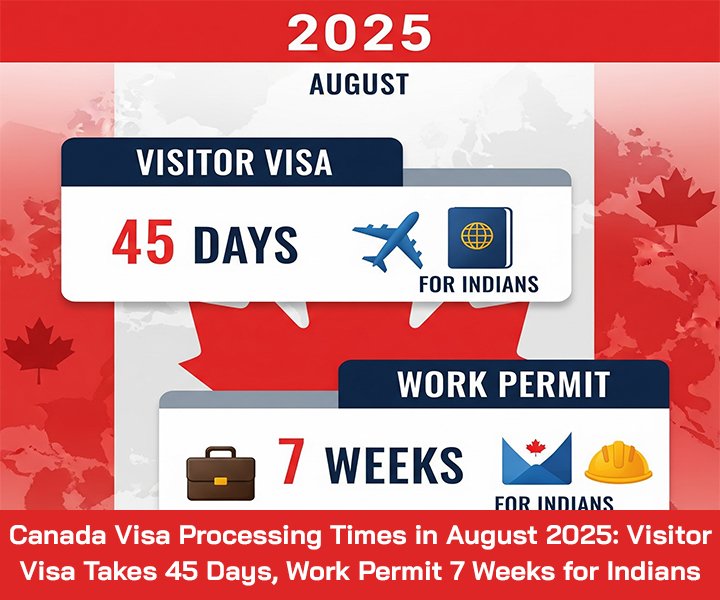
Planning to visit, work, or settle in Canada? If you’re applying from India, you may need to wait a bit longer. According to the latest update from Immigration, Refugees and Citizenship Canada (IRCC), a visitor visa currently takes around 45 days, while a work permit takes just over seven weeks.
These timelines are based on how long it takes to process 80% of applications and serve as a guide for students, workers, families, and entrepreneurs preparing to move to Canada. However, IRCC warns that delays can occur due to incomplete applications, increased demand, or additional security checks.
Why Processing Times Differ by Country
Processing times vary depending on:
- 1. Volume of applications received by Canadian visa offices
- 2. Verification requirements for specific cases
- 3. Capacity and workload of regional offices
Applicants from high-demand countries such as India and Pakistan often face longer processing times compared to those from the U.S. or the Philippines.
Canada Citizenship Application Timelines (August 2025)
IRCC updates citizenship processing estimates monthly:
- 1. Citizenship grant: 10 months (no change)
- 2. Citizenship certificate (proof): 5 months (no change)
- 3. Renunciation of citizenship: 5 months (reduced by 2 months)
- 4. Search of records: 14 months (reduced by 1 month)
Permanent Residency (PR) Cards
Processing times for PR cards, essential for international travel, are updated weekly:
- 1. New PR card: 36 days (1 day faster)
- 2. PR card renewal: 31 days (1 day slower)
IRCC strongly recommends applying well in advance of any travel plans.
Family Sponsorship Processing Times
Processing times vary significantly across Canada, with Quebec applications taking longer due to extra provincial requirements:
- 1. Spouse/common-law (outside Canada, non-Quebec): 13 months (+2 months)
- 2. Spouse/common-law (outside Canada, Quebec): 41 months (+3 months)
- 3. Spouse/common-law (inside Canada, non-Quebec): 36 months (+2 months)
- 4. Spouse/common-law (inside Canada, Quebec): 40 months (+2 months)
- 5. Parents/Grandparents PR (non-Quebec): 36 months (no change)
- 6. Parents/Grandparents PR (Quebec): 48 months (no change)
Economic Class Permanent Residency Applications
IRCC updates economic immigration timelines monthly:
- 1. Canadian Experience Class (CEC): 5 months (no change)
- 2. Federal Skilled Worker Program (FSWP): 7 months (no change)
- 3. Provincial Nominee Program (Express Entry): 8 months (no change)
- 4. Non-Express Entry PNP: 20 months (+1 month)
- 5. Quebec Skilled Worker Program: 9 months (no change)
- 6. Federal Self-Employed Program: 60 months (+2 months)
- 7. Start-Up Visa: 52 months (+1 month)
Canada Study Permit Processing Times (August 2025)
Processing times for study permits vary by country:
- 1. India: 3 weeks (no change)
- 2. United States: 9 weeks (+2 weeks)
- 3. Nigeria: 5 weeks (no change)
- 4. Pakistan: 9 weeks (no change)
- 5. Philippines: 7 weeks (-1 week)
- 6. Inside Canada: 6 weeks (-1 week)
Note: Study permit extensions inside Canada are taking 172 days on average.
Canada Work Permit Processing Times (August 2025)
For work permits filed outside Canada:
- 1. India: 7 weeks (no change)
- 2. U.S.: 3 weeks (no change)
- 3. Nigeria: 9 weeks (+1 week)
- 4. Pakistan: 7 weeks (-1 week)
- 5. Philippines: 5 weeks (no change)
Inside Canada (including extensions): About 185 days.
Other Temporary Visas
- 1. Seasonal Agricultural Worker Program: 45 days (+4 days)
- 2. International Experience Canada: 5 weeks (no change)
- 3. Electronic Travel Authorization (eTA): 5 minutes to 72 hours (no change)
IRCC Processing Time Updates
- Temporary visas & PR cards: Updated weekly
- Permanent residency & citizenship applications: Updated monthly
Final Advice: Apply Early & Stay Updated
Whether you’re applying for a Canada visitor visa, work permit, study permit, or permanent residency, start early and submit complete documentation to avoid delays.
Keep checking IRCC’s official processing time tool for real-time updates.
With Canada remaining a top destination for students, skilled workers, and families, understanding these timelines will help you plan your move better in 2025.