
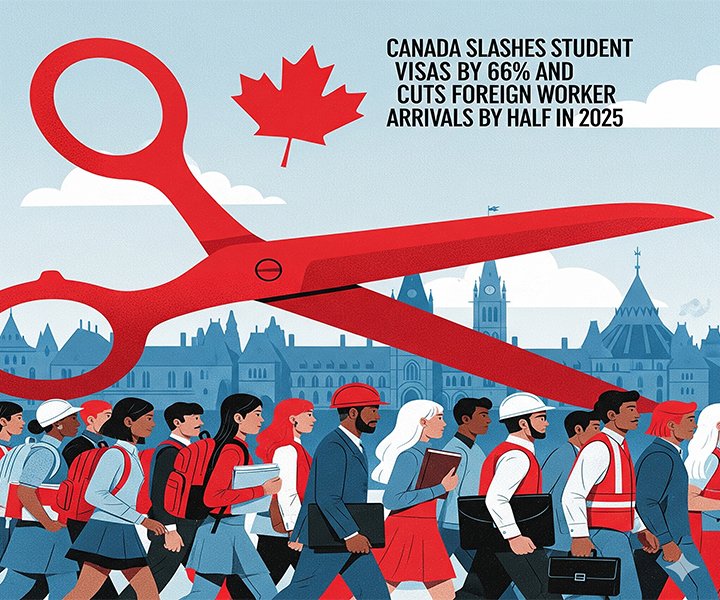
Canada’s immigration landscape is undergoing one of its most dramatic shifts in years. According to newly released data from Immigration, Refugees and Citizenship Canada (IRCC), the country has significantly reduced the intake of international students and temporary foreign workers in 2024 and the first half of 2025.
Between January and June 2025, new study permit approvals dropped by 66% compared to the same period last year. Only 4,185 new study permits were issued in June 2025, marking a sharp decline of 88,617 fewer international students than in 2024.
Why Canada Is Reducing International Students and Workers
In an update released on Monday, IRCC stated:
“Through the 2025–2027 Immigration Levels Plan, we’re making our immigration system more responsive to the needs of the country. This includes reducing the number of students and temporary workers coming to Canada to help ease pressures on housing, infrastructure, and services. We have committed to returning immigration to sustainable levels, including reducing Canada’s temporary population to less than 5 per cent.”
This policy shift is driven by rising housing costs, strained infrastructure, and a growing temporary population, which policymakers argue is unsustainable in the long term.
A Steep Drop in Study Permits
Canada’s international education sector has been hit hard by these changes:
- In 2024, Canada issued just 267,890 new study permits, nearly 100,000 below IRCC’s target and 48% lower than 2023.
- A national cap on international students was introduced in 2024 and tightened by another 10% in 2025.
- As of June 30, 2025, 546,562 people held only a study permit, while another 312,010 held both study and work permits.
Key Policy Changes Impacting International Students:
- Annual cap on study permits, reduced further in 2025
- Stricter verification of acceptance letters to combat fraud
- Higher financial requirements for student visa applicants
- Closure of the Student Direct Stream (SDS), a previously fast-track option
Temporary Foreign Worker Arrivals Cut by Half
The crackdown isn’t limited to students. Temporary foreign worker entries dropped 51% in the first half of 2025 compared to the same period last year, with just 24,058 new workers arriving in June 2025.
Key Measures Targeting Temporary Workers:
- 10% cap on low-wage hires per workplace (20% allowed in select high-demand sectors)
- Refusal-to-process applications in urban areas with unemployment rates at or above 6%
- Tighter rules for Post-Graduation Work Permit (PGWP) eligibility
- Restrictions on work permits for spouses of temporary residents
As of June 30, 2025, 1,504,573 individuals held only a work permit in Canada.
More Pathways to Permanent Residency Despite Declines
While fewer newcomers are entering, Canada is increasing opportunities for those already in the country to transition to permanent status.
From January to June 2025, over 100,000 temporary residents became permanent residents, making up half of all new PRs during this period.
Most of these individuals were:
- Graduates of Canadian institutions
- Skilled workers with Canadian work experience
- Selected through economic immigration pathways, including Express Entry and the Provincial Nominee Programme (PNP)
What This Means for Prospective Students and Workers
These changes mark a major turning point in Canada’s immigration policy, shifting focus from mass temporary migration to long-term, sustainable immigration.
For international students, this means:
- Fewer study permits available and tougher application requirements
- Higher financial thresholds to prove eligibility
- Limited post-study work options unless enrolled in eligible programs
For temporary foreign workers, expect:
- Stricter caps on job opportunities
- Fewer open work permits for family members
- Greater competition for PR pathways within Canada
Final Thoughts
Canada’s reputation as a welcoming destination for international students and workers is undergoing a profound transformation. With fewer permits, higher costs, and stricter eligibility, planning ahead has never been more critical.
If you’re considering studying or working in Canada, early preparation, stronger applications, and exploring permanent residency options from the start will be essential in 2025 and beyond.