


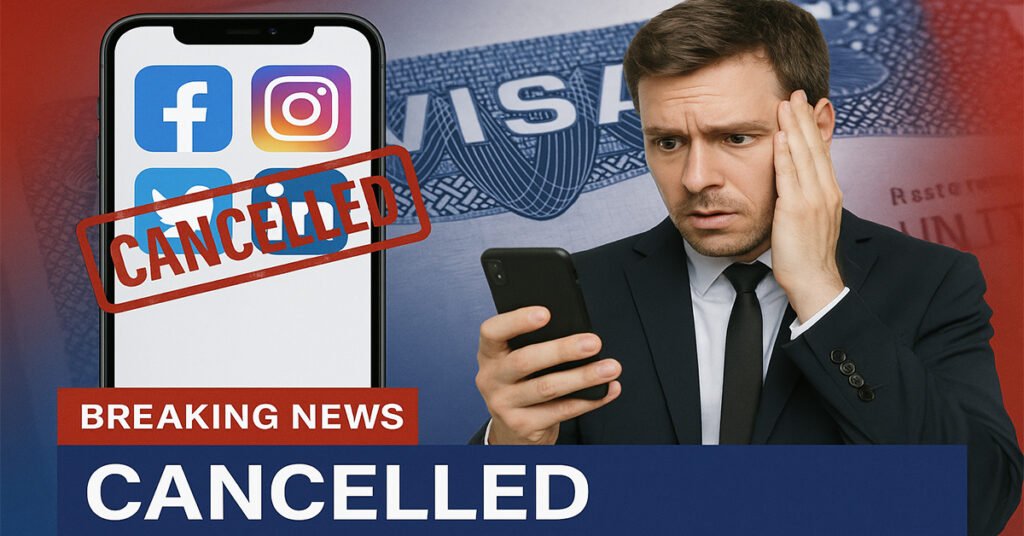
Hundreds of H-1B and H-4 visa applicants are facing unexpected appointment cancellations as the United States implements sweeping social media vetting requirements starting December 15, 2025. This comprehensive guide explains the new policy, its impact on applicants, and crucial steps to protect your visa application.
Breaking News: Mass Appointment Cancellations Hit Visa Applicants
The US State Department’s expansion of online presence screening to H-1B skilled workers and H-4 dependents has triggered widespread disruption at consulates worldwide, particularly in India. Applicants who had December appointments are now being rescheduled to March 2026 or later, creating chaos for workers, families, and employers.
What’s Happening Right Now
Immediate Impact:
- Hundreds of visa appointments originally scheduled for mid-to-late December 2025 are being cancelled
- Applicants receiving new dates 3-4 months later (March 2026)
- US consulates reducing daily interview capacity to accommodate new vetting procedures
- Application Service Center (ASC) biometric appointments remain unchanged, but interview portions are being rescheduled
Timeline of Events:
- December 3, 2025: State Department announces expanded social media vetting
- December 9, 2025: Mass cancellation emails begin reaching applicants
- December 15, 2025: New vetting policy officially takes effect
- March 2026: Earliest rescheduled appointments for many applicants
Understanding the New Social Media Vetting Policy
The US Department of State announced on December 3, 2025, that all H-1B and H-4 visa applicants will undergo mandatory “online presence review” starting December 15. This represents the first expansion of social media screening beyond student and exchange visitor categories.
Key Requirements for All Applicants
Mandatory Actions:
- Make all social media profiles public – No private accounts allowed during application period
- Disclose all social media accounts – Used in the last 5 years, including deleted or deactivated ones
- Provide usernames and handles – For every platform with platform URLs
- Submit to comprehensive digital review – Consular officers will examine your entire online footprint
Covered Platforms Include:
- Facebook, Instagram, X (Twitter)
- LinkedIn, YouTube, TikTok
- Reddit, WhatsApp, WeChat
- Professional forums and niche networks
- Any platform where you maintain a public or private profile
Important: Passwords are NOT required, but all content must be publicly viewable.
What Consular Officers Are Looking For
Based on official State Department guidance and immigration attorney analyses, consular officers will scrutinize social media for:
Red Flag Content:
- Hostility toward the United States – Criticism of US citizens, culture, government, institutions, or founding principles
- National security concerns – Support for designated terrorist organizations or entities threatening US interests
- Anti-American activity – Content perceived as undermining American values or interests
- Antisemitic content – Posts promoting or engaging in unlawful antisemitic harassment or violence
- Political activism – History of activism and likelihood of continuing such activity in the US
- Employment inconsistencies – Discrepancies between social media and application information
- Censorship involvement – Responsibility for or complicity in censoring US citizens (especially relevant for H-1B)
- False information spread – Content deemed to spread misinformation for political or other reasons
Official State Department Position
The State Department has emphasized that “every visa adjudication is a national security decision” and that “a U.S. visa is a privilege, not a right.” Officials stated they must ensure applicants do not intend to harm Americans or national interests and credibly establish eligibility for their visa category.
Why Appointments Are Being Cancelled
Immigration attorney James Hollis explained the operational reasons behind the cancellations. Consular officials expect to interview fewer H-1B and H-4 applicants per day once the new checks begin, and are cancelling upcoming interviews to match the anticipated pace of the revised workflow.
The Perfect Storm of Bad Timing
The policy rollout overlaps with:
- Holiday travel season – When many Indian professionals travel home for visa stamping
- Year-end business cycles – Critical period for companies bringing new employees onboard
- Pre-scheduled travel plans – Applicants with flights, accommodations, and employment start dates already arranged
- Family reunification plans – H-4 dependents separated from primary H-1B holders
Geographic Impact
Consulates most affected by cancellations:
- New Delhi, India – Largest volume of cancellations reported
- Chennai, India – Significant rescheduling activity
- Hyderabad, India – Multiple weeks of appointments affected
- Mumbai, India – Extended wait times for new slots
Other countries with H-1B processing may see similar patterns as the policy is implemented globally.
This Policy’s Broader Context: Trump Administration Immigration Crackdown
The social media vetting expansion is part of a comprehensive tightening of US immigration controls under the Trump administration’s second term.
Related Policy Changes in 2025
August 2025: US Citizenship and Immigration Services (USCIS) announced that “anti-American” activity would be heavily weighted against applicants for all immigration benefits, including visa extensions, green cards, and citizenship.
September 2025: President Trump issued a proclamation imposing a one-time $100,000 fee on new H-1B work visa petitions, significantly impacting cost structures for employers and foreign workers.
December 5, 2025: Employment Authorization Document (EAD) validity reduced from 5 years to 18 months for certain categories, including refugees and adjustment of status applicants.
2025 Overall: Over 80,000 nonimmigrant visas revoked during the year, including more than 8,000 student visas, as part of expanded enforcement.
Project Firewall and Enhanced Enforcement
The administration has launched “Project Firewall,” an enforcement initiative targeting employers alleged to sideline US workers in favor of H-1B holders. This has intensified scrutiny of the entire H-1B program even as Congress debates bills to expand the annual cap.
Impact on Indian Professionals and Tech Workers
Indian nationals constitute the largest group of H-1B visa recipients, making them disproportionately affected by the new requirements.
Statistical Reality
Indian H-1B Dominance:
- Over 70% of H-1B holders are from India and China
- Indian professionals in technology, medicine, engineering most impacted
- Thousands of families face separation due to H-4 dependent delays
AI consultant Anshuman Jha characterized the changes as “a major shift for global talent mobility,” noting the outsized impact on Indian workers who depend on the H-1B program for US employment opportunities.
Employer Concerns
US companies relying on H-1B talent face:
- Project delays – Key employees unable to return on schedule
- Increased costs – Additional legal fees, travel rebooking, temporary housing
- Talent retention risks – Skilled workers considering other countries with simpler processes
- Competitive disadvantage – Rivals in other nations face no such barriers
How to Prepare Your Social Media for Visa Vetting
If you’re applying for an H-1B or H-4 visa after December 15, 2025, take these steps immediately to protect your application.
Step 1: Conduct a Comprehensive Social Media Audit
Review Every Platform:
- Search your name on Google, Bing, and other search engines
- Check all accounts you’ve created in the past 5 years
- Review posts, comments, likes, shares, and group memberships
- Examine photos, videos, and tagged content
- Check private messages that might become public
Look for Problematic Content:
- Political statements about US government or officials
- Criticism of Trump administration or policies
- Comments on controversial social issues
- Participation in protest movements or activism
- Jokes or memes that could be misinterpreted
- Religious or cultural commentary that might seem extreme
- Any employment information inconsistent with your application
Step 2: Make All Profiles Public
Platform-Specific Instructions:
Instagram:
- Go to Settings → Privacy → Account Privacy
- Turn off “Private Account”
- Verify anyone can see your posts without following you
X (Twitter):
- Go to Settings → Privacy and Safety → Audience and Tagging
- Uncheck “Protect your Tweets”
- Ensure posts are visible to everyone
Facebook:
- Settings → Privacy → Posts
- Set “Who can see your future posts?” to Public
- Review individual posts for custom privacy settings
- Make profile information public
LinkedIn:
- Should already be public for professional networking
- Review all posts and activity
- Ensure employment history matches visa application exactly
TikTok, YouTube, Reddit:
- Adjust account settings to public
- Review all posted content
- Consider content discoverability settings
Step 3: Clean Up Questionable Content
What to Consider Removing or Editing:
- Political posts critical of US government
- Comments on controversial US policies
- Posts about protests or activism
- Content that could be seen as anti-American
- Memes or jokes about US politics or culture
- Religious or ideological content that might be misunderstood
- Employment or education claims inconsistent with application
CRITICAL WARNING: Do NOT delete accounts or falsify information. Lying about social media accounts constitutes immigration fraud and will result in visa denial and potential permanent bars to US entry.
Step 4: Ensure Consistency Across Platforms
Cross-Check Everything:
- Employment history – LinkedIn must match DS-160 and USCIS petition exactly
- Education credentials – Degrees, universities, graduation dates consistent
- Location history – Countries lived in match application
- Job titles and descriptions – No exaggerations or discrepancies
- Affiliations – Organizations, groups, clubs must be disclosed
- Travel history – Posts revealing undisclosed international travel
Common Inconsistencies That Trigger Denials:
- LinkedIn shows different job title than H-1B petition
- Facebook posts from locations not mentioned in travel history
- Instagram reveals business activities not disclosed in application
- X/Twitter shows political activism not mentioned in forms
Step 5: Be Strategic About Timing
Best Practices:
- Make profiles public at least 2-3 weeks before visa interview
- Complete audit and cleanup before changing settings
- Take screenshots of profile settings as proof of compliance
- Don’t post new content during application period
- Avoid controversial topics until visa is approved
What Happens During the Online Presence Review
Understanding the vetting process can help you prepare and respond appropriately.
The Review Process
Standard Procedure:
- Consular officer reviews DS-160 application
- Officer searches social media using provided usernames
- Officer examines posts, connections, and online activity
- Content compared against USCIS petition and other documents
- Security databases checked for flagged content or connections
- Officer makes preliminary admissibility determination
If Issues Are Found:
- Additional interview questions about specific posts or content
- Request for clarification on discrepancies
- Referral for Security Advisory Opinion (SAO)
- Administrative processing (221(g) hold)
- Potential visa denial under Section 214(b)
Processing Times Under New System
Expected Delays:
- Standard processing: 2-4 weeks longer than previous norms
- With SAO referral: 2-6 months additional processing
- Administrative processing: 60-180+ days possible
- Complex cases: 6-12 months not uncommon
Section 214(b) Denials on the Rise
Immigration attorneys report increasing H-1B visa refusals under Section 214(b), traditionally used for tourists who can’t prove they’ll return home. Now it’s being applied to H-1B applicants based on:
- Social media revealing credibility issues
- Inconsistencies in employment information
- Questions about prior status compliance
- Concerns from online presence review
Critical Issue: Section 214(b) denials require NO explanation, are NOT reviewable administratively or judicially, and reconsideration requests typically go back to the same officer who made the initial decision.
What to Do If Your Appointment Is Cancelled
Immediate Actions
- Check email carefully – Some posts report biometric appointments remain valid while interviews are rescheduled
- Don’t cancel ASC appointment – Unless specifically instructed by consulate
- Reschedule interview promptly – Slots fill up quickly; delay compounds the problem
- Notify your employer – They need to adjust onboarding plans and project timelines
- Review travel arrangements – Cancel/postpone flights and accommodations if needed
Important Rescheduling Rules
According to consulate guidance:
- One reschedule allowed – After your first appointment, you can only reschedule once more
- Receipt expiration – If you purchased your visa fee receipt more than one year ago, it has expired
- Expired receipts – Cannot be used to reschedule; fee must be paid again
- Missed appointments – Failing to attend rescheduled interview forfeits your fee receipt
Communication Strategy
With Your Employer:
- Provide immediate notification of cancellation
- Share new appointment date once scheduled
- Discuss remote work options if return is delayed
- Request support for additional costs (rebooking, housing, etc.)
With Consulate:
- Follow official instructions exactly
- Don’t attempt to contact consulate to expedite
- Prepare thoroughly for rescheduled appointment
- Bring additional documentation if requested
Legal and Professional Guidance
When to Consult an Immigration Attorney
Seek professional help if you:
- Have any arrest history (even if charges dropped)
- Posted political content critical of US government
- Participated in protests or activism
- Have inconsistencies between social media and application
- Previously overstayed a US visa
- Have connections to sensitive countries or organizations
- Work in sensitive industries (defense, surveillance, AI)
- Are uncertain about any aspect of social media content
What Attorneys Are Advising
Immigration lawyers recommend:
- Proactive review – Don’t wait until appointment is scheduled
- Documentation – Screenshot everything showing compliance
- Consistency – Ensure perfect alignment across all sources
- Transparency – Disclose issues upfront rather than hoping they won’t be found
- Preparation – Practice explaining any questionable content
- Alternative planning – Consider Canada, UK, or other destinations if US is too risky
Attorney Pamela Rangel noted the new policy adds “a new layer of complexity” to an already unpredictable H-1B stamping process, emphasizing the need for careful preparation.
Privacy Concerns and Criticisms
The expanded vetting requirements have drawn criticism from privacy advocates, immigration experts, and affected communities.
Privacy and Safety Risks
Concerns Raised:
- Family exposure – Children’s photos and personal milestones exposed to the open web
- Identity theft risks – Public profiles more vulnerable to scammers and hackers
- Harassment potential – Visible profiles attract trolls and bad actors
- Professional risks – Employers or competitors gaining access to private information
- Cultural sensitivity – Some cultures value privacy more highly than American norms
Particular Impact on Women: Female applicants express concern about safety risks from making personal information and photos publicly accessible globally.
Political and Civil Liberties Issues
First Amendment Concerns:
- Chilling effect on free speech for visa applicants
- Discouraging criticism of government policies
- Self-censorship to avoid jeopardizing applications
- Unclear standards for what constitutes “anti-American” content
Discrimination Risks:
- Subjective interpretation of political views
- Potential bias based on nationality, religion, or ethnicity
- Unequal application of vetting standards
- Lack of due process or appeal rights
Business Community Reaction
Corporate Concerns:
- Deterring top talent from accepting US positions
- Competitive disadvantage vs. countries with simpler processes
- Increased costs and administrative burden
- Project delays affecting bottom line
- Talent pipeline disruption
Technology companies particularly affected, as H-1B is crucial for filling software engineering, data science, and AI research positions where US citizen supply is limited.
Comparison: How Other Countries Handle Visa Social Media Vetting
United Kingdom:
- No mandatory social media disclosure for work visas
- Limited screening for security-sensitive cases only
- Faster processing times than US
Canada:
- No social media vetting for Express Entry or work permits
- Privacy respected unless security concerns arise
- Simpler, more straightforward process
Australia:
- Optional social media disclosure
- Character assessment doesn’t routinely include social media review
- Focus on criminal history and security checks
Germany:
- No social media requirements for EU Blue Card or work visas
- Data privacy laws protect applicants
- Streamlined skilled worker immigration
Singapore:
- No mandatory social media vetting
- Efficiency-focused immigration system
- Actively courting global talent
The United States now has among the most intrusive visa screening processes globally, particularly for employment-based immigration.
Long-Term Implications for US Competitiveness
Brain Drain Concerns
Potential Consequences:
- Top global talent choosing other destinations
- STEM workers avoiding US due to complexity and scrutiny
- Universities losing international researchers and postdocs
- Startups struggling to recruit technical talent
- Innovation ecosystem weakening relative to competitors
Economic Impact
Research institutions, tech companies, and healthcare systems depend heavily on H-1B workers:
- Technology sector: 70%+ of Silicon Valley engineers on H-1B or former H-1B holders
- Healthcare: Thousands of doctors in underserved areas on J-1 or H-1B
- Research: Over 60% of postdocs in US labs are international scholars
- Academia: Many STEM professors entered on student or work visas
Deterring this talent has measurable economic costs in lost innovation, unfilled positions, and competitive disadvantage.
Global Talent Competition
While the US erects barriers, competitor nations are:
- Canada: Expanding Express Entry and creating tech-specific immigration streams
- UK: Launching High Potential Individual visa and streamlining skilled worker routes
- Singapore: Aggressively recruiting tech talent with generous packages
- Germany: Simplifying Blue Card process and reducing barriers
- Australia: Increasing skilled migration intake and improving processing times
The question is whether the US can maintain its position as the preferred destination for global talent if the visa process becomes prohibitively difficult and invasive.
Frequently Asked Questions
Q: Do I need to make my profiles public if I don’t have a visa appointment yet? A: Once you create your DS-160 application, you should make profiles public. The requirement applies to all applicants after December 15, 2025, regardless of appointment date.
Q: What if I don’t have social media accounts? A: You won’t be penalized for not having social media, but you must not lie about accounts you do have. False statements constitute fraud and result in visa denial and potential permanent inadmissibility.
Q: Can I temporarily make my profiles public just for the visa interview? A: Yes, but they must be public before your interview and remain public throughout processing. Some attorneys recommend keeping them public for several weeks to ensure thorough review.
Q: What if someone else posted something offensive on my profile? A: You’re responsible for content on your accounts, including what others post. Review and remove problematic content before making profiles public. Use reporting features for harassing or offensive posts you can’t remove.
Q: Will consular officers really read through years of my posts? A: Officers use automated tools to scan for keywords and patterns, then manually review flagged content. They won’t read every post but will examine anything that raises concerns.
Q: Can I delete old posts or accounts? A: You can delete individual posts that are problematic, but you MUST disclose all accounts you’ve had in the past 5 years, including deleted ones. Failing to disclose accounts is fraud.
Q: What happens if my visa is denied based on social media? A: Most denials cite Section 214(b) without specific explanation. You can reapply, but the same issues will likely arise unless circumstances change. Consider consulting an immigration attorney.
Q: Does this apply to visa renewals or only new applications? A: The policy applies to ALL H-1B and H-4 visa applications and renewals processed after December 15, 2025. Even longtime visa holders must undergo social media vetting.
Q: What if I have work-related social media accounts? A: All accounts must be disclosed and made public, including professional accounts. Ensure professional accounts show information consistent with your H-1B petition.
Q: How long will processing take under the new system? A: Standard cases may see 2-4 weeks additional processing. Complex cases or those requiring security advisory opinions could take 2-6+ months.
Q: Can my employer help with this process? A: Employers can provide guidance, pay for immigration attorney consultations, and offer resources like professional social media audit services. Some are making this an employee benefit.
Q: What if I posted criticism of the US government years ago? A: Political speech is constitutionally protected for US citizens but can be grounds for visa denial for foreign nationals. Consult an immigration attorney about specific concerns.
Q: Are there any exemptions to this policy? A: No exemptions have been announced. All H-1B and H-4 applicants are subject to online presence review regardless of nationality, employer, or circumstances.
Taking Action: Your Step-by-Step Checklist
Before Your Application
- Conduct comprehensive audit of all social media accounts
- Search your name on Google, Bing, and other search engines
- Review and screenshot all profiles and content
- Identify and address inconsistencies with application
- Remove or edit problematic content (without deleting accounts)
- Ensure employment, education, and location information is consistent
- Make all profiles public at least 2-3 weeks before interview
During Application Process
- Complete DS-160 with accurate social media information
- Provide all usernames and platform URLs as requested
- Double-check consistency between social media and application
- Prepare explanations for any questionable content
- Avoid posting new controversial content
- Keep screenshots proving compliance with public profile requirement
- Monitor email for appointment changes or cancellations
For Your Interview
- Bring printed confirmation of rescheduled appointment (if applicable)
- Have list of all social media accounts and usernames ready
- Prepare to explain any discrepancies if asked
- Bring additional employment documentation if helpful
- Stay calm and answer questions truthfully
- Don’t volunteer information unless asked
- Follow up promptly if additional documents requested
If Facing Issues
- Consult qualified immigration attorney immediately
- Document all communications with consulate
- Gather evidence supporting your case
- Prepare detailed explanations for any concerns
- Consider alternative immigration pathways if necessary
- Evaluate options in other countries if US too difficult
Conclusion: Navigating the New Reality
The expansion of social media vetting to H-1B and H-4 visa applicants represents a fundamental shift in how the United States screens skilled foreign workers. With appointment cancellations creating immediate disruption and long-term uncertainty about approval standards, applicants must approach the process with unprecedented caution and preparation.
Key Takeaways:
- The policy is real and immediate – December 15, 2025 implementation is causing actual appointment cancellations now
- Public profiles are mandatory – No exceptions; private accounts will delay or deny your application
- Consistency is critical – Any discrepancy between social media and application documents raises red flags
- Processing will be slower – Expect weeks or months of additional time for vetting
- Standards are unclear – Subjective interpretation by officers means increased uncertainty
- The stakes are high – Visa denial can end US employment plans and affect future applications
Looking Forward:
For the thousands of H-1B workers and their families affected by these changes, the path forward requires careful navigation. While the policy is framed as a national security measure, its practical effect is to make US employment significantly more difficult to obtain and maintain for foreign nationals.
The ultimate question is whether the United States can maintain its historic advantage in attracting global talent if the process becomes so onerous and invasive that top candidates choose other destinations. As other countries streamline their immigration systems and actively court skilled workers, the US risks losing its competitive edge in the global race for talent.
For now, applicants must adapt to the new reality: comprehensive social media audits, public profiles, extended processing times, and uncertain outcomes. Those with December appointments face immediate disruption, while future applicants must prepare for a more rigorous, intrusive, and unpredictable process than ever before.
The message from the State Department is clear: a US visa is a privilege, not a right. For H-1B applicants in 2025 and beyond, earning that privilege now requires unprecedented transparency, perfect consistency, and patience through delays that can stretch for months.
Disclaimer: This article provides general information only and does not constitute legal advice. Visa rules and policies change frequently. Consult a licensed immigration attorney for advice specific to your situation.