


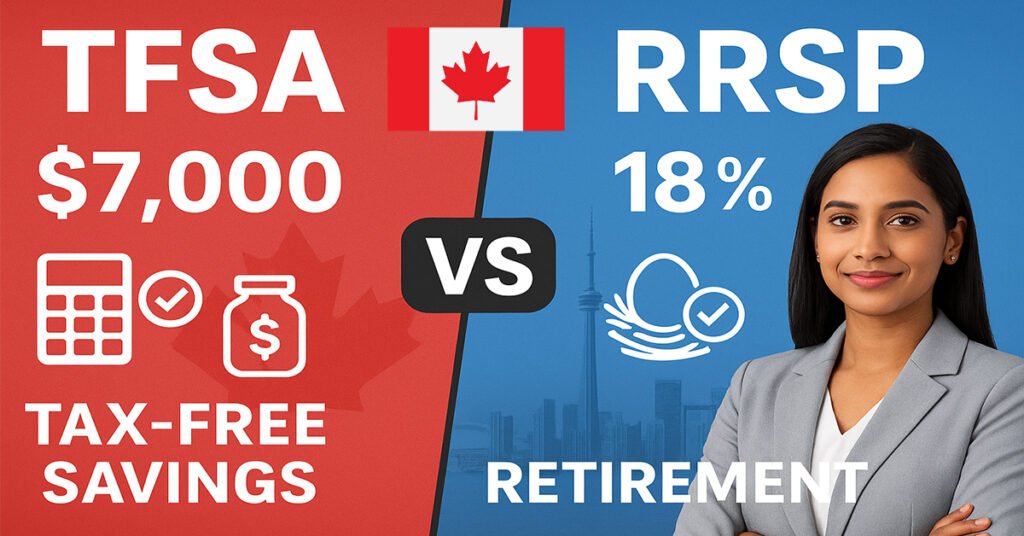
Quick Comparison: TFSA vs RRSP for Newcomers
Need flexibility and building emergency savings? → Start with a TFSA
Have higher income and want tax deductions now? → Consider an RRSP
Established in Canada with stable income? → Use both strategically
As a newcomer to Canada, understanding the country’s tax-advantaged savings accounts is essential for building financial security. The Tax-Free Savings Account (TFSA) and Registered Retirement Savings Plan (RRSP) are two powerful tools that can help you save money, reduce taxes, and achieve your financial goals—but they work very differently.
This comprehensive guide explains everything newcomers need to know about TFSAs and RRSPs, including eligibility requirements, contribution rules, tax benefits, and strategic advice for choosing the right account for your situation.
Understanding the Tax-Free Savings Account (TFSA)
What Is a TFSA?
The Tax-Free Savings Account (TFSA) is a registered savings and investment account that allows Canadian residents to grow their money completely tax-free. Despite its name, a TFSA can hold much more than just savings—it’s a versatile account that can contain various investments including stocks, bonds, mutual funds, and GICs.
Key TFSA Benefits:
Tax-free growth: All interest, dividends, and capital gains earned are never taxed
Tax-free withdrawals: Take money out anytime without paying tax
Flexible access: Withdraw funds whenever needed (subject to product terms)
No income required: Anyone eligible can contribute, regardless of employment status
Contribution room restored: Withdrawn amounts return to your contribution room next year
How TFSA Contributions and Withdrawals Work
Making Contributions:
When you contribute to a TFSA, you’re depositing after-tax money—meaning you’ve already paid income tax on these dollars. Because of this, TFSA contributions don’t provide a tax deduction on your income tax return.
However, the trade-off is significant: once money is inside your TFSA, it grows completely tax-free, and you never pay tax when withdrawing it.
Example: If you deposit $5,000 into your TFSA and it grows to $7,000 through investments, you can withdraw the entire $7,000 tax-free. You won’t report this withdrawal as income, and you won’t pay any taxes on the $2,000 gain.
Understanding Withdrawals:
One of the TFSA’s most attractive features is withdrawal flexibility:
- Withdraw anytime: Access your money whenever you need it (some investment products may have term restrictions)
- No tax on withdrawals: The amount you take out is never considered taxable income
- Contribution room restored: The amount you withdraw gets added back to your contribution room on January 1 of the following year
Withdrawal Example: If you have $10,000 contribution room and deposit $10,000, your room is now $0. If you later withdraw $3,000, you’ll have $3,000 in new contribution room added on January 1 next year, plus any annual increase announced by the government.
TFSA Investment Options
TFSAs are not limited to simple savings accounts. You can hold a wide range of qualified investments:
Cash and Savings Products:
- High-interest savings accounts
- Guaranteed Investment Certificates (GICs)
- Term deposits
Investment Products:
- Canadian and foreign stocks
- Bonds (government and corporate)
- Mutual funds
- Exchange-Traded Funds (ETFs)
- Income trusts
- Segregated funds
This flexibility allows you to match your TFSA strategy to your risk tolerance, timeline, and financial goals—whether you’re saving for emergencies, a down payment, a wedding, or long-term wealth building.
Understanding the Registered Retirement Savings Plan (RRSP)
What Is an RRSP?
The Registered Retirement Savings Plan (RRSP) is a tax-advantaged account specifically designed to help Canadian residents save for retirement. The RRSP’s main benefit is the immediate tax deduction you receive when making contributions, plus tax-deferred growth on your investments.
Key RRSP Benefits:
✅ Tax deduction now: Contributions reduce your taxable income in the year you contribute
✅ Tax-deferred growth: Investments grow without annual taxation
✅ Lower tax on withdrawal: Typically withdraw in retirement when your income (and tax rate) is lower
✅ Home Buyers’ Plan (HBP): Borrow up to $60,000 for your first home purchase
✅ Lifelong Learning Plan (LLP): Borrow up to $20,000 for education expenses
How RRSP Contributions Work
Tax Deduction Benefit:
When you contribute to an RRSP, you can deduct that amount from your taxable income when filing your tax return. This often results in a tax refund or reduces taxes owing.
Example: If you earn $60,000 and contribute $10,000 to your RRSP, your taxable income becomes $50,000. If your marginal tax rate is 30%, you could receive approximately $3,000 back in tax savings ($10,000 × 30%).
Tax-Deferred Growth:
Once money is inside your RRSP, all investment earnings grow tax-deferred. You don’t pay taxes on interest, dividends, or capital gains annually—allowing your money to compound faster.
The Retirement Strategy:
The RRSP is designed around a specific tax strategy:
- Contribute during working years when your income and tax rate are typically higher
- Claim tax deductions to reduce current-year taxes
- Let investments grow tax-deferred for decades
- Withdraw in retirement when your income is lower, resulting in less tax paid
This strategy works best when your retirement income is lower than your working income, which is true for most Canadians.
RRSP Withdrawals and Conversion
Standard Withdrawals:
When you withdraw from an RRSP (outside of HBP or LLP programs):
- Withholding tax applies: The financial institution withholds tax at source (10-30% depending on amount)
- Reported as income: The full withdrawal amount must be included in your income when filing taxes
- Contribution room lost: Unlike TFSA, RRSP contribution room is permanently lost when you withdraw
- May trigger higher taxes: If you’re still working, the withdrawal could push you into a higher tax bracket
RRSP Maturity:
You must convert or close your RRSP by December 31 of the year you turn 71. At that point, you have three options:
- Convert to a RRIF (Registered Retirement Income Fund): Most common option; provides regular retirement income
- Purchase an annuity: Provides guaranteed income for life or a specified period
- Cash out entirely: Withdraw all funds and pay tax on the full amount (usually not recommended)
RRSP Investment Options
Like TFSAs, RRSPs can hold various qualified investments:
- Mutual funds and segregated funds
- Stocks (Canadian and foreign)
- Bonds and debentures
- GICs and term deposits
- ETFs (Exchange-Traded Funds)
- Mortgage-backed securities
- Income trusts
The ability to hold diverse investments allows you to build a retirement portfolio aligned with your age, risk tolerance, and retirement timeline.
TFSA and RRSP Eligibility for Newcomers to Canada
TFSA Eligibility Requirements
To open and contribute to a TFSA, you must meet ALL of these criteria:
Age Requirement:
- Must be 18 years of age or older (some financial institutions require age of majority in your province, which may be 19)
Residency Requirement:
- Must be a resident of Canada for tax purposes
Social Insurance Number:
- Must have a valid Canadian Social Insurance Number (SIN)
Important for Newcomers:
Your TFSA contribution room begins accumulating from the year you become a Canadian resident (and are 18 or older), NOT from 2009 when TFSAs were introduced. This means if you arrived in Canada in 2023, you only have contribution room from 2023 onward.
RRSP Eligibility Requirements
To open and contribute to an RRSP, you must meet these criteria:
Residency:
- Must be a Canadian resident for tax purposes
Social Insurance Number:
- Must have a valid Canadian SIN
Earned Income:
- Must have earned income reported on a Canadian tax return
Tax Return Filed:
- Must have filed at least one Canadian income tax return (your contribution room appears on your Notice of Assessment)
Age Limit:
- Can contribute until December 31 of the year you turn 71
Critical Point for Newcomers:
You cannot contribute to an RRSP until AFTER you’ve filed your first Canadian tax return and received a Notice of Assessment showing your RRSP contribution room. This means newcomers typically must wait a full year after earning their first Canadian income before making RRSP contributions.
Required Documentation for Newcomers
When opening TFSA or RRSP accounts as a newcomer, financial institutions typically require:
Personal Identification:
- Valid passport
- Canadian driver’s license (if obtained)
- Provincial ID card
Immigration Documents:
- Permanent Resident Card, OR
- Work permit, OR
- Study permit with valid work authorization
Canadian Documentation:
- Social Insurance Number (SIN)
- Proof of Canadian address (utility bill, lease agreement, bank statement)
For RRSP Specifically:
- Notice of Assessment from Canada Revenue Agency (CRA) showing contribution room
Always contact your chosen financial institution in advance to confirm exact requirements, as they may vary slightly between banks.
TFSA vs RRSP: Contribution Limits and Rules
TFSA Contribution Limits
Annual Contribution Room:
The Government of Canada sets TFSA contribution limits each year. As of 2024, the annual limit is $7,000.
Cumulative Contribution Room:
Your total TFSA contribution room equals:
- Annual limit for each year you were a Canadian resident (age 18+)
- PLUS any unused contribution room from previous years
- PLUS any withdrawals made in previous years (added back January 1)
- MINUS all contributions you’ve made
Example for Newcomer: If you became a Canadian resident in 2022 at age 25:
- 2022: $6,000
- 2023: $6,500
- 2024: $7,000
- Total room: $19,500 (assuming no contributions yet)
Over-Contribution Penalties:
Exceeding your TFSA contribution room results in a 1% penalty tax per month on the excess amount. The CRA tracks your contributions, so it’s crucial to know your available room before contributing.
How to Check Your TFSA Room:
- Log into your CRA My Account online
- Call the CRA’s Tax Information Phone Service (TIPS)
- Check your latest Notice of Assessment
RRSP Contribution Limits
Annual Contribution Room Calculation:
RRSP contribution room is based on your earned income:
- 18% of previous year’s earned income
- Up to the annual maximum ($31,560 for 2024)
- PLUS unused contribution room from previous years
- MINUS any pension adjustments
Example: If you earned $50,000 in 2023:
- 2024 RRSP room = $50,000 × 18% = $9,000
If you earned $100,000 in 2023:
- Calculation = $100,000 × 18% = $18,000
- 2024 RRSP room = $18,000 (under the maximum)
Contribution Deadline:
You have until 60 days after December 31 to make contributions that count for the previous tax year. This means contributions made between January 1 and February 29/March 1 can be claimed on either the current or previous year’s tax return.
Over-Contribution Rules:
You’re allowed a lifetime $2,000 over-contribution buffer without penalty. Beyond that, you’ll pay 1% per month on the excess amount.
Finding Your RRSP Contribution Room:
Your available RRSP contribution room appears on your Notice of Assessment from CRA after filing your tax return. You can also check online through your CRA My Account.
Tax Treatment: TFSA vs RRSP Compared
TFSA Tax Benefits
On Contributions:
- No tax deduction when you contribute
- Contributes with after-tax dollars
During Growth:
- Zero tax on interest earned
- Zero tax on dividends received
- Zero tax on capital gains
- No annual tax reporting required
On Withdrawals:
- Zero tax when you withdraw
- Not reported as income
- Doesn’t affect income-tested benefits (OAS, GIS, GST credit, etc.)
Best for:
- Emergency funds that may be needed anytime
- Short to medium-term savings goals
- People in lower tax brackets
- Supplementing retirement income without affecting benefits
RRSP Tax Benefits
On Contributions:
- Full tax deduction on contributions
- Reduces current year’s taxable income
- May result in tax refund
During Growth:
- Tax-deferred (not tax-free) growth
- No annual taxes on investment earnings
- Allows faster compounding
On Withdrawals:
- Fully taxable as income
- Withholding tax applied at source
- Reported on T4RSP slip
- May affect income-tested government benefits
Best for:
- Long-term retirement savings
- People in higher tax brackets
- Those who expect lower income in retirement
- Maximizing current-year tax savings
Strategic Advice: Which Account Should Newcomers Choose?
Start with a TFSA If You:
Have Lower or Uncertain Income
If you’re just starting your Canadian career, working part-time, or have income below $50,000 annually, a TFSA often makes more sense. The tax deduction from an RRSP provides less benefit at lower tax brackets, while the TFSA’s flexibility is more valuable.
Need Emergency Savings
Before investing in any long-term retirement account, build an emergency fund covering 3-6 months of expenses. The TFSA’s withdrawal flexibility makes it ideal for this purpose—your money remains accessible if unexpected expenses arise.
Are Establishing Your Life in Canada
Newcomers often face significant expenses during their first years: furnishing an apartment, buying a car, professional certification costs, or helping family members immigrate. A TFSA keeps your savings accessible for these important short-term needs.
Don’t Have Contribution Room Yet
Remember, you can’t contribute to an RRSP until after filing your first Canadian tax return and receiving a Notice of Assessment. During this waiting period, a TFSA is your only tax-advantaged option.
Want to Save for a Home
While RRSPs offer the Home Buyers’ Plan, a TFSA provides more flexibility. You can withdraw your down payment savings tax-free without repayment requirements, and it won’t reduce your future RRSP contribution room.
Consider an RRSP If You:
Have Higher Income
If you’re earning $70,000+ annually (or in a tax bracket of 30%+), the immediate tax savings from RRSP contributions become significant. The higher your tax bracket, the more valuable the RRSP tax deduction.
Won’t Need the Money Until Retirement
The RRSP’s strength is long-term, tax-deferred growth. If you’re certain you won’t need these funds for 20-30+ years, the RRSP’s structure works in your favor, especially when combined with compound growth.
Expect Lower Retirement Income
The RRSP strategy assumes you’ll withdraw money in retirement when your income (and tax rate) is lower. If you expect your retirement income to be substantially less than your working income, this tax arbitrage can save significant money over your lifetime.
Have Maximized Your TFSA
Once you’ve fully utilized your TFSA contribution room, RRSPs become the next logical tax-advantaged savings vehicle for additional funds.
Want to Use the Home Buyers’ Plan
The Home Buyers’ Plan allows first-time buyers to borrow up to $60,000 from their RRSP for a down payment without immediate tax consequences. You must repay this amount over 15 years, but it can be a useful strategy combined with TFSA savings.
The Optimal Strategy: Use Both Accounts
Most financial experts recommend using both accounts strategically:
TFSA for:
- Emergency fund (3-6 months expenses)
- Short-term savings goals (1-5 years)
- Down payment savings
- Flexible retirement income (to avoid benefit clawbacks)
RRSP for:
- Primary retirement savings
- Maximizing current-year tax savings
- Long-term wealth building (10+ years)
- Income splitting with spouse (spousal RRSP)
Sample Strategy:
- Build emergency fund in TFSA first
- Once emergency fund is complete, split savings between TFSA and RRSP
- Contribute to RRSP enough to maximize employer matching (if available)
- Max out TFSA contributions
- Return to RRSP for additional contributions if funds available
Common Mistakes Newcomers Should Avoid
TFSA Mistakes
1. Over-Contributing Without Knowing Your Room
Always verify your exact contribution room through CRA My Account before making deposits. The 1% monthly penalty on excess contributions adds up quickly.
2. Treating It Like a Trading Account
Frequent buying and selling of stocks in a TFSA could trigger CRA’s “business income” rules, potentially making gains taxable. Use TFSAs for investments, not day trading.
3. Not Tracking Withdrawals and Recontributions
If you withdraw $5,000 in October, that room doesn’t return until January 1. Recontributing the same year causes over-contribution penalties.
RRSP Mistakes
1. Contributing Without Contribution Room
Don’t assume you have RRSP room—verify it on your Notice of Assessment. Contributing without room triggers penalty taxes beyond the $2,000 buffer.
2. Withdrawing Before Retirement
Early RRSP withdrawals result in immediate taxation, withholding tax, and permanent loss of contribution room. Use the Home Buyers’ Plan or Lifelong Learning Plan if you must access funds.
3. Missing the Contribution Deadline
The RRSP contribution deadline (typically February 29/March 1) is strictly enforced. Late contributions cannot be claimed on the previous year’s taxes.
4. Not Claiming Deductions Strategically
You don’t have to claim RRSP deductions in the year you contribute. If you expect higher income in future years, you can carry forward deductions to maximize tax savings.
Frequently Asked Questions
Can I have both a TFSA and RRSP at the same time?
Yes, absolutely. Most Canadians maintain both accounts simultaneously, using each for different financial goals. There’s no restriction on having both.
Do I pay tax on investment gains in my TFSA?
No. All investment income—interest, dividends, and capital gains—earned inside a TFSA is completely tax-free. You also don’t pay tax when withdrawing gains.
When should newcomers start contributing to an RRSP?
Wait until after filing your first Canadian tax return and receiving your Notice of Assessment showing RRSP contribution room. This typically means waiting until your second year in Canada.
What happens to my TFSA contribution room if I leave Canada?
If you become a non-resident, you stop accumulating annual TFSA contribution room. However, you can maintain your existing TFSA, and any withdrawals while non-resident may be subject to withholding tax.
Can I use both TFSA and RRSP for buying my first home?
Yes. You can use the Home Buyers’ Plan to borrow up to $60,000 from your RRSP, and withdraw unlimited amounts from your TFSA (up to your available funds). This combination can significantly boost your down payment.
What’s the penalty for over-contributing to an RRSP?
You have a $2,000 lifetime buffer. Beyond that, over-contributions are taxed at 1% per month on the excess amount until corrected.
Should I prioritize TFSA or RRSP if I can only afford one?
For most newcomers, start with a TFSA for its flexibility and accessibility. Once you have emergency savings established and higher income, add RRSP contributions for tax benefits.
Can my spouse and I share TFSA or RRSP accounts?
No, these are individual accounts. However, you can have a “spousal RRSP” where one spouse contributes but the other spouse owns the account—useful for income splitting in retirement.
Taking Action: Next Steps for Newcomers
Immediate Actions (Month 1-3)
1. Get Your Social Insurance Number
Apply for your SIN immediately upon arrival—you need it for employment, banking, and to open TFSA or RRSP accounts.
2. Open a Bank Account
Establish your primary banking relationship at a Canadian financial institution. Many banks offer newcomer packages with benefits.
3. File Your First Tax Return
Even if you had limited income, file a tax return to start establishing your RRSP contribution room and to receive benefits like GST credits.
Short-Term Actions (Month 3-12)
4. Open a TFSA
Start with a TFSA as your first tax-advantaged account. Begin with a high-interest savings account if you’re building emergency savings, or consider investment options for longer-term goals.
5. Build Emergency Savings
Aim for 3-6 months of expenses in your TFSA before focusing on retirement savings or other investment goals.
6. Learn About Investment Options
Educate yourself on investment basics—stocks, bonds, mutual funds, ETFs. Consider starting with balanced mutual funds or robo-advisors for simplicity.
Long-Term Actions (Year 2+)
7. Review Your Notice of Assessment
After filing your first tax return, check your RRSP contribution room. If you have room and sufficient income, consider opening an RRSP.
8. Meet with a Financial Advisor
Once established, consult with a financial planner to develop a comprehensive savings strategy using both TFSA and RRSP accounts.
9. Maximize Tax-Advantaged Savings
As your income grows, prioritize maximizing both TFSA and RRSP contributions before saving in taxable accounts.
Finding Financial Guidance as a Newcomer
Resources for Newcomers
Government Resources:
- Canada Revenue Agency (CRA): Official information on TFSAs and RRSPs at canada.ca/taxes
- Financial Consumer Agency of Canada: Free, unbiased financial education resources
- Settlement Services: Many provinces offer free financial literacy programs for newcomers
Professional Advice:
- Bank advisors: Most banks offer free consultations for account holders
- Financial planners: Consider fee-for-service planners for unbiased advice
- Certified Financial Planners (CFP): Look for professionals with recognized credentials
Community Support:
- Local settlement agencies often provide financial workshops
- Newcomer community centers offer peer support and guidance
- Online forums and newcomer groups share practical experiences
Choosing a Financial Institution
Consider These Factors:
Newcomer Programs:
- Fee waivers or rebates
- Credit card access despite limited credit history
- Multilingual services
- Simplified account opening processes
Account Features:
- Low or no monthly fees
- Online and mobile banking
- Branch accessibility in your area
- Investment platform quality
Support Services:
- Availability of advisors who understand newcomer situations
- Educational resources in multiple languages
- Customer service hours and accessibility
Major Canadian Banks with Newcomer Services:
- TD Canada Trust
- RBC Royal Bank
- Scotiabank
- BMO Bank of Montreal
- CIBC
Many offer dedicated newcomer programs with packages designed specifically for recent immigrants.
Building Your Financial Future in Canada
Understanding TFSAs and RRSPs is just the beginning of your financial journey in Canada. These accounts provide powerful tools for saving, investing, and building wealth in a tax-efficient manner.
Key Takeaways:
TFSAs offer flexibility: Perfect for emergency funds, short-term goals, and accessible savings
RRSPs provide tax benefits: Ideal for retirement savings and current-year tax deductions
Newcomers can use both: Strategic use of both accounts maximizes your financial potential
Start simple: Begin with a TFSA while establishing yourself, add RRSP later
Contribution room matters: Always verify your available room before contributing
Seek guidance: Don’t hesitate to consult financial professionals for personalized advice
As you build your life in Canada, these tax-advantaged accounts will serve as fundamental building blocks of your financial security. Take the time to understand them, start contributing early, and adjust your strategy as your income and goals evolve.
Welcome to Canada, and welcome to a financial system designed to help you succeed.