


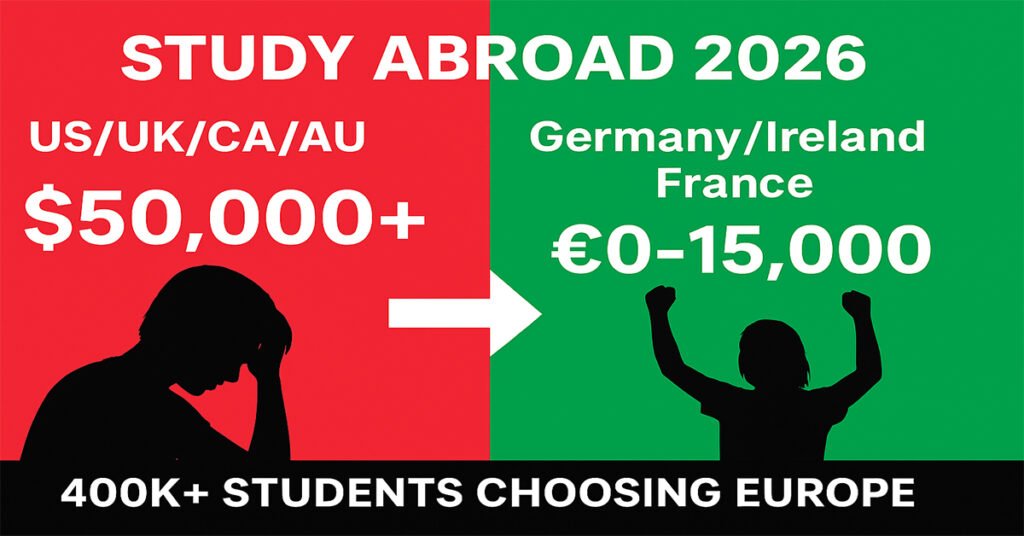
The Shift Away from Traditional Study Destinations
International students are fundamentally rethinking their study abroad choices as rising costs and restrictive policies reshape the global education landscape. According to ApplyBoard’s “2026 Trends Report: Building and Rebuilding Global Education”, affordability and employment opportunities now outweigh institutional prestige in student decision-making.
The traditional “big four” study destinations—Canada, the United States, the United Kingdom, and Australia—are experiencing unprecedented challenges as students seek more financially viable alternatives with stable immigration policies.
Financial Pressures Drive Strategic Choices
The cost of international education has become the dominant factor influencing destination selection. Rising tuition fees combined with significantly higher proof-of-funds requirements have made traditional English-speaking countries increasingly inaccessible for many students.
Recent data shows a dramatic shift in student priorities:
Cost of Studying Remains Top Priority:
- Q1 2024: 85.7%
- Q3 2025: 91.4% (significant increase)
Post-Study Work Opportunities Surge in Importance:
- Q1 2024: 73.1%
- Q3 2025: 87.8%
Cost of Living Considerations:
- Q3 2025: 76.7% of students cite this as critical
These statistics reveal that students are approaching study abroad decisions as careful financial investments rather than aspirational choices based solely on university rankings.
Germany and Ireland Lead the Affordable Alternative Pack
Germany has emerged as a top choice for cost-conscious international students. The country welcomed over 400,000 international students in the winter 2024-25 semester, driven by:
- Minimal or no tuition fees at public universities
- Streamlined study-to-work pathways
- Recent dual citizenship reforms
- Strong post-graduation employment opportunities
Ireland similarly attracts students with lower tuition compared to the UK and US, along with flexible post-study work visa options that allow graduates to remain and seek employment.
France and Spain Gain Momentum
France has set ambitious targets to host 30,000 Indian students by 2030, supported by:
- National housing initiatives for international students
- Simplified student visa procedures
- Clear pathways from education to employment
- Growing English-taught programs
Spain has seen record enrollment increases, benefiting from affordable living costs, simplified visa routes, and an appealing lifestyle for international students.
Policy Tightening in Traditional Destinations
The big four countries face declining appeal due to restrictive policy changes:
Canada:
- Study permit issuances expected to fall 54% year-over-year in 2025
- Post-graduation work permit issuances could drop 30%
Australia and United Kingdom:
- Steady numbers but softer demand
- Stricter compliance requirements
- Rising living costs deterring applicants
These policy shifts represent a significant departure from the welcoming stance these countries previously maintained toward international students.
Emerging Destinations on the Rise
Beyond Europe, several countries are strategically positioning themselves to capture international student market share:
South Korea:
- Extended post-study work rights
- Efficient immigration processing
- Growing reputation for technology and business programs
United Arab Emirates:
- Expanding student enrollment capacity
- Longer work rights for graduates
- Tax-free income attracting international talent
Student Priority Evolution: What Matters Now
Recent quarterly data reveals how dramatically student priorities have shifted:
Work While Studying Opportunities:
- Q1 2024: 68.1%
- Q3 2025: 74.6%
Welcoming Environment for International Students:
- Q1 2024: 32.4%
- Q3 2025: 48.6%
This nearly 50% increase in students prioritizing welcoming environments reflects growing concerns about discrimination, policy uncertainty, and social integration challenges in traditional destinations.
The Return on Investment Mindset
Meti Basiri, co-founder and CEO of ApplyBoard, emphasized this fundamental shift in student thinking:
“The decision to study abroad is now, more than ever, a financial calculation. For international students, the focus has shifted toward tangible outcomes—affordable education, post-study work opportunities, and destinations that offer policy consistency.”
Indian students and families in particular are conducting thorough cost-benefit analyses before committing to international education, weighing tuition, living expenses, work opportunities, and immigration prospects against potential career outcomes.
Future Projections: 10 Million Students by 2030
Despite current disruptions, global student mobility continues expanding. ApplyBoard projects international student numbers could reach 10 million by 2030, but the distribution will look markedly different from previous decades.
Movement patterns will be shaped primarily by:
- Affordability rather than prestige
- Economic opportunity rather than tradition
- Policy stability rather than marketing campaigns
- Employment prospects rather than university rankings alone
Making Informed Study Abroad Decisions
For prospective international students, the 2026 landscape requires more strategic planning:
Research Beyond Rankings:
- Compare total cost of attendance including living expenses
- Investigate post-study work visa policies
- Assess job market conditions for your field
- Evaluate long-term immigration pathways
Consider Emerging Destinations:
- Explore affordable European options like Germany, Ireland, France, and Spain
- Research Asia-Pacific alternatives including South Korea and UAE
- Weigh English proficiency requirements against total costs
Prioritize Policy Stability:
- Monitor immigration policy trends
- Choose destinations with consistent, student-friendly regulations
- Avoid countries with frequent policy reversals
Conclusion
The international education landscape is undergoing its most significant transformation in decades. Students are voting with their applications, choosing destinations that offer financial accessibility, clear employment pathways, and stable policies over traditional prestige.
As this trend accelerates toward 2026 and beyond, universities and countries that adapt to these new priorities will capture growing market share, while those clinging to reputation alone may find themselves with declining international enrollment.