


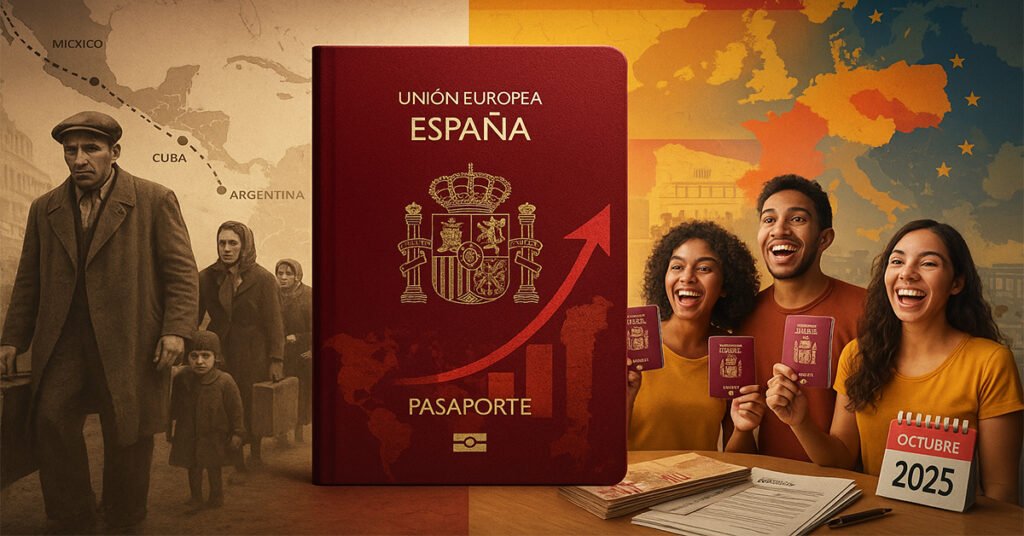
Spain is experiencing an unprecedented wave of citizenship applications as descendants of Spanish exiles rush to reclaim their heritage under the Democratic Memory Law. With over 2.3 million applications flooding Spanish consulates worldwide, the country faces a bureaucratic crisis that could take decades to resolve.
Understanding Spain’s Democratic Memory Law
The Democratic Memory Law, commonly known as the “Grandchildren’s Law” (Ley de Nietos), was enacted in October 2022 to correct historical injustices from Spain’s darkest era. The legislation offered a lifeline to descendants of Spaniards who fled during General Francisco Franco’s dictatorship, which lasted from 1939 until his death in 1975.
This groundbreaking law expired on October 22, 2025, creating an urgent rush among eligible applicants across Latin America and beyond to secure their Spanish citizenship before the deadline.
Record-Breaking Application Numbers
The response to Spain’s citizenship offer has been extraordinary:
- 2.3 million total applications submitted worldwide
- 4.5 times higher than the 2007 Historical Memory Law
- Over 1 million applications processed and approved
- 1.3 million people still waiting for initial appointments
- Only 2% rejection rate among processed applications
These numbers dwarf previous citizenship initiatives, revealing the massive diaspora created by Franco’s 36-year authoritarian regime and the enduring connection descendants feel to their Spanish roots.
Where Applications Are Coming From
Top Countries by Application Volume
Argentina: 1,000,000+ applications Argentina leads by a significant margin, home to one of the world’s largest Spanish exile communities. Waves of Spanish republicans fled to Buenos Aires during and after the Civil War, establishing thriving communities that maintained strong cultural ties.
Cuba: 350,000 applications (Havana Consulate) Cuba’s Spanish community, already substantial before the Civil War, grew with republican exiles who found refuge in Havana.
Mexico: 165,000 applications (Mexico City Consulate) Mexico welcomed tens of thousands of Spanish refugees, with President Lázaro Cárdenas offering sanctuary to republicans fleeing Franco’s regime.
Brazil: 150,000 applications (São Paulo Consulate) São Paulo’s Spanish community has deep roots, with descendants now seeking to formalize their connection to their ancestral homeland.
United States: 120,000 applications (Miami Consulate) Miami’s consulate serves not only direct descendants in the U.S. but also Latin Americans who prefer processing through American offices.
Venezuela: 40,000 applications (Caracas Consulate) Despite Venezuela’s current challenges, thousands of descendants are pursuing Spanish citizenship as a pathway to European opportunities.
Who Qualifies for Spanish Citizenship?
The Democratic Memory Law extended eligibility to several categories of descendants:
Primary Eligible Groups
- Children of Spanish nationals who lost or renounced citizenship due to exile
- Grandchildren of Spanish nationals who fled during the Franco era (1939-1975)
- Descendants of those who left Spain for political, ideological, religious, or sexual orientation persecution
- Children born abroad to Spanish mothers who couldn’t pass citizenship before the 1978 Constitution
Key Requirements
- Proof of Spanish ancestry through birth certificates and family documents
- Evidence that ancestors left Spain due to Franco-era persecution or exile
- No criminal record in Spain or country of residence
- Valid passport and identification documents
Unlike previous laws, the Democratic Memory Law significantly expanded the timeframe and categories of eligible descendants, explaining the massive application surge.
The Bureaucratic Bottleneck Crisis
Spain’s 178 consular offices worldwide are buckling under unprecedented demand:
Processing Timeline Reality
- Appointment waiting times: Months to years in major consulates
- Current processing rate: 50% of applications handled
- Estimated completion time: Potentially decades at current pace
- Consular capacity: Severely strained across all 86 consulates general
Infrastructure Challenges
Spanish consulates face multiple obstacles:
- Insufficient staff to handle document verification
- Limited physical space in high-demand locations
- Outdated technology for processing applications
- No digital submission options for most documents
- Manual data entry creating processing delays
Expert Calls for Systemic Reform
Violeta Alonso Peláez, president of the General Council of Spanish Citizenship Abroad, has outlined urgent reforms needed:
Recommended Solutions
1. Consular Network Redeployment Redistribute resources to high-volume consulates and create mobile processing units for underserved regions.
2. Civil Registry Integration Activate Spain’s 7,000 civil registries to assist with citizenship registration, distributing the workload beyond consular offices.
3. Staff Expansion Hire specialized personnel trained in genealogical document verification and Franco-era historical records.
4. Outsource Routine Tasks Contract private services for document digitization, data entry, and preliminary verification to free consular staff for complex cases.
5. Physical Infrastructure Expansion Many consulates lack adequate space for interviews, document storage, and processing—requiring immediate facility upgrades.
What the October 2025 Deadline Means
While the October 22, 2025 deadline has passed for new applications, the impact continues:
- Existing applications remain valid and will be processed
- Appointments scheduled after the deadline are still being honored
- No new applications can be submitted under this law
- Processing could continue for years or decades
The Spanish government faces pressure to honor commitments to millions who applied in good faith, creating both a legal obligation and diplomatic necessity.
Comparing Spain’s Citizenship Programs
2007 Historical Memory Law vs. 2022 Democratic Memory Law
Historical Memory Law (2007-2011):
- Limited to grandchildren only
- Stricter eligibility requirements
- Approximately 500,000 applications
- More manageable processing timeline
Democratic Memory Law (2022-2025):
- Expanded to great-grandchildren in some cases
- Broader persecution categories
- 2.3+ million applications
- Overwhelmed consular capacity
The dramatic increase reflects both expanded eligibility and growing interest in European citizenship amid global uncertainty.
Benefits of Spanish Citizenship
For approved applicants, Spanish citizenship offers substantial advantages:
European Union Access
- Live and work in any of 27 EU member states
- Travel visa-free to 190+ countries
- Access to EU healthcare and education systems
- Business opportunities across European markets
Dual Citizenship Rights
Spain allows dual citizenship with most Latin American countries, meaning applicants don’t need to renounce their current nationality.
Generational Transfer
Once obtained, Spanish citizenship can be passed to future generations, creating lasting family connections to Europe.
Economic and Diplomatic Implications
This citizenship surge carries significant consequences:
For Spain
- Strengthened cultural ties with Latin America
- Potential economic boost from new citizens investing in Spain
- Diplomatic goodwill across Spanish-speaking world
- Administrative burden requiring substantial government investment
For Latin America
- Brain drain concerns as skilled professionals pursue European opportunities
- Remittance changes as citizens relocate
- Bilateral relationship impacts depending on Spain’s handling of applications
What Applicants Should Know
If you’ve applied under the Democratic Memory Law:
Immediate Steps
- Maintain documentation of your application and appointment
- Keep contact information updated with your consulate
- Monitor consular communications regularly
- Preserve original family documents safely
- Consider legal representation for complex cases
Realistic Expectations
- Processing takes years, not months
- Patience is essential given the backlog
- Approval rates are high (98%) for eligible applicants
- The wait will be lengthy but applications remain valid
Alternative Pathways to Spanish Citizenship
For those who missed the Democratic Memory Law deadline, other options exist:
Citizenship by Residence: 10 years of legal residence (2 years for Latin Americans)
Sephardic Jewish Descent: Separate program for descendants of expelled Sephardic Jews
Marriage: 1 year of residence after marrying a Spanish citizen
Birth in Spain: Children born in Spain to foreign parents may qualify under certain conditions
The Future of Spain’s Citizenship Policy
Questions remain about Spain’s approach moving forward:
- Will the Democratic Memory Law be extended or reopened?
- Can Spain’s consular system handle the existing backlog?
- What reforms will be implemented to accelerate processing?
- How will this impact future citizenship legislation?
The Spanish government faces mounting pressure from applicants, advocacy groups, and Latin American governments to resolve the bottleneck efficiently and fairly.
Key Takeaways
The Democratic Memory Law represents Spain’s most ambitious effort to acknowledge its authoritarian past and reconnect with its diaspora. However, the overwhelming response—2.3 million applications from descendants across Latin America—has created an administrative crisis requiring urgent reforms.
For the million applicants already approved, Spanish citizenship offers a gateway to European opportunities and a restoration of ancestral ties. For the 1.3 million still waiting, patience and persistence remain essential as Spain works through decades of applications.
This historic citizenship surge underscores the lasting impact of the Franco dictatorship and the enduring connection between Spain and Latin America—bonds that transcend generations and borders.