


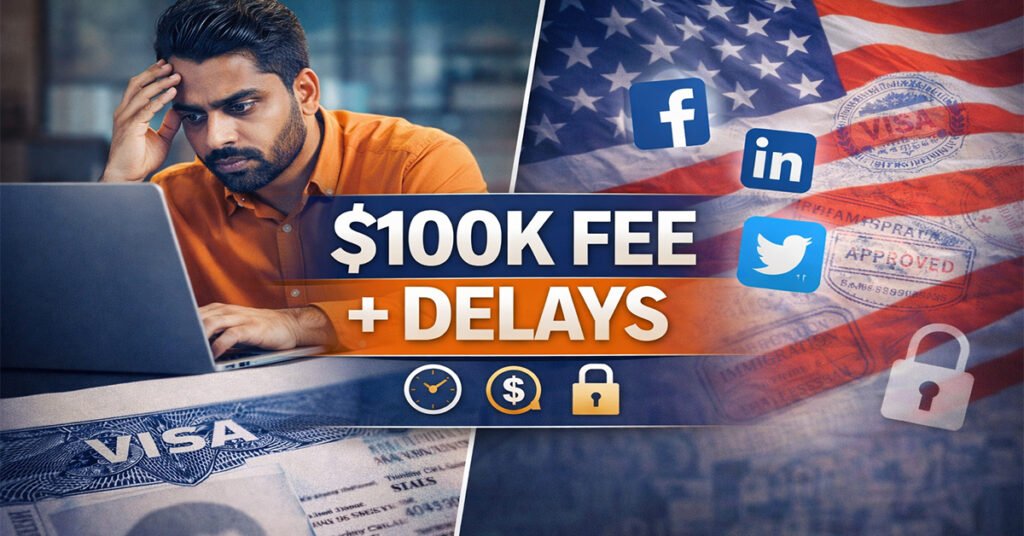
What’s Changing: H-1B Visa Updates December 2025
Starting December 15, 2025, the United States implemented sweeping changes to H-1B and H-4 visa policies that directly impact thousands of Indian professionals. These modifications introduce mandatory social media screening, substantial new fees, extended processing times, and stricter eligibility reviews—fundamentally altering the landscape for skilled workers seeking employment in America.
Quick Summary of Changes:
- Mandatory public social media profiles for all applicants
- New $100,000 one-time fee for certain H-1B visas
- Interview delays pushing appointments to March-May 2026
- Ended automatic work permit extensions for H-4 dependents
- Introduction of “prudential revocations” for existing visa holders
Understanding the New Social Media Screening Requirements
What the Policy Requires: All H-1B visa applicants and their H-4 dependent family members must now undergo comprehensive social media vetting as part of the application process. This represents a significant expansion of existing security protocols.
Key Requirements:
- Public Profile Mandate: Applicants must set all social media accounts to “public” visibility
- Multi-Platform Review: Authorities examine posts across Facebook, Twitter/X, Instagram, LinkedIn, and other platforms
- Historical Content: Past posts and online activity are subject to scrutiny
- Security Assessment: Content is reviewed for potential security concerns or inadmissibility factors
Platforms Under Review:
- Professional networks (LinkedIn)
- Social platforms (Facebook, Instagram, Twitter/X)
- Video platforms (YouTube, TikTok)
- Messaging apps with public profiles
- Any platform where content is publicly accessible
Official Justification: The US State Department emphasizes that a US visa is a “privilege, not a right,” and these measures aim to identify applicants who may pose security risks or have provided misleading information in their applications.
The $100,000 Fee: What You Need to Know
Fee Structure: A substantial one-time fee of $100,000 has been introduced for certain new H-1B visa applications, representing one of the most significant cost increases in the program’s history.
Who Pays:
- Typically borne by sponsoring employers
- Cannot be passed to employee in most cases per existing regulations
- Applies to new H-1B petitions under specific categories
Financial Impact:
- Small to Mid-Size Companies: The fee may deter sponsorship of foreign workers
- Large Tech Firms: While more capable of absorbing costs, budgets for hiring international talent may shrink
- Indian Professionals: Reduced sponsorship opportunities as companies evaluate cost-benefit ratios
Alternative Costs to Consider: Beyond the new fee, applicants still face:
- Base H-1B filing fees ($460-$500)
- American Competitiveness and Workforce Improvement Act fees ($750-$1,500)
- Fraud Prevention and Detection fees ($500)
- Premium processing fees ($2,805 for expedited review)
- Attorney and consultation fees ($2,000-$5,000)
Interview Delays and Rescheduling: The Timeline Reality
Current Situation: Thousands of Indian H-1B and H-4 applicants are experiencing unprecedented delays as US consulates in India reschedule visa interviews.
New Timeline:
- Previous Average: 2-6 weeks for interview scheduling
- Current Reality: Interviews pushed to March, April, or May 2026
- Total Delay: 3-5 months beyond original appointments
Consulates Affected:
- US Embassy New Delhi
- US Consulate Mumbai
- US Consulate Chennai
- US Consulate Hyderabad
- US Consulate Kolkata
Why the Delays:
- Expanded social media vetting requires additional processing time
- Increased scrutiny and documentation review
- Limited consular staff capacity
- Backlog from accumulated applications
Planning Considerations: Professionals should now factor in 6-9 months total processing time from petition approval to visa issuance and US entry.
Prudential Revocations: Understanding Temporary Visa Suspensions
What Is a Prudential Revocation? A prudential revocation is a precautionary, temporary cancellation of a visa issued when the US State Department identifies potential eligibility concerns about a current visa holder.
Why It Happens:
- New information emerges questioning eligibility
- Security or background check concerns
- Suspected misrepresentation in original application
- Changes in applicant circumstances affecting visa status
Impact on Visa Holders:
- Cannot use existing visa for travel to the US
- May face immediate questioning if already in the US
- Must undergo additional review process
- Creates employment uncertainty for affected professionals
Resolution Process: Individuals issued prudential revocations typically must:
- Receive official notification
- Submit additional documentation
- Potentially attend new visa interview
- Await final determination on visa validity
This measure has created significant anxiety among Indian professionals currently working in or planning to travel to the United States.
End of Automatic EAD Extensions: Impact on H-4 Spouses and Students
Policy Change Effective October 30, 2025: The automatic extension of Employment Authorization Documents (EADs) for H-4 visa holders (spouses of H-1B workers) and F-1 OPT students has been discontinued.
Who’s Affected:
- H-4 EAD Holders: Spouses of H-1B workers with work authorization
- F-1 OPT Students: International students on Optional Practical Training
- Estimated Impact: Tens of thousands of Indian nationals
Practical Consequences:
- Employment Gaps: Workers must stop working when EAD expires, even if renewal is pending
- Income Loss: Families lose dual-income stability during processing gaps
- Career Disruption: Professionals may lose job offers or positions due to work authorization gaps
- Financial Strain: Single-income households face increased financial pressure
New Requirements:
- Must receive physical EAD card before beginning or continuing work
- Processing times now average 4-6 months
- No grace period for continued employment during renewal
Alternative Options: Some affected individuals are exploring:
- H-1B visa applications for spouses (subject to cap)
- L-1 visa options if spouse’s employer has international offices
- Returning to home country temporarily
- Career breaks until documentation is resolved
What Is the H-1B Visa Program?
Program Overview: The H-1B is a non-immigrant work visa allowing US employers to temporarily employ foreign professionals in specialty occupations requiring specialized knowledge and typically a bachelor’s degree or higher.
Common Professions:
- Software Engineers and Developers
- IT Specialists and Systems Analysts
- Data Scientists and Analysts
- Engineers (Mechanical, Electrical, Civil)
- Healthcare Professionals (Doctors, Researchers)
- Financial Analysts
- Architects and Designers
Key Program Details:
- Initial Duration: 3 years
- Maximum Duration: 6 years (with extensions possible during green card processing)
- Annual Cap: 85,000 visas (65,000 regular + 20,000 advanced degree)
- Employer Requirement: Must be sponsored by US employer
- Wage Standards: Employer must pay prevailing wage for position
Indian Dominance in H-1B: India consistently receives the majority of H-1B approvals:
- Approximately 70-75% of H-1B visas go to Indian nationals
- Driven by India’s robust IT sector and STEM education system
- Major Indian IT companies (TCS, Infosys, Wipro) are top H-1B sponsors
Industry Impact: IT Sector and Project Disruptions
Challenges for Indian IT Companies: India’s technology sector, which relies heavily on H-1B talent for US operations, faces multiple challenges:
Workforce Planning Issues:
- Difficulty predicting when employees can start US assignments
- Project timelines disrupted by visa delays
- Client commitments harder to fulfill with uncertain staffing
Financial Burden:
- $100,000 fee per new H-1B significantly impacts hiring budgets
- Small and medium IT firms may reduce US operations
- Cost-benefit analysis may favor remote work from India
Competitive Disadvantages:
- Projects may be awarded to US-based firms
- Client relationships strained by staffing uncertainties
- Potential loss of contracts due to inability to guarantee on-site presence
Strategic Shifts: Companies are exploring:
- Increased remote work arrangements
- Expansion in other global markets (Canada, UK, Australia)
- Greater investment in US local hiring
- Hybrid delivery models mixing onshore and offshore teams
Alternative Destinations: Where Indian Professionals Are Looking
Emerging Competition for US Tech Talent:
Canada:
- Express Entry immigration system
- Provincial Nominee Programs
- Tech-friendly visa policies
- Shorter processing times (6-12 months for PR)
United Kingdom:
- Skilled Worker Visa (formerly Tier 2)
- High Potential Individual route for top university graduates
- Scale-up visa for fast-growing companies
- Recently relaxed immigration policies
Australia:
- Skilled Independent Visa (subclass 189)
- Employer-sponsored visas
- Points-based immigration system
- Pathway to permanent residence
Germany:
- EU Blue Card program
- Skilled Immigration Act benefits
- Growing tech sector in Berlin, Munich
- Relatively straightforward work permits
Singapore:
- Employment Pass for professionals
- Tech.Pass for tech entrepreneurs
- Regional tech hub status
- Strategic location in Asia
Impact on US Competitiveness: Immigration experts warn that making the H-1B process more difficult and expensive could:
- Drive top global talent to competitor nations
- Reduce US innovation capacity
- Weaken American tech sector competitiveness
- Create brain drain benefiting other countries
Practical Steps for Current and Prospective H-1B Applicants
For Prospective Applicants:
- Social Media Audit:
- Review all social media accounts for potentially problematic content
- Set profiles to public before application
- Consider deleting controversial or misinterpretable posts
- Ensure consistency between online presence and application information
- Financial Planning:
- Discuss fee responsibility with employer upfront
- Budget for 6-9 months without US income during processing
- Maintain emergency funds for extended delays
- Timeline Adjustment:
- Plan for March-May interview dates if applying now
- Factor in additional 2-3 months for processing post-interview
- Notify employers of realistic start dates
- Document Preparation:
- Gather comprehensive employment history
- Obtain detailed educational credentials
- Prepare for enhanced scrutiny with thorough documentation
For Current H-1B Holders:
- Maintain Compliance:
- Keep all visa documentation current
- Inform employer immediately of any status changes
- Avoid any actions that could trigger prudential revocation
- Travel Considerations:
- Minimize international travel during uncertain period
- Ensure all documentation is perfect before leaving US
- Be prepared for additional scrutiny at ports of entry
- Dependent Planning:
- H-4 spouses should file EAD renewals 6 months early
- Plan for potential income gaps
- Explore alternative employment authorization if available
For Employers:
- Budget Adjustments:
- Factor $100,000 fee into international hiring budgets
- Evaluate ROI on H-1B sponsorships
- Consider alternatives like remote work or local hiring
- Timeline Management:
- Build 9-12 month lead time for international hires
- Communicate realistic expectations to hiring managers
- Develop contingency plans for delayed arrivals
Legal and Policy Context
Administration’s Immigration Stance: These H-1B changes are part of a broader immigration enforcement strategy under the current administration, which emphasizes:
- Prioritizing American workers
- Enhanced vetting for national security
- Reduction in overall immigration levels
- Stricter enforcement of existing rules
Previous H-1B Reforms: The current changes build on earlier modifications:
- 2020: Increased wage requirements (later rescinded)
- 2021: Lottery system modifications
- 2023: Modernized registration process
- 2024: Enhanced fraud detection measures
Countries of Concern: Broader restrictions affecting applicants from designated “countries of concern” have also paused various immigration applications, adding to overall uncertainty for foreign professionals from specific regions.
Expert Opinions and Industry Response
Immigration Attorneys: Legal experts note that while changes are significant, they remain within executive authority over visa policy. However, they express concern about:
- Lack of clear guidelines for social media review
- Potential for subjective decision-making
- Due process concerns with prudential revocations
Technology Industry Leaders: Tech sector representatives argue these policies:
- Harm US competitiveness for global talent
- Disadvantage American companies
- May drive innovation to other countries
- Create unnecessary bureaucratic barriers
Immigration Policy Advocates: Groups supporting restrictive immigration argue the changes:
- Protect American jobs
- Enhance national security screening
- Reduce visa fraud
- Properly prioritize limited visa slots
Frequently Asked Questions
Q: Do I need to make all my social media public? A: Yes, all H-1B and H-4 applicants must set social media profiles to public for the duration of the application process.
Q: What if I don’t have social media accounts? A: You must declare this in your application. Failure to disclose existing accounts could be considered misrepresentation.
Q: Who pays the $100,000 fee? A: Typically the sponsoring employer, though specific arrangements may vary by employment agreement and company policy.
Q: Can I expedite my visa interview? A: Premium processing expedites USCIS petition review but does not affect consular interview scheduling. Emergency appointments may be available for urgent situations with documentation.
Q: What happens to my H-4 spouse’s job if EAD expires? A: They must stop working immediately when EAD expires, even if renewal is pending. No automatic extension is available.
Q: How long are prudential revocations valid? A: Duration varies by case. Resolution requires submitting additional documentation and potentially attending a new interview.
Q: Should I delete my social media accounts? A: No. Deleting accounts after applying could be viewed as attempting to hide information. Instead, review and remove problematic content before applying.
Q: Are there exceptions to the new fee? A: Fee structures vary by visa category and company size. Consult with an immigration attorney for your specific situation.
Long-Term Outlook
Potential Future Changes: Immigration policy remains fluid, with possible future modifications including:
- Congressional legislation to increase or decrease H-1B caps
- Changes in fee structures
- Modified lottery system
- Enhanced pathways to permanent residence
- Reciprocal agreements with specific countries
Strategic Considerations: Indian professionals should:
- Stay informed about policy updates
- Develop backup plans and alternative career pathways
- Maintain strong professional credentials
- Build networks across multiple countries
- Consider long-term immigration goals beyond H-1B
Industry Adaptation: The tech industry is likely to respond through:
- Increased remote work infrastructure
- Distributed team models
- Investment in alternative markets
- Advocacy for policy reform
- Enhanced local talent development
Conclusion
The December 2025 H-1B visa changes represent the most significant shift in US skilled worker immigration policy in years. With mandatory social media screening, substantial new fees, extended delays, and eliminated automatic work permit extensions, Indian professionals face a considerably more challenging pathway to US employment.
While these changes create obstacles, the H-1B program remains a viable option for skilled workers, albeit one requiring more careful planning, patience, and financial resources. Understanding these new requirements and preparing accordingly will be essential for anyone pursuing American professional opportunities.
For the Indian IT sector and thousands of professionals with US career aspirations, adapting to this new reality while exploring alternative options will define the next chapter of global talent mobility.