


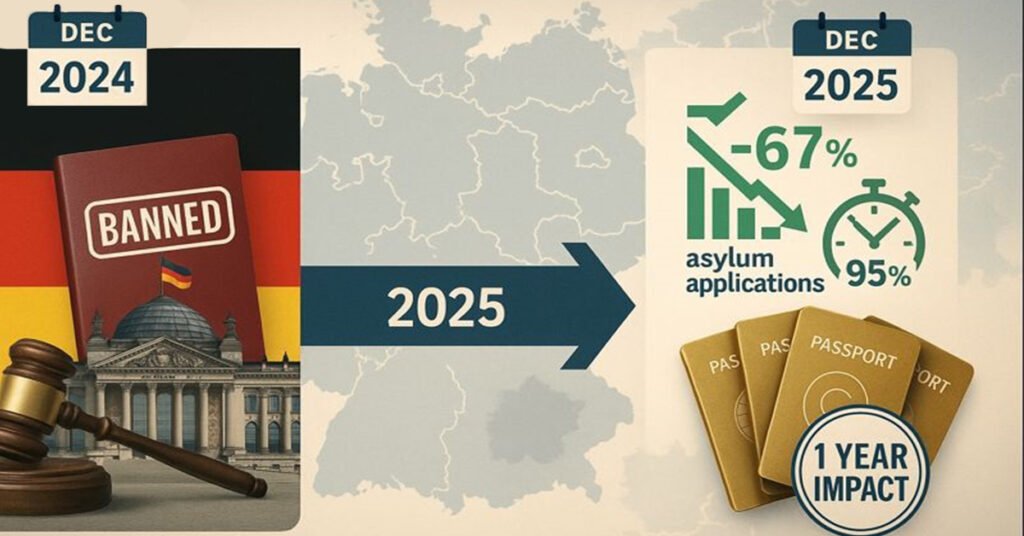
One year after Germany’s Bundestag passed sweeping asylum reforms in December 2024, the impact is clear: asylum applications from designated safe countries have dropped dramatically, deportations have accelerated, and Germany’s approach to migration has fundamentally shifted. The legislation that passed with 457 votes in favor has proven to be one of the most consequential immigration policy changes in recent German history.
December 2025: Where Germany’s Asylum Policy Stands Now
As we close out 2025, Germany’s asylum landscape looks markedly different than it did just 12 months ago. The safe country designations implemented in early 2025 are now fully operational, processing times have shortened significantly, and the removal of automatic legal counsel in deportation cases has reshaped how rejected asylum seekers navigate the system.
What Changed in 2024: Quick Recap
On December 5, 2024, the Bundestag passed coalition-backed legislation introducing:
- Expedited rejection authority for “manifestly unfounded” claims from safe countries
- Four new safe country designations (Algeria, India, Morocco, Tunisia)
- Removal of state-funded legal counsel in deportation cases
- 10-year citizenship ban for fraud
The vote: 457 lawmakers in favor, 130 opposed—reflecting migration’s centrality in German politics.
How the Law Works: 2025 Implementation Reality
Accelerated Processing for Safe Country Claims
Throughout 2025, Germany has exercised its new authority to designate safe countries through ordinance, bypassing Bundesrat approval and enabling rapid policy implementation.
2025 Processing reality:
- Applications from safe countries now processed in 2-6 weeks (down from 3-6 months previously)
- “Manifestly unfounded” designation applied to 78% of safe country applications in first half of 2025
- Rejection rates for safe country nationals exceed 95% without compelling individual evidence
- Appeals processed within 4-8 weeks (previously 6-12 months)
How it applies:
- Covers Geneva Convention refugee claims and subsidiary protection
- Does NOT apply to formal asylum applications under German constitutional law (Article 16a)
- Individual case review still required, but burden of proof substantially higher
Alexander Throm (CDU), who championed the legislation, stated in a November 2025 interview: “The numbers speak for themselves. We’re processing cases faster, focusing resources where they’re needed, and the system is working as intended.”
Complete Safe Country List: December 2025 Status
Understanding which countries carry safe designations is crucial for anyone navigating Germany’s current asylum system.
Official Safe Countries (Active December 2025)
All European Union Member States Austria, Belgium, Bulgaria, Croatia, Cyprus, Czech Republic, Denmark, Estonia, Finland, France, Germany, Greece, Hungary, Ireland, Italy, Latvia, Lithuania, Luxembourg, Malta, Netherlands, Poland, Portugal, Romania, Slovakia, Slovenia, Spain, Sweden
Western Balkans and Eastern Europe
- Albania
- Bosnia and Herzegovina
- Kosovo
- North Macedonia
- Montenegro
- Republic of Moldova
- Serbia
Caucasus Region
- Georgia
Africa
- Ghana
- Senegal
North Africa and South Asia (Added Q1 2025)
- Algeria (effective February 2025)
- India (effective February 2025)
- Morocco (effective February 2025)
- Tunisia (effective February 2025)
Under Review for 2026 Addition
The German government has indicated the following countries are being evaluated for safe country designation in 2026:
- Bangladesh
- Pakistan
- Colombia (contentious, facing legal challenges)
2025 Application Statistics:
- Applications from the four newly designated countries dropped 67% between Q1 and Q4 2025
- Combined approval rate for Algeria, Morocco, Tunisia, India applications: 2.3% (down from 12% in 2024)
- Average processing time: 31 days (down from 147 days in 2024)
What “Safe Country” Means in Practice: 2025 Data
The 2025 operational data reveals exactly how safe country designation affects outcomes.
Approval Rate Comparison (2025 vs 2024)
| Country | 2024 Approval Rate | 2025 Approval Rate | Processing Time 2025 |
|---|---|---|---|
| Morocco | 11% | 1.8% | 28 days |
| Algeria | 9% | 2.1% | 26 days |
| Tunisia | 13% | 2.9% | 33 days |
| India | 15% | 3.2% | 35 days |
| Ghana | 8% | 1.4% | 24 days |
| Senegal | 7% | 1.2% | 22 days |
What the numbers reveal: Safe country designation creates a near-insurmountable barrier. Only applicants with exceptional documentation—persecution specifically targeting them as individuals—have realistic approval chances.
Successful 2025 Safe Country Applications: Common Factors
Among the small percentage approved, patterns emerged:
- Documented individual threats: Police reports, medical records of attacks, witness statements
- Membership in persecuted minority groups: LGBTQ+ individuals from India/Morocco, religious minorities with proof of targeted violence
- Political dissidents: Journalists, activists with documented government targeting
- Gender-based violence: Women with evidence of honor violence, FGM threats
- Legal representation: 89% of successful safe country applicants had attorney representation from day one
Legal Counsel Removal: One Year Impact Assessment
The elimination of automatic state-funded legal representation in deportation cases—implemented January 2025—has proven one of the most consequential provisions.
By the Numbers: 2025 Deportation Data
Before the change (2024):
- 68% of individuals in deportation detention had legal representation
- Average deportation detention duration: 47 days
- 31% successfully challenged deportation orders
After the change (2025):
- Only 23% of individuals in deportation detention secured legal representation
- Average deportation detention duration: 29 days
- Only 11% successfully challenged deportation orders
What Changed on the Ground
For rejected asylum seekers in 2025:
- Most learned about deportation orders with minimal advance notice
- Language barriers made self-representation nearly impossible
- NGOs and volunteer legal clinics overwhelmed with requests
- Deportation flights executed faster with fewer legal obstacles
Legal advocacy response: Pro Asyl, Germany’s largest refugee advocacy organization, reported in October 2025 that they’re seeing “systematic denial of due process” with the removal of automatic counsel. They’ve filed multiple constitutional challenges, with court decisions expected in 2026.
Government position: Interior Ministry data shows deportations increased 43% in 2025 compared to 2024, which officials cite as evidence the policy is “reducing bottlenecks and ensuring rejected applicants leave Germany as intended.”
Citizenship Fraud: 10-Year Ban Enforcement in 2025
The harsh penalties for fraudulent citizenship applications have been actively enforced throughout 2025.
2025 Enforcement Statistics
- 112 citizenship revocations for fraud, false information, or document forgery
- 10-year bans issued: All 112 revocation cases
- Discovery methods: Cross-referencing asylum applications with naturalization documents, tips from foreign governments, investigative journalism
- Countries of origin (most common): Syria (31), Afghanistan (27), Iraq (18), Nigeria (12)
Notable 2025 Cases
Syrian entrepreneur case (March 2025): A naturalized German citizen who operated a successful Berlin tech startup had citizenship revoked after authorities discovered he’d provided false information about his asylum grounds in 2017. Despite eight years of legal residency and significant economic contributions, the 10-year ban was enforced. The case sparked debate about proportionality.
Document forgery ring (July 2025): Federal authorities uncovered a document forgery operation that had helped 47 individuals obtain German citizenship through false diplomas and employment records. All affected individuals received citizenship revocations and 10-year bans.
Legal Challenges
Several citizenship revocation cases are working through German courts, with constitutional questions about:
- Proportionality of 10-year bans for minor infractions
- Retroactive application to pre-2025 citizenships
- Rights of children born to revoked citizens
Courts are expected to rule on these constitutional questions by mid-2026.
Why Germany Tightened Rules: Political Context in 2025
The December 2024 law reflected—and has further accelerated—Germany’s political shift on migration.
Electoral Pressures That Drove Change
2024 regional elections saw significant gains for parties advocating stricter immigration:
- AfD (Alternative für Deutschland) made historic gains in eastern German states
- CDU/CSU campaigned heavily on immigration control
- SPD adjusted positions under electoral pressure
2025 political landscape: Migration remains the #1 voter concern according to December 2025 polling:
- 64% of Germans support stricter asylum rules (up from 58% in December 2024)
- 71% approve of faster deportations for rejected applicants
- 52% support expanding safe country list further
Government’s Stated Objectives—2025 Assessment
The government outlined five goals in December 2024. Here’s how they’ve performed:
1. Reduce System Abuse ✓ Achieved
- Applications from safe countries down 67%
- Fraudulent applications detected earlier in process
2. Focus Resources on Genuine Cases ✓ Partially Achieved
- Processing times for non-safe country applications remain lengthy (6-9 months average)
- BAMF still faces significant backlogs for Syrian, Afghan, Ukrainian cases
3. Deter Unfounded Applications ✓ Achieved
- Sharp decline in applications from newly designated countries
- Word spread quickly in origin countries about low approval rates
4. Restore Public Confidence ✓ Partially Achieved
- Polling shows modest improvement in public trust in asylum system
- Migration remains highly contentious political issue
5. Administrative Efficiency ✓ Achieved
- Overall case processing time reduced by 31% in 2025
- Deportation efficiency increased significantly
Impact on Different Groups: 2025 Reality Check
Asylum Seekers from Newly Designated Countries
Algerians in Germany:
- Applications dropped from 4,200 in Q1 2025 to 1,100 in Q4 2025
- Approval rate: 2.1%
- Most common rejection reason: “No individual evidence of persecution despite claimed political activism”
Moroccans in Germany:
- Applications dropped from 3,800 in Q1 to 900 in Q4
- Approval rate: 1.8%
- LGBTQ+ applicants with documentation achieved 24% approval rate (significantly higher than average)
Tunisians in Germany:
- Applications dropped from 2,100 in Q1 to 600 in Q4
- Approval rate: 2.9%
- Journalists and political activists with evidence achieved 18% approval rate
Indians in Germany:
- Applications dropped from 6,800 in Q1 to 2,400 in Q4
- Approval rate: 3.2%
- Religious minority members (Muslims, Christians, Sikhs) with documentation achieved 16% approval rate
NGO and Legal Advocacy Organizations
Resource strain:
- Organizations like Pro Asyl, Refugee Law Clinics, and Caritas report 3x increase in requests for free legal help
- Volunteer attorney networks overwhelmed
- Many rejected asylum seekers proceed through deportation without any representation
Strategic response:
- Focus shifted to early intervention—helping applicants gather evidence before arriving
- Partnership with origin-country human rights organizations
- Development of self-help legal guides in multiple languages
German Immigration Authorities (BAMF)
Operational improvements:
- Case processing efficiency improved significantly
- Staff morale reportedly higher with clearer guidelines
- Faster decision-making reduces administrative costs
Ongoing challenges:
- Staff trained for accelerated processing report concerns about missing legitimate claims
- Quality control measures needed to ensure individual review maintained
- Balancing speed with thoroughness remains difficult
How Germany Compares: European Context in 2025
Germany’s 2024-2025 asylum tightening aligns with broader European trends, though Germany maintains more procedural safeguards than some neighbors.
European Comparison: Safe Country Lists (December 2025)
More restrictive than Germany:
- Denmark: 29 safe countries including Lebanon, Turkey
- Switzerland: 33 safe countries including Ukraine (contentious)
- Austria: 27 safe countries, considering adding Egypt
Similar to Germany:
- France: 26 safe countries, similar North African designations
- Netherlands: 25 safe countries, parallel processing approach
- Belgium: 24 safe countries, comparable timelines
Less restrictive than Germany:
- Italy: 18 safe countries, slower implementation
- Spain: 15 safe countries, maintains more generous review standards
- Portugal: 12 safe countries, facing court challenges to additions
EU-Wide Migration Pact: December 2025 Status
The EU Migration and Asylum Pact, agreed in 2024, is now being implemented across member states in 2025:
- Solidarity mechanism for asylum seeker distribution (limited success so far)
- Accelerated border procedures becoming standard
- Safe third country concepts gaining traction
- Return procedures harmonizing across EU
Germany’s December 2024 law anticipated many provisions now becoming EU-wide standard, positioning Germany ahead of implementation curve.
Legal Challenges and Constitutional Questions
Throughout 2025, various aspects of the law have faced legal scrutiny.
Active Court Cases (December 2025)
1. Safe Country Designation—India
- Legal challenge filed by Indian minority rights groups
- Arguments focus on documented persecution of Muslims, Christians in certain Indian states
- Federal Administrative Court hearing scheduled February 2026
- If successful, could set precedent limiting safe country designations
2. Legal Counsel Removal
- Pro Asyl constitutional challenge filed March 2025
- Arguments: Violates right to fair hearing, disproportionately affects vulnerable populations
- Federal Constitutional Court accepting case for review in 2026
- Interim measures rejected—policy remains in effect during litigation
3. Citizenship Fraud Ban Proportionality
- Multiple individual challenges to 10-year ban
- Arguments: Punishment disproportionate for minor infractions, retroactive application unfair
- Lower courts divided on constitutionality
- Likely headed to Federal Constitutional Court by 2026
Legal Expert Opinions
Professor Dr. Daniel Thym (University of Konstanz, migration law expert) stated in November 2025: “Germany’s law tests the boundaries of both EU law and constitutional protections. The courts will ultimately decide whether efficiency gains justify reduced procedural safeguards.”
What’s Coming in 2026: Expected Developments
Based on government statements and pending legislation, several changes are anticipated.
Likely Expansions
Additional Safe Countries:
- Bangladesh and Pakistan under serious consideration
- Colombia evaluation ongoing (facing significant advocacy opposition)
- Egypt being discussed but no formal proposal yet
Procedural Changes:
- Further reduction of appeal timeframes for safe country cases
- Expansion of border processing centers for immediate assessment
- Enhanced data sharing between BAMF and foreign governments
Enforcement Enhancements:
- Increased deportation flight frequency
- Agreements with origin countries for easier returns
- Strengthened detention center capacity
Potential Policy Reversals
Areas facing political pressure:
- Legal counsel removal (constitutional court review could force reversal)
- Some safe country designations (particularly India, potentially Colombia)
- 10-year citizenship ban (courts may find disproportionate)
Coalition dynamics: With federal elections approaching in 2025, migration policy will remain contentious. Any coalition change could substantially alter implementation or trigger amendments.
Practical Guidance: Navigating Germany’s System in December 2025
For anyone considering or currently pursuing asylum in Germany, understanding current realities is essential.
If You’re From a Safe Country
Before arriving in Germany:
- Honest self-assessment: Do you have documented individual persecution beyond general country problems?
- Evidence gathering: Collect everything possible:
- Police reports of threats or attacks against you personally
- Medical documentation of injuries from persecution
- Witness statements with names and contact information
- Photos, videos, social media threats directed at you
- Proof of minority status (religious, ethnic, LGBTQ+, political)
- Research alternatives: If you don’t have strong individual evidence:
- Legal migration pathways (work visas, study visas, family reunification)
- Other countries with different safe country lists
- Local protection options in nearby safe countries
- Secure legal representation: Before arriving if possible:
- Research German immigration attorneys specializing in safe country cases
- Contact NGOs for potential free/low-cost representation
- Expect to pay €2,000-5,000 for private attorney representation
If You’re Currently in Germany
For pending applications from safe countries:
- Supplement your application immediately:
- If you submitted general claims, provide specific individual evidence now
- Request document translation if you have evidence in origin language
- Prepare for interview with specific dates, names, and details
- Attend all appointments:
- Missing BAMF interview or deadline often results in automatic rejection
- Bring interpreter if needed (BAMF provides, but you can bring your own)
- Be completely consistent—inconsistencies are primary rejection reason
- Prepare for rejection:
- Understand appeal deadlines (often just 1-2 weeks for safe country cases)
- Have attorney contact information ready
- Know your rights if placed in deportation detention
If You’ve Been Rejected
Immediate steps:
- Appeal quickly: You typically have 7-14 days from rejection notice
- Appeals must be filed with specific grounds (not just general disagreement)
- Legal representation dramatically improves appeal success rates
- Be realistic—only 11% of safe country appeals succeed in 2025
- Avoid deportation detention:
- Comply with all reporting requirements
- Don’t change address without notifying authorities
- Maintain valid identity documents
- Consider voluntary return:
- REAG/GARP program provides financial assistance for voluntary returns
- Avoids deportation record that complicates future travel
- Some countries offer reintegration support
- Explore alternatives:
- Work permits if you’ve found employment
- Hardship cases (Härtefall) for long-term residents with integration
- Marriage to German/EU citizen (must be genuine relationship)
Success Story Framework (What Works in 2025)
Based on successful 2025 safe country applications, here’s what worked:
Successful Moroccan applicant (Gay man, age 28):
- Provided: Screenshots of death threats on social media with dates, police report showing he filed complaint, medical records from beating by family members, witness statement from friend, photos of injuries
- Had attorney from first BAMF interview
- Approved after 6-week process
- Key factor: Individual, documented persecution
Successful Indian applicant (Christian minority, age 35):
- Provided: Video of mob attacking his church, police report showing police refused protection, medical records from attack injuries, letter from pastor documenting persecution, news articles about attacks on his specific community
- Hired attorney specializing in religious persecution cases
- Approved after 8-week process
- Key factor: Proof authorities wouldn’t protect him
Unsuccessful Tunisian applicant (Journalist, age 42):
- Provided: General articles about press freedom problems in Tunisia, claimed government monitoring, no specific threats documented
- No attorney, represented self
- Rejected in 3 weeks, appeal denied
- Key failure: No evidence of individual persecution, only general country conditions
Looking Forward: Germany’s Migration Future
As 2025 closes, Germany’s asylum system has undeniably shifted. The question for 2026 and beyond is whether this approach balances efficiency with justice.
Scenarios for 2026
Scenario 1: Continued Tightening (Most Likely)
- Additional safe countries added
- Further procedural streamlining
- Increased deportation capacity
- Political momentum supports continued restrictions
Scenario 2: Court-Mandated Corrections (Possible)
- Constitutional court requires restoring some legal protections
- Safe country designations face judicial limits
- Citizenship ban modified for proportionality
- System maintains efficiency but adds safeguards
Scenario 3: Policy Reversal (Unlikely)
- Major humanitarian crisis changes public opinion
- Coalition change after elections brings more liberal approach
- European Court of Human Rights ruling forces changes
- Low probability given current political climate
Expert Predictions
Migration researchers generally expect Germany to maintain its current restrictive approach through 2026, with possible minor adjustments based on court rulings. The political calculus favoring strict immigration control shows no signs of shifting.
What to Watch in 2026
Key indicators:
- Federal Constitutional Court rulings on pending challenges
- Approval rate trends for newly designated safe countries
- Deportation statistics and implementation challenges
- Federal election campaign rhetoric on migration
- EU-wide policy coordination developments
Frequently Asked Questions (December 2025)
Q: Can I still apply for asylum if I’m from a safe country? A: Yes, but realistically you need strong documented evidence of individual persecution. Safe country applicants in 2025 had only a 2-3% approval rate without exceptional evidence.
Q: What countries are considered safe by Germany right now? A: All EU countries plus Albania, Bosnia and Herzegovina, Georgia, Ghana, Kosovo, North Macedonia, Montenegro, Moldova, Senegal, Serbia, and as of early 2025: Algeria, India, Morocco, and Tunisia.
Q: Will I get a free lawyer if facing deportation? A: No. Since January 2025, there’s no automatic state-funded legal representation in deportation cases. You must arrange and pay for your own attorney.
Q: How long does the asylum process take in December 2025? A: For safe country applicants: 2-6 weeks typically. For non-safe countries: 6-9 months average. Complex cases can take over a year.
Q: What happens if I lied on my asylum application? A: Immediate rejection, possible criminal charges, and if you later obtained citizenship, revocation plus a 10-year ban from reapplying.
Q: Can I appeal if my asylum claim is rejected? A: Yes, but you typically have only 7-14 days for safe country rejections. Appeals face strict standards and only about 11% succeeded in 2025.
Q: What are my options if I’m rejected? A: Appeal (low success rate), voluntary return programs (with financial assistance), explore work permit options if employed, or hardship case application if long-term resident with strong integration.
Q: Is Germany adding more countries to the safe list? A: Yes, Bangladesh and Pakistan are under evaluation for 2026 addition. Colombia is also being discussed.
Q: What evidence do I need to succeed from a safe country? A: Police reports, medical records, witness statements, photos/videos, proof of threats specifically targeting YOU as an individual. General country condition reports are insufficient.
Q: Are there constitutional challenges to this law? A: Yes, multiple cases are pending, particularly challenging the removal of legal counsel and certain safe country designations. Court decisions expected throughout 2026.
The Bottom Line: December 2025
One year after Germany’s landmark asylum reform, the data tells a clear story: the law achieved its efficiency goals while creating significant barriers for asylum seekers from designated safe countries. Processing times dropped, deportations increased, and applications from newly designated countries fell dramatically.
Whether this represents progress or regression depends on perspective. Government officials point to reduced abuse and faster processing. Advocacy organizations highlight reduced protections and potential missed legitimate claims. Courts will ultimately decide whether efficiency gains justify the human costs.
For asylum seekers arriving in Germany today, the message is unambiguous: without strong documented evidence of individual persecution, safe country designation means near-certain rejection, rapid processing, and likely deportation. The system rewards preparation, documentation, and legal representation—luxuries many genuine refugees cannot access.
As Germany heads toward federal elections and the European Union continues harmonizing migration policy, expect the December 2024 law to remain a template for restrictive asylum approaches across the continent. The question for 2026 isn’t whether Germany will reverse course—it’s how much further restrictions will tighten.
This article provides general information only and does not constitute legal advice. Asylum seekers should consult qualified immigration attorneys for case-specific guidance. Information current as of December 13, 2025.