


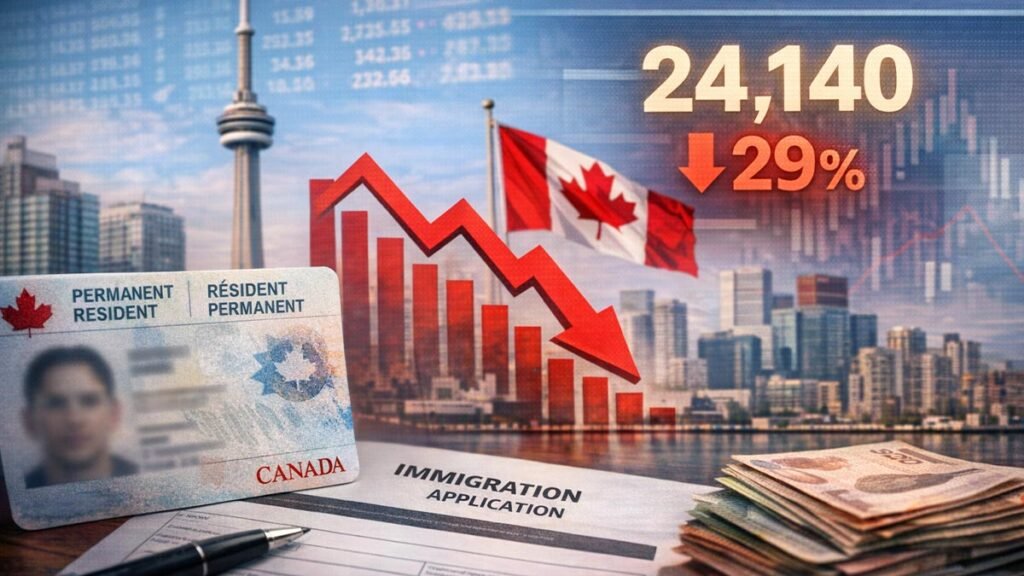
Canada’s immigration system has entered 2026 with a noticeable slowdown in permanent resident approvals, according to the latest figures released on March 17, 2026 by Immigration, Refugees and Citizenship Canada. The data confirms that only 24,140 new permanent residents were approved in January 2026, marking a sharp year-over-year decline of approximately 29 percent.
While this drop has raised concerns about whether Canada can meet its annual immigration target, a deeper analysis shows that the decline is part of a broader policy shift rather than a sudden disruption.
January 2026 Numbers in Context
The January 2026 figure represents a significant decrease from 34,055 approvals recorded in January 2025. This means Canada admitted nearly 10,000 fewer permanent residents in just one month.
To stay aligned with its 2026 immigration target of 380,000 permanent residents, Canada would need to average about 31,667 approvals per month.
However, January’s total falls roughly 24 percent below that required monthly pace, making it one of the weakest starts to a year since the post-pandemic recovery period.
It is important to note that these figures reflect approvals rather than physical arrivals. A large proportion of permanent residents are already living in Canada as temporary residents and are transitioning through programs like Express Entry or Provincial Nominee Programs.
Major Source Countries See Sharp Declines
India remains Canada’s leading source country for permanent residents, continuing a long-standing trend. In January 2026, 6,430 Indians became permanent residents, accounting for more than a quarter of total approvals.
Despite this dominance, India also recorded one of the steepest declines, with a drop of nearly 39 percent compared to the previous year.
Other major countries also experienced notable reductions:
The Philippines saw a decrease of nearly 35 percent
China experienced a sharp decline of over 43 percent
Pakistan, Colombia, and Eritrea also recorded significant drops
On the other hand, a few countries showed resilience. Cameroon and France posted modest increases, aligning with Canada’s strategy to boost Francophone immigration outside Quebec.
A Decade of Immigration Trends Leading to 2026
To fully understand the January 2026 slowdown, it is useful to look at long-term immigration trends.
Canada’s immigration levels have fluctuated significantly over the past decade. After a pandemic-related drop in 2020, the country experienced a strong rebound, reaching record-breaking numbers in 2021 and continuing high admissions through 2024.
In 2024, Canada welcomed over 483,000 permanent residents, the highest number in its history. This was followed by a decline in 2025 to around 393,500 as the government began recalibrating immigration levels.
The 2026 slowdown reflects a continuation of this transition toward more controlled and sustainable immigration targets.
Policy Shift Toward Sustainable Immigration Levels
The decline in approvals is closely tied to Canada’s updated immigration strategy outlined in the 2026–2028 Immigration Levels Plan.
Under this plan, permanent resident admissions are set to stabilize at 380,000 annually through 2028.
At the same time, the government is reducing the number of temporary residents entering the country. The goal is to bring the temporary resident population below 5 percent of Canada’s total population by 2027.
This shift is intended to ease pressure on housing, healthcare, and public services, while maintaining steady economic growth.
Reduced Temporary Residents Impact PR Numbers
One of the key reasons for the decline in permanent resident approvals is the reduced intake of temporary residents.
Historically, a significant portion of permanent residents comes from individuals already in Canada on study or work permits. In fact, more than 40 percent of permanent residents in recent years have transitioned from temporary status.
With fewer temporary residents entering the country, the pool of candidates eligible for permanent residency has naturally shrunk, contributing to lower approval numbers.
Processing Backlogs and Inventory
Despite the drop in approvals, there is no shortage of applicants. Canada currently has a large inventory of permanent residence applications under processing.
This backlog indicates that demand for immigration remains strong. The slower numbers are primarily due to processing timelines rather than a lack of interest.
As the year progresses and processing capacity increases, approval numbers are expected to rise.
Government Initiatives to Boost PR Admissions
Several government initiatives are already in place to support higher permanent resident numbers later in 2026.
One of the most significant measures is a new pathway aimed at transitioning 33,000 temporary foreign workers to permanent residency over two years.
Additionally, the government is prioritizing the processing of protected persons already in Canada, which could add tens of thousands of approvals to annual totals.
Provincial Nominee Programs are also expanding, with increased allocation targets to help address regional labour shortages.
Economic Immigration Takes Priority
Canada’s immigration strategy is increasingly focused on economic outcomes. Under the current plan, economic immigration accounts for the majority of permanent resident admissions.
The government is prioritizing skilled workers in sectors such as healthcare, construction, and technology. This targeted approach aims to address labour shortages while ensuring newcomers can integrate successfully into the workforce.
By shifting toward economic immigration, Canada is aligning its immigration system more closely with labour market needs.
Will Canada Meet Its 2026 Immigration Target
Based on January data alone, Canada appears to be behind schedule in reaching its 380,000 target.
If the current pace were to continue throughout the year, total admissions would fall significantly short of the goal. However, several factors suggest that this outcome is unlikely.
January is traditionally a slow month for immigration processing due to seasonal factors and carryover from the previous year.
Processing volumes typically increase between February and June, leading to higher monthly admissions.
The large backlog of applications provides a strong pipeline for approvals, and government initiatives are expected to further boost numbers.
Taken together, these factors indicate that Canada could still come close to its annual target, even if it does not fully reach it.
What This Means for Immigration Applicants
For individuals seeking permanent residency in Canada, the evolving immigration landscape presents both challenges and opportunities.
Competition remains high, with a large number of applicants already in the system. Candidates will need to strengthen their profiles to improve their chances of success.
For Express Entry applicants, increasing Comprehensive Ranking System scores through education, language proficiency, and work experience is essential.
Provincial Nominee Programs offer alternative pathways, particularly for candidates who may not meet federal criteria.
Temporary residents already in Canada continue to have an advantage, as they are more likely to transition to permanent residency.
Outlook for the Rest of 2026
Despite the slow start, there are strong indicators that immigration numbers will recover in the coming months.
The Canadian government has invested in digital processing systems to improve efficiency and reduce backlogs.
Express Entry draws have remained consistent, and provincial programs are expanding their intake.
With a significant inventory of applications and targeted policy measures in place, permanent resident approvals are expected to increase as the year progresses.
Conclusion
The decline in permanent resident approvals in January 2026, confirmed by March 17 IRCC data, reflects a broader shift in Canada’s immigration policy rather than a collapse in demand.
The government is moving toward a more balanced and sustainable approach, focusing on economic priorities and infrastructure capacity.
While the early numbers may appear concerning, the overall outlook for 2026 remains stable. With strong demand, a large application backlog, and ongoing policy initiatives, Canada is still well-positioned to welcome a substantial number of new permanent residents this year.
For applicants, the key is to stay informed, adapt to changing policies, and ensure their profiles are competitive in an increasingly selective immigration system.
FAQs
How many permanent residents did Canada approve in January 2026
Canada approved 24,140 permanent residents in January 2026.
Why did PR approvals drop in 2026
The decline is mainly due to policy changes, reduced temporary resident intake, and seasonal processing factors.
What is Canada’s immigration target for 2026
Canada aims to admit 380,000 permanent residents in 2026.
Will immigration numbers increase later in the year
Yes, approvals are expected to rise as processing speeds improve and government initiatives take effect.
Is it still a good time to apply for PR
Yes, but competition is high. Applicants should focus on strengthening their qualifications and exploring multiple pathways.