


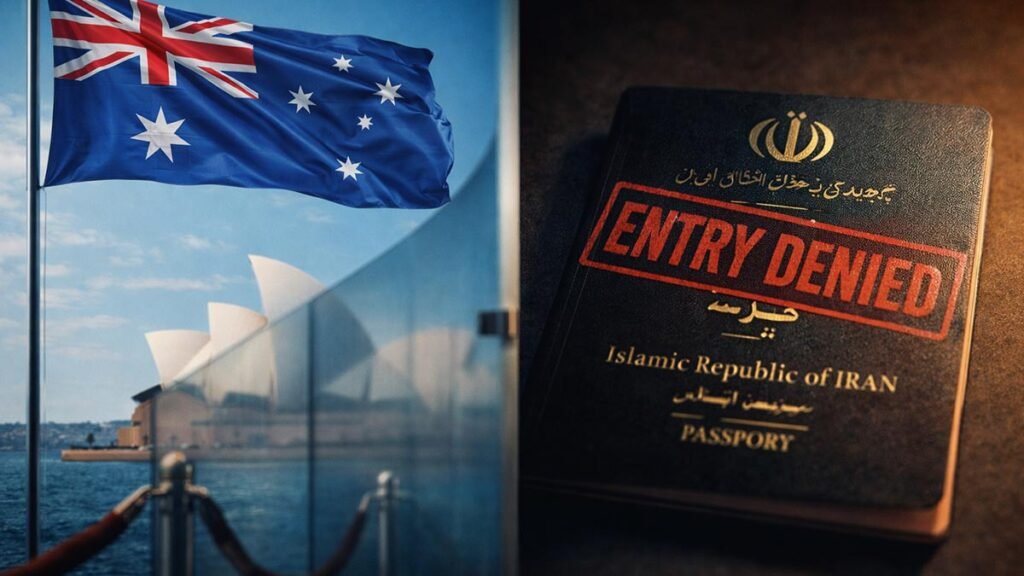
On 26 March 2026, Australia formally activated one of its most significant recent immigration measures — a six-month entry restriction targeting Iranian nationals holding Visitor (Subclass 600) tourist visas. Announced by Home Affairs Minister Tony Burke and enacted under newly passed legislation, the move has generated intense national debate, drawing both support from those concerned about visa integrity and sharp condemnation from refugee and humanitarian advocates.
The Legal Framework Behind the Ban
A New Ministerial Power
Unlike previous immigration interventions, this restriction is not a standalone policy decision — it is backed by freshly enacted law. Under the Migration Amendment (2026 Measures No. 1) Act 2026, a new ministerial power allows the Home Affairs Minister, with the written consent of both the Prime Minister and the Foreign Affairs Minister, to suspend travel for specific classes of offshore temporary visa holders when circumstances outside Australia significantly change.
The legal instrument used to activate the ban is formally called an Arrival Control Determination — a tool that does not cancel or invalidate the visa itself, but limits the ability of ticketed travellers to board flights and enter Australia.
Parliamentary Transparency Requirements
To ensure accountability, the Minister is required to table the determination and a statement of reasons in both Houses of Parliament within two sitting days of the determination being made.
What the Ban Actually Means
Australian Home Affairs Minister Tony Burke confirmed that the government has issued an Arrival Control Determination to temporarily halt the entry of Iranian citizens travelling on Visitor (Subclass 600) visas. The suspension took effect on 26 March 2026 and will remain in place for an initial period of six months.
Crucially, the underlying visa remains valid throughout the restriction period. This means that once the six-month block concludes, affected travellers could potentially enter Australia under normal conditions — provided the ban is not reissued or replaced by a separate determination.
Importantly, the temporary travel restriction does not prevent prospective Iranian travellers from lodging new visa applications. Applications can continue to be submitted and will be assessed individually against existing eligibility criteria.
Why Australia Introduced This Measure
Overstay Risk Amid Active Conflict
Minister Burke stated that the decision was driven by concerns that the ongoing conflict involving Iran has significantly increased the risk of visa holders being unable or unwilling to return home once their authorised stay expires. The Minister emphasised that decisions regarding who remains in Australia should result from deliberate immigration policy — not from the unintended consequences of international instability.
Visa Conditions Have Changed Since Approval
A key element of the government’s rationale is that a substantial number of tourist visas were approved before the current conflict escalated — under conditions that no longer reflect present-day realities. Officials argued that granting entry under those original approvals would be inconsistent with how those same applications would be assessed today.
Who Is Affected?
The restriction applies to a clearly defined group:
- Up to 7,200 Iranian nationals holding valid Visitor (Subclass 600) tourist visas
- Only those who are currently located outside Australia at the time the ban takes effect
- Individuals who have not yet boarded or departed for Australia
The ban does not affect those already on Australian soil, nor does it retroactively impact those who entered before the determination was activated.
Who Is Exempt?
The Australian government has established several exemption categories for individuals who will not be subject to the entry restriction:
- Iranian nationals already present in Australia, including those currently transiting through Australian airports
- Spouses and dependent children of Australian citizens or permanent residents
- Holders of a permitted travel certificate, which provides case-specific official clearance for entry
- Iranian parents of Australian citizens, who may be given sympathetic consideration by immigration authorities when their case is reviewed
Special Permissions and Humanitarian Exemptions
While the ban establishes a broad restriction, the government has confirmed that a limited number of travellers may still be permitted entry under exceptional circumstances. Those facing compelling personal situations — particularly cases involving humanitarian concerns — can apply for special travel permissions.
This pathway is not automatic and carries no guarantee of approval, but it does provide a legitimate avenue for individuals with urgent or extraordinary needs to seek entry despite the general restriction in place.
Duration, Review, and Possible Extension
The current restriction is explicitly framed as a temporary measure. After the initial six-month period concludes, the government is required to formally reassess the situation and determine whether the ban should be lifted, modified, or extended for a further period.
Officials have stressed that regional developments are being actively and continuously monitored. Any significant escalation or de-escalation of conflict in the Middle East could trigger a policy reassessment ahead of the scheduled review date, meaning the situation remains subject to change.
Criticism and Community Pushback
The announcement has not been without significant opposition. Refugee advocacy organisations and humanitarian groups have voiced strong objections to the policy, arguing that it unfairly penalises individuals who followed Australia’s visa application process in good faith and made legitimate travel arrangements accordingly.
Two primary criticisms have emerged. First, that the blanket nature of the restriction fails to account for the individual circumstances of affected travellers, many of whom have entirely lawful and genuine reasons for visiting Australia. Second, that the policy risks damaging confidence in Australia’s broader immigration system — sending a troubling signal internationally about the reliability of visa approvals once granted.
Iranian-Australian communities, already under considerable stress due to the ongoing regional crisis, have expressed deep concern about the human and emotional toll this decision carries for families separated by the restriction.
Conclusion
Australia’s six-month entry ban on Iranian tourist visa holders represents one of the more consequential immigration decisions the country has made in recent years. Backed by new legislation and framed as a measured response to regional instability, the policy reflects the government’s determination to manage overstay risk proactively — even at the cost of disrupting the travel plans of thousands of individuals who applied for and received their visas through legitimate channels.
Whether the restriction achieves its stated goals without causing undue harm to affected individuals and Australia’s international reputation will depend heavily on how the exemption process is administered and how transparently the six-month review is conducted. For Iranian nationals currently holding valid tourist visas and planning travel to Australia, seeking advice from a registered migration agent and exploring available exemption pathways remains the most practical course of action at this time.
Frequently Asked Questions (FAQs)
Q: What exactly has Australia announced regarding Iranian travellers in 2026? A: As of 26 March 2026, Australia has activated a six-month Arrival Control Determination preventing Iranian nationals holding Visitor (Subclass 600) tourist visas from entering the country. The measure was introduced under the Migration Amendment (2026 Measures No. 1) Act and was announced by Home Affairs Minister Tony Burke.
Q: Does the ban cancel existing visas? A: No. The restriction does not revoke or cancel visas that have already been issued. It prevents holders from boarding flights to and entering Australia during the ban period, but the visa itself remains valid and may be usable once the restriction is lifted.
Q: Can Iranian nationals still apply for new Australian visas during the ban? A: Yes. The Arrival Control Determination does not prevent new visa applications from being lodged. Applications will continue to be assessed individually against existing criteria throughout the restriction period.
Q: How many people are affected? A: Approximately 7,200 Iranian nationals currently holding valid tourist visas and located outside Australia are directly affected by the entry restriction.
Q: Who is exempt from the ban? A: Exemptions apply to Iranian nationals already in Australia or in transit, spouses and dependent children of Australian citizens or permanent residents, holders of a permitted travel certificate, and Iranian parents of Australian citizens who may receive sympathetic consideration.
Q: Can affected travellers still enter Australia under special circumstances? A: Yes, on a limited case-by-case basis. Individuals facing compelling or humanitarian circumstances can apply for special travel permissions, though approval is not guaranteed and the pathway is narrow.
Q: How long will the restriction remain in place? A: The ban is set for an initial period of six months from 26 March 2026. After that, the government must formally review and decide whether to extend, modify, or lift the restriction based on regional conditions at that time.
Q: Why has the ban drawn criticism? A: Critics argue the restriction unfairly targets individuals who followed all visa rules and made travel plans in good faith. Humanitarian groups contend it undermines trust in Australia’s migration system and adds hardship to communities already affected by the crisis in Iran.